Major Venture Forward gift names Sarofim Pavilion in Princeton’s new engineering and environmental studies neighborhood
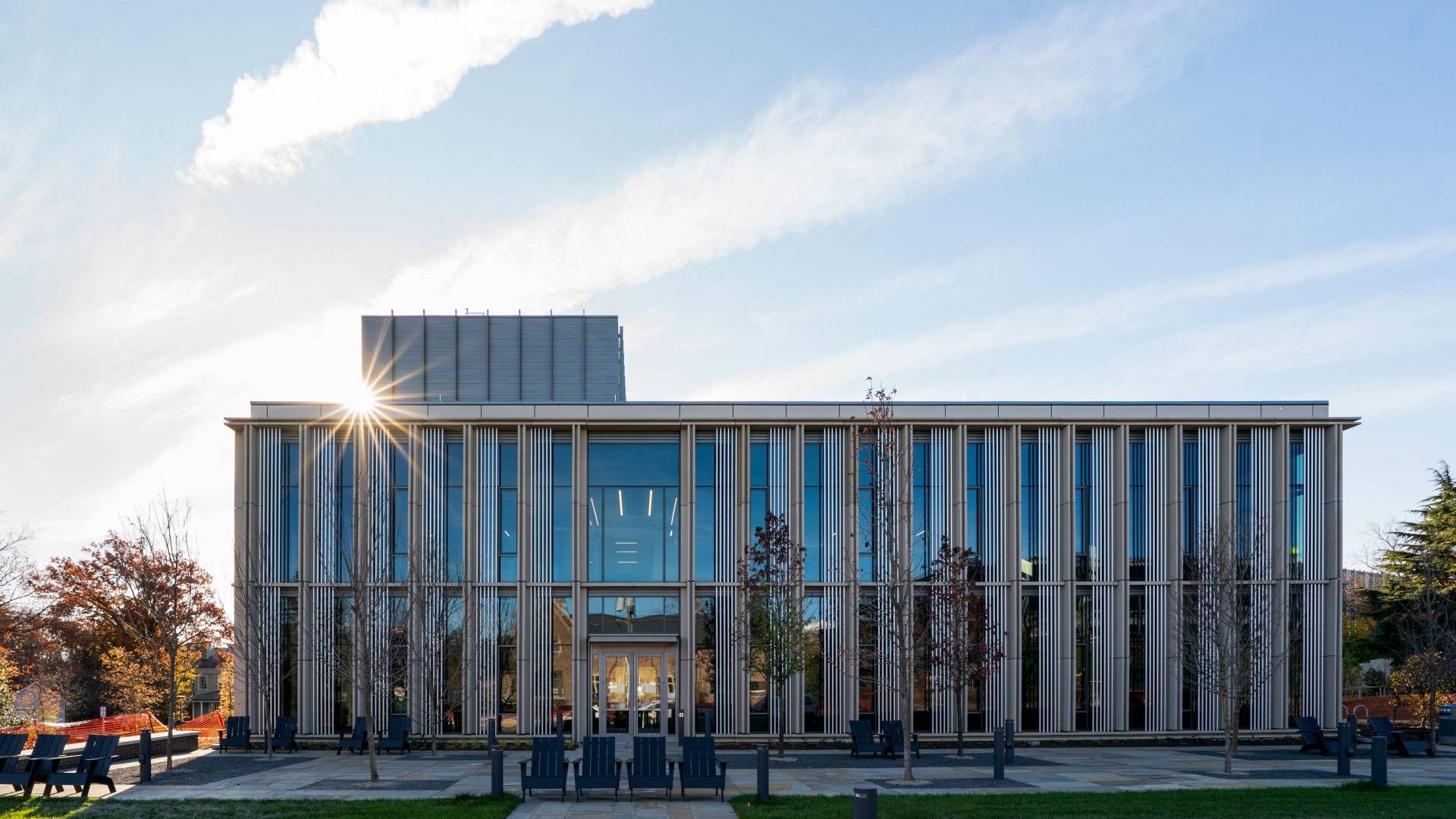
The Sarofim Pavilion serves as the northern entrance into the University’s new Prospect Avenue neighborhood for engineering and environmental studies.
A major gift from the Sarofim Foundation has named the Sarofim Pavilion, which will serve as an academic home to Princeton University faculty members, graduate students and postdoctoral researchers in the Department of Chemical and Biological Engineering (CBE).
“We are deeply grateful to the Sarofim Foundation for this extraordinary Venture Forward gift,” said President Christopher L. Eisgruber ’83. “Their generosity has helped us build state-of-the-art facilities that will spark creative inquiry, enhance research in CBE, and enable collaboration across engineering and the sciences.”
The Sarofim Pavilion encompasses 10,000 square feet and is connected to the new laboratory building for CBE, which serves as the northern entrance into the University’s new Prospect Avenue neighborhood for engineering and environmental studies. The Sarofim Pavilion addresses the University’s critical need for cutting-edge facilities to accommodate the research and the growing number of faculty, professionals and students working in engineering. CBE previously had been housed in the Engineering Quadrangle, which opened in 1962.
“The Sarofim Pavilion provides a beautiful entrance into both our new neighborhood and into a new era for the School of Engineering and Applied Science,” said Andrew Houck ’00, dean of the School and the Anthony H.P. Lee ’79 P11 P14 Professor of Electrical and Computer Engineering. “The pavilion and the new CBE and bioengineering laboratories advance our mission to develop the next generation of engineering scholars and to produce research that benefits society and contributes to the nation’s technological leadership.”
The Sarofim Foundation was established by the late Fayez Sarofim, who had a long legacy of philanthropy in support of organizations in Houston, Texas, and beyond. Sarofim founded Fayez Sarofim & Co. in 1958, which became the largest investment advisory firm in the Southwest. Early clients included many non-profits, endowments and foundations that shaped his personal philanthropic vision, which focused particularly on education, healthcare and the arts.
“My father’s philosophy was to ‘bet on people first,’ and we are honored to make, as President Eisgruber says, an ‘audacious bet’ through this gift on the extraordinary faculty, students and researchers whose discoveries will make a difference beyond Princeton,” said Christopher Binyon Sarofim ’86, who is chairman of both the Sarofim Foundation and Fayez Sarofim & Co.
CBE faculty members’ research is critical to advances in energy technologies, drug discovery, and the invention of new materials needed across nearly all areas of science and technology. The department is chaired by Christos Maravelias, Anderson Family Professor in Energy and the Environment and professor of chemical and biological engineering and the Andlinger Center for Energy and the Environment.
Research advances of CBE faculty have benefited multiple industries and led to start-up companies in areas such as lithium-ion battery recycling, sustainable and durable building products, and precision drug delivery. The faculty includes three members of the National Academy of Engineering, one member of the National Academy of Sciences, a MacArthur Fellow, a Howard Hughes Medical Institute Investigator, two Guggenheim Fellows, three winners of New Faculty and Teacher-Scholar awards from the Dreyfus Foundation, and three members of the American Academy of Arts and Sciences.
“This gift is an investment in Princeton’s excellence in liberal arts education and in building the future of engineering research,” said Sarofim. “We look forward to seeing research and discovery continue to flourish — within the Sarofim Pavilion and across the University.”
The Sarofim Foundation’s gift to Princeton was made as part of the Venture Forward campaign, which built alumni engagement, secured critical philanthropic support for the University’s strategic priorities, and shared Princeton’s defining principles and their impact on the world. The campaign concluded June 30, 2025.