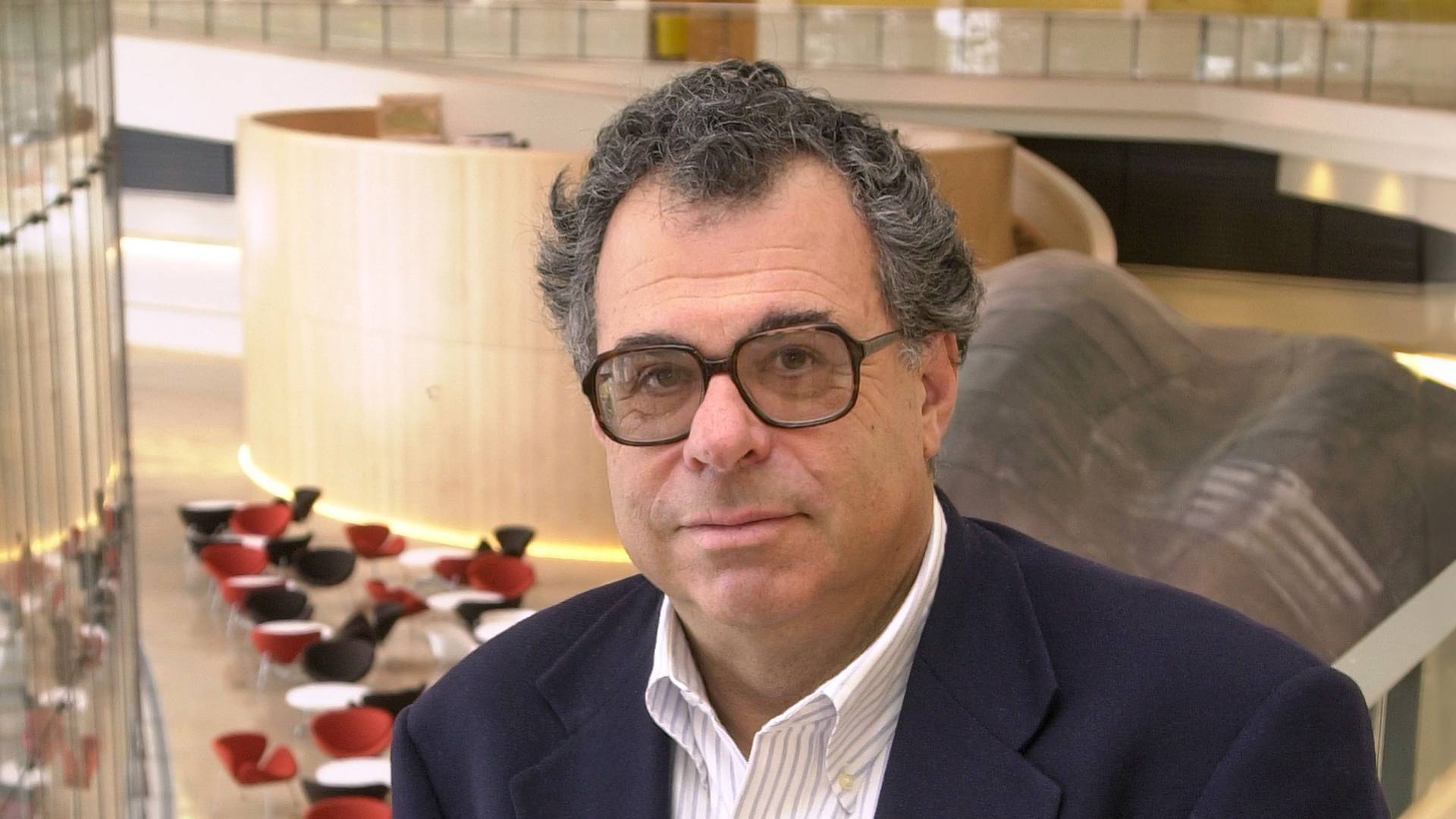
David Botstein, a leader of the Human Genome Project, dies at 83
David Botstein
David Botstein, Princeton’s Anthony B. Evnin ‘62 Professor of Genomics, Emeritus, and an emeritus professor of molecular biology and the Lewis-Sigler Institute for Integrative Genomics, died on Feb. 27.
Botstein taught at Princeton for 12 years, transferring to emeritus status in February 2015. He was one of the leaders of the Human Genome Project, and he was one of the initial winners of the Breakthrough Prize, a $3 million award honoring the key insights that make the human genome map possible. He came to Princeton in July 2003 to lead the University’s new genomics institute, and he helped recruit many of its now renowned faculty members.
“We mourn the passing of our former director, David Botstein, a visionary whose leadership built the Lewis-Sigler Institute for Integrative Genomics and defined the modern era of quantitative biology,” said Coleen Murphy, director of LSI and Princeton’s James A. Elkins Jr. Professor in the Life Sciences. “Beyond his pioneering contributions to the Human Genome Project and DNA microarrays, David’s enduring legacy remains the generations of scientists he inspired through his commitment to intellectual rigor and the integrated science and Quantitative and Computational Biology (QCB) curricula.”
Botstein came to Princeton from Stanford University, where he headed the medical school’s genetics program. Before that, he was vice president of Genentech and a genetics professor at the Massachusetts Institute of Technology (MIT). After leaving Princeton, he returned to industry and spent a decade at Calico, a leading genetics company.
“He was one of the most intellectually deep people I’ve ever met, and he was passionate about whatever he took on,” said Shirley M. Tilghman, emeritus president of Princeton University and emeritus professor of molecular biology and public affairs, who worked with Botstein on the Human Genome Project.
“I think I can do something really important at Princeton”
Botstein came to Princeton with two goals: to help make LSI successful, including moving it into its newly completed home at the Carl Icahn building, and to revamp the teaching of biology to make it more quantitative and more intimately intertwined with chemistry, physics and computer science.
Tilghman, who founded LSI in 1998, recalled a conversation with Botstein shortly after she became University president in 2003. Botstein lauded Princeton as a place dedicated to teaching and research and said he was eager to help educate the next generation of scientists.
“‘I think I can do something really important at Princeton,’” Tilghman recalled Botstein saying at the time.
As soon as Botstein arrived at LSI, he reached out to senior professors across the sciences and engineering to build a coalition for his integrated science teaching model. The coalition built a certificate program called Quantitative and Computational Biology, which rapidly became a Ph.D.-granting program.
From the beginning, the Integrated Science Curriculum required four semesters’ worth of work — two in the fall and two in the spring — in an undergraduate’s first or second year. The idea was that once through this academic boot camp, a student would be prepared to take upper-level classes in almost any science discipline.
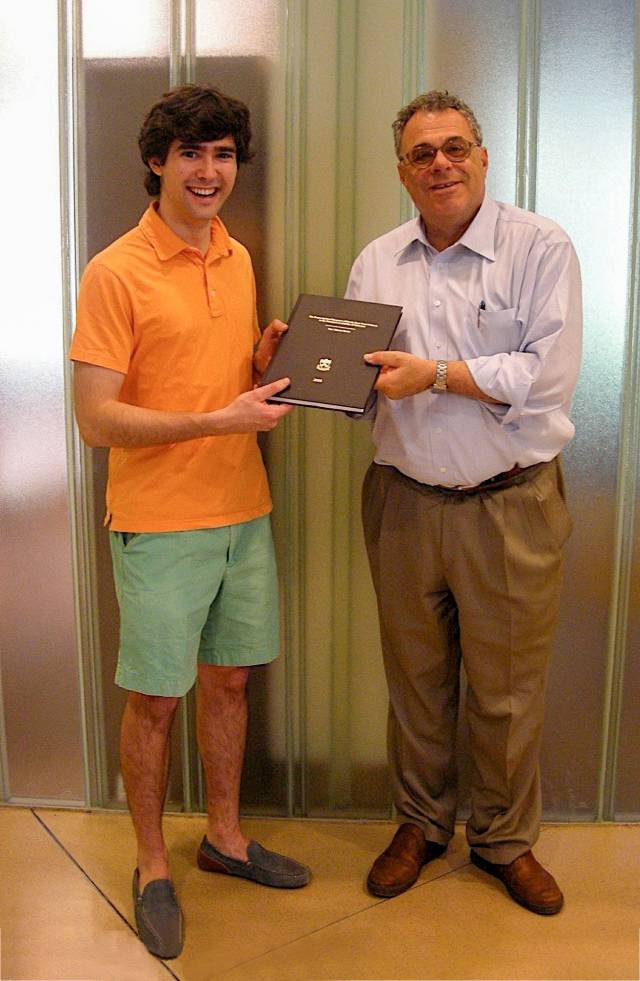
Then-senior Max Staller (left) and Botstein hold a bound copy of Staller's senior thesis. "I use the skills I learned from David every day: to show students how to do rigorous science, to lead by example, to support students unwaveringly," Staller said.
“In fall 2004 … I enrolled in a brand-new double course that promised to blend together all introductory courses in the natural sciences and train us to become modern scientists,” recalled Max Staller, a member of the Class of 2008 who is now a genetics professor at the University of California-Berkeley. “Emphasizing the underlying math, our professors showed us how the same equations underpinned population growth, chemical reaction kinetics, electronic circuits, and the physics of motion.”
Of the 23 students who completed that first year, Staller said, at least 12 completed a Ph.D. and one became a medical doctor. “Today, half my closest friends I met in Integrated Science. I met my wife in Integrated Science. Six members of our bridal party were in Integrated Science with us.”
“David was a teacher and mentor of unmatched patience and kindness,” said Joshua Rabinowitz, a professor of chemistry and LSI, whom Botstein recruited to Princeton. “His towering intellectual contributions and uncompromising commitment to scholarship were paired with a true love for teaching. He came to Princeton to develop a new way of teaching introductory science that would prepare students for the boundaryless, interdisciplinary science that he saw, now a quarter-century ago, already on the horizon. This led to the Integrated Science program, to which he recruited Nobel laureate and department chair teachers, and the best and brightest students. The program remains a fixture on campus.”
Botstein was determined not only to change how biology was taught, but to widen the net of incoming biology students, said Alison Gammie, who spent 24 years on the Princeton faculty before moving to the National Institutes of Health. She said graduates of LSI’s doctoral program are now successful scientists across the biomedical research workforce.
“A giant among scientists”
Botstein was born in Switzerland on Sept. 8, 1942, to two Polish doctors, both Jewish, who had gone to Zurich for medical school and then stayed when their homeland was no longer safe. After World War II ended, the family moved to New York City, where Botstein graduated from Bronx High School of Science at age 16. He then completed an A.B. in biochemistry at Harvard and a Ph.D. in human genetics at the University of Michigan.
Much of his early work was in yeast genetics. He referred to yeast as “the ancients,” recalled Olga Troyanskaya, who was one of his Ph.D. students at Stanford before coming to Princeton, where she is now an LSI professor, the director of the Princeton Precision Health initiative (PPH) and the Maduraperuma/Khot Professor of Computer Science.
Yeast might not seem to have much in common with humans, Troyanskaya said, but appearances are deceiving. “A lot of early genetics was figured out in yeast, and he was one of the absolute greats of ‘the ancients,’ as he called them,” she said.
“The first colon cancer gene, for example, was discovered in yeast,” she said. “So many super-important human disease genes were originally discovered in yeast, because they’re fundamentally DNA repair genes. Pat Brown invented microarrays, a way of looking at the functioning of the cell, and then he and David together pioneered using this technology for analysis and also for cancers. For example, almost everyone diagnosed with breast cancer gets a multi-gene screening to predict outcomes and treatments. And that comes out of those early breast cancer papers that David published. There’s truly no way to measure the full scale of his impact. He is one of the greats.”
“David Botstein was a giant among scientists,” agreed Mark Rose, an emeritus professor of molecular biology at Princeton who now chairs the Department of Biology at Georgetown University. “David had major impact on bacterial genetics, yeast genetics and cell biology, and human genetics. Perhaps his most important contributions concern the development of new tools and techniques for genetic analysis; this included the use of transposable elements for bacterial genetics, microarrays and gene fusions for analysis of gene expression in eukaryotic cells, genome engineering in yeast, and the use of variations in our DNA for mapping and identifying the human genetic diseases. He will be missed!”
Assembling a 3-billion-piece puzzle: the Human Genome Project
In 2013, Botstein and 10 others won $3 million each as the inaugural winners of the Breakthrough Prize in Life Sciences. Botstein’s citation praised his “linkage mapping of Mendelian disease in humans using DNA polymorphisms,” which refers to his key insight that human DNA varies just enough from person to person that you can snip identical segments along a genome, known as restriction fragment length polymorphisms (RFLPs).
Without those RFLPs, said Tilghman, it would never have been possible to turn 3 billion As, Ts, Gs and Cs into a cohesive map of the human genome. She added: “I remember hearing him give the first seminar on RFLPs and going, ‘Wow, yes!’ As soon as you heard it, you went, ‘Of course, this makes sense! Why didn’t I think of that?!’”
While a professor at MIT, Botstein had worked closely with Tilghman and others on the National Research Council’s study to determine whether and how the nation should tackle a human genome project. Together, they developed a plan to identify and organize the 3 billion nucleotides that make up the human genome.
“David and I really bonded on that committee,” Tilghman said. “The reason we bonded is that we were both — probably more than anyone else on the committee — persuaded that the only way to go about it was to first sequence model organisms.”
There were two key reasons for that, she recalled. One was the recognition that genetic sequencing techniques and technologies needed to improve massively before a human genome could even be attempted, and working on simpler creatures would give the field time to advance.
They needed “a five-fold improvement in one technique, and then another five-fold improvement, and then another five, and soon those compound in really powerful ways,” she said.
Those exponential improvements have continued, she added. “That first genome cost $3 billion, and today you can get one for $200. But we didn’t get there in one step.”
Tilghman and Botstein remained committed to the idea that the project needed to assemble simpler genomes along the way, sequencing a bacterium and yeast and a worm before progressing to a mouse and finally a human.
That approach was not popular at first, Tilghman noted. “A lot of the people on the committee were mainly interested in the human genome. They were human geneticists, they were doctors, they didn’t want to hear why worms were important to sequence,” she said. “But David and I fought that fight, and we won that fight.”
The choice to sequence simpler organisms on the way to the human genome probably saved the project from being cut when costs grew, Tilghman said. “And I think the reason it was so important to do it that way was not just that that’s how we learned to sequence, but we attracted into the field of genomics biologists who didn’t care about the human genome at all, but really wanted to sequence their own research organisms, because they could see how incredibly valuable it was going to be.”
Rather than working a decade toward a single big payoff, “We had all these victory parades along the way,” Tilghman said. “We celebrated E. coli, and then we celebrated yeast, then we celebrated worms and flies and mice. We brought the whole genomics community — the whole biological community — together.”
In addition to winning the 2013 Breakthrough Prize, Botstein’s many awards and honors include the 2020 Thomas Hunt Morgan Medal from the Genetics Society of America, the Albany Prize in Medicine (2010, with Eric Lander and Francis Collins), the Gruber Foundation Prize in Genetics (2003), an honorary doctorate from Mount Sinai School of Medicine (1999), the Dickson Prize in Science (1992), the Genetics Society of America Medal (1998), and the Eli Lilly Award in Microbiology and Immunology (1978). He also served on many scientific advisory boards, including trustee and board member for the Cold Spring Harbor Laboratory, and on the editorial boards of every major journal in his field.
He is survived by his wife, Renée; his brother, Leon; his sister, Eva; his children, Ruth and Sam; and two grandchildren.