Jan-Werner Müller named University Professor
Jan-Werner Müller
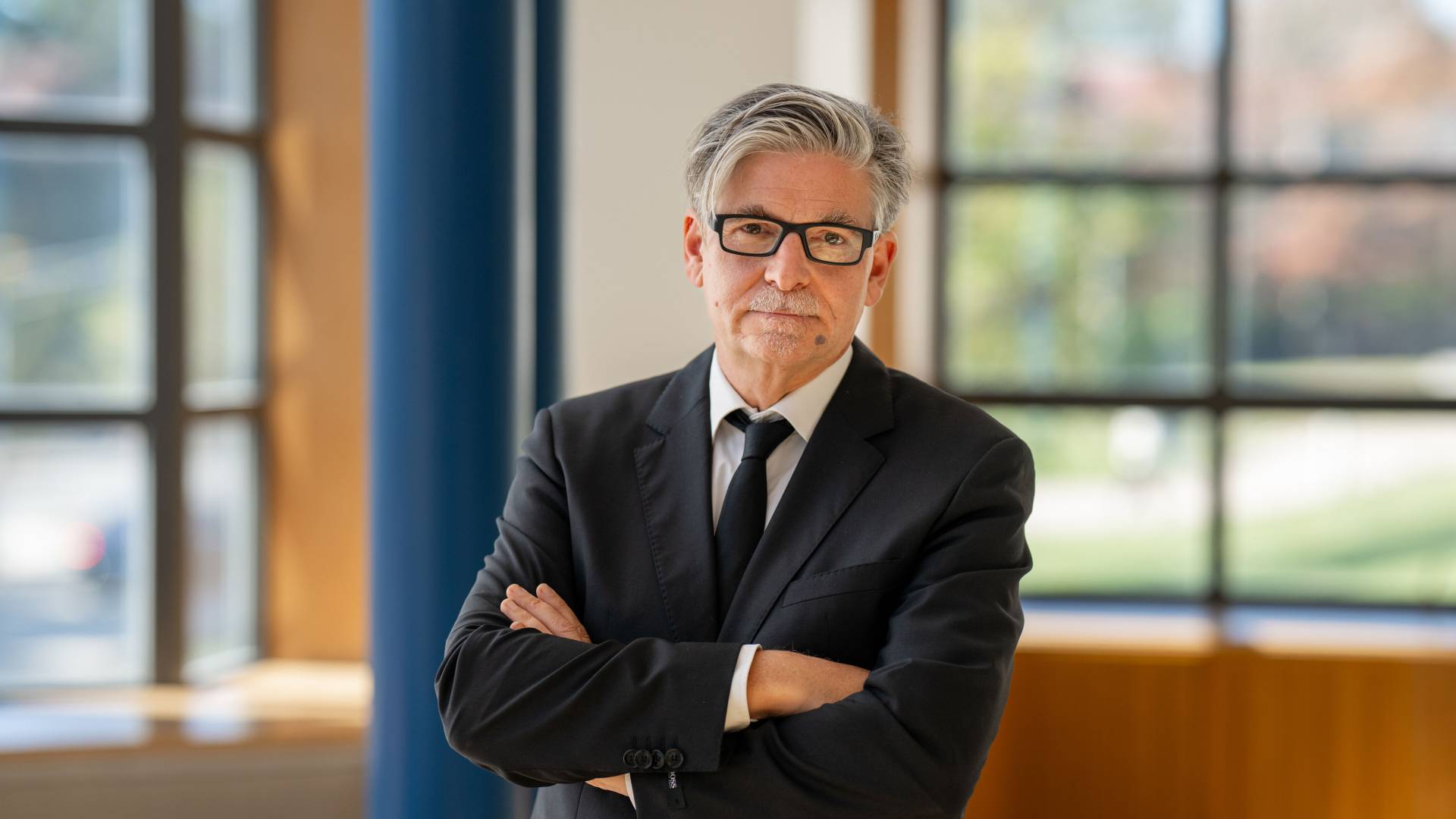
Jan-Werner Müller, a renowned scholar in democratic theory and the history of political thought, has been named the Class of 1943 University Professor of Politics. University Professorships are Princeton’s highest honor for faculty.
A member of the Princeton faculty since 2005, Müller serves as director of the Political Philosophy Program at Princeton. He is the founding director of the Academic Freedom Initiative at Princeton and also founding director of the Forum for the History of Political Thought, both hosted through the University Center for Human Values. Beyond classic topics in political theory, Müller’s research interests span from the relationship between architecture and politics to the normative implications of structural transformations of the public sphere. His appointment as the Class of 1943 University Professor of Politics is effective March 28.
“Jan-Werner Müller is a renowned thinker whose influential work on democracy and modern political thought has shaped scholarly debate and public discourse worldwide,” said Dean of the Faculty Gene A. Jarrett. “He exemplifies a rare breadth of achievement, combining intellectual distinction with sustained and meaningful contributions to the University community.”
“When I was here as a visiting graduate student in the nineties, Princeton became a formative experience and gave me a lot of intellectual confidence; I was very lucky to return as faculty about a decade later,” Müller said. “I always felt an affinity with Princeton’s commitment to intense undergraduate education focused on the liberal arts. And I am grateful that the University has been providing generous backing for projects like the Forum for the History of Political Thought and the Academic Freedom Initiative — needed more than ever, as U.S. universities are under unprecedented attack. Not least, I feel very privileged that I have inspiring colleagues — many are also personal friends — and that I keep having the opportunity to teach extremely talented graduate students, from whom I continue to learn much as well.”
From 1996 until 2003, Müller was a Prize Fellow at All Souls College, a constituent college of the University of Oxford. During this time, he also played a role as co-founder and founding research director of the European College of Liberal Arts in Berlin (now Bard College Berlin), Germany’s first private, English-speaking liberal arts college. He extended his time at Oxford through 2005 as a fellow in Modern European thought at the European Studies Centre of St. Antony’s College.
Following these formative appointments, Müller joined Princeton’s Department of Politics. In 2008, he was promoted to associate professor and then to professor three years later. In 2020, Müller was named the Roger Williams Straus Professor in the Social Sciences.
Throughout his career, Müller has maintained a prolific publishing record. His books include “Street, Palace, Square: The Architecture of Democratic Spaces” (Penguin, forthcoming in 2026), “Democracy Rules” (Farrar, Straus and Giroux, 2021), “Furcht und Freiheit: Für einen anderen Liberalismus” (Suhrkamp Verlag, 2019), “What Is Populism?” (University of Pennsylvania Press, 2016), “Wo Europa endet: Ungarn, Brüssel und das Schicksal der liberalen Demokratie” (Suhrkamp Verlag, 2013), “Contesting Democracy: Political Ideas in Twentieth-Century Europe” (Yale University Press, 2011), “Constitutional Patriotism” (Princeton University Press, 2007), “A Dangerous Mind: Carl Schmitt in Post-War European Thought” (Yale University Press, 2003) and “Another Country: German Intellectuals, Unification, and National Identity” (Yale University Press, 2000).
“What Is Populism?”, written before Brexit and the election of Donald Trump in 2016, is probably Müller’s best-known work; it has been translated into more than 25 languages and has been referred to as “field-defining.” “Furcht und Freiheit” which argues for a revitalized liberalism that focuses on protection of the vulnerable from cruelty and fear, won the Bavarian Book Prize, an award notable for its public jury debate in the presence of the authors.
Müller’s edited volumes include “Isaiah Berlin’s Cold War Liberalism” (Palgrave Pivot, 2019), “German Ideologies Since 1945: Studies in the Political Thought and Culture of the Bonn Republic” (Palgrave Macmillan, 2003) and “Memory and Power in Post-War Europe: Studies in the Presence of the Past” (Cambridge University Press, 2002).
His extensive record of international recognition includes prestigious visiting fellowships at the Wissenschaftskolleg zu Berlin, the Helsinki Collegium for Advanced Studies, and the Institute for Human Sciences in Vienna, among many others. He has also served as a visiting professor at Collège de France, the American University of Beirut (a Princeton partner through the Bobst-AUB Collaborative Initiative), Peking University, the School for Advanced Studies in the Social Sciences in Paris, and the Paris Institute of Political Studies (Sciences Po).
Müller’s scholarship has earned him a series of distinctions in the humanities and social sciences. In 2025, Müller was elected to the Berlin-Brandenburg Academy of Sciences and Humanities. This followed his 2024 Guggenheim Fellowship in Political Science and 2018 election to the European Academy of Sciences and Arts. Prior to these honors, he delivered the Tanner Lectures on Human Values at the University of Cambridge (2017) and the Carlyle Lectures in the History of Political Thought at the University of Oxford (2011). He is a past member of the Institute for Advanced Study (2013).
Müller’s public affairs commentary and essays have appeared in the London Review of Books, the New York Review of Books, Foreign Affairs, The Guardian, The New York Times, and Project Syndicate, in addition to numerous European outlets.
In addition to his scholarly work, Müller is active in several international advisory roles. He currently serves on the advisory boards for the “Strengthening Democracy Research in Hessen” initiative of the Hessian Ministry of Science and Research, Arts and Culture; the Zentrum Liberale Moderne in Berlin; and the Enforcing the Rule of Law (ENROL) project at the University of Oslo. Earlier this year, he was appointed to a board advising the German Science and Humanities Council (Wissenschaftsrat) on the relationship between democracy and academic freedom.
At Princeton, his record of service is equally robust with seats on the executive committees for both the University Center for Human Values and the Program in Contemporary European Politics and Society, having previously served as the acting director for the latter.
Müller received a Bachelor of Science in economics and history from University College London in 1994. In 1996, he earned a Master of Philosophy in politics from St. Antony’s College, Oxford. He was a visiting graduate student in Princeton’s politics department for the 1996-97 academic year, supported by an ERP Study Scholarship from the German government to strengthen transatlantic relations, before receiving his doctorate from the University of Oxford in 1999.
Princeton currently endows 25 University Professorships. University Professors are recognized for demonstrating scholarly preeminence in their professional accomplishments, as well as making exceptional contributions to the University’s research and teaching community.
The Class of 1943 University Professorship was established by the members of the Class of 1943 and their friends for the support of a chair in a traditional or new area of scholarship.