Thirteen scholars named Presidential Postdoctoral Research Fellows
Thirteen scholars will join the Princeton Presidential Postdoctoral Research Fellows program for its 2026 cohort, from disciplines spanning the humanities, engineering, sciences and social sciences.
The program, now in its seventh year, recognizes and supports outstanding scholars primed to make important contributions in their fields. By bringing together scholars across academic fields, the program allows them to deepen their disciplinary expertise while testing out new ideas from other disciplines. These scholars will contribute to the University’s excellence and its diversity, broadly defined. The program is open to all eligible scholars, regardless of identity. Financial support is provided for up to two years at full salary.
“To meet some of the biggest challenges in society, we need to renew the field with people who are going to go beyond what we already know. We need them to be exposed to the best talent in other fields as well, germinating new ideas and challenging old ones,” said Frederick Wherry, the Townsend Martin, Class of 1917 Professor of Sociology, vice dean for development and inclusion and director of the Presidential Postdoctoral Fellowship Program. “That’s how we advance the frontiers of knowledge. That’s how inclusive excellence brings to fruition the University’s core mission in research and teaching.”
The 2026 Presidential Postdoctoral Research Fellows are listed below.
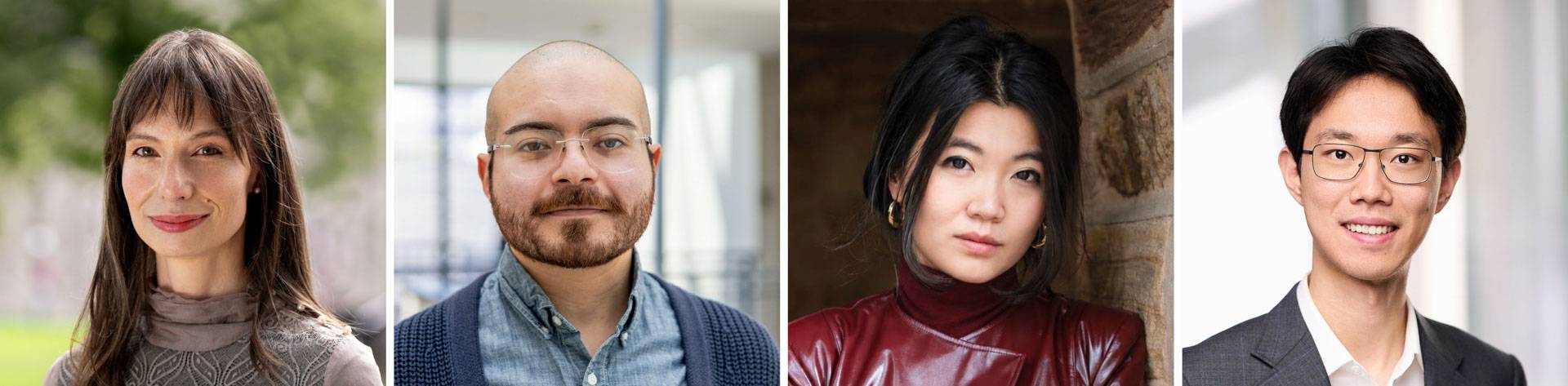
(Left to right) Sherah Bloor, Oscar Gonzalez, Nancy Ko and Fengyuan “Michael” Liu.
Sherah Bloor joins the Department of Comparative Literature, with research that examines poetry as a mnemonic craft. Bloor explores how physicians used poetry, beginning with medieval Arabic and Latin didactic verse, to theorize memory and treat its disorders, revealing that changing scientific theories of memory have been reflected in poetic form. Her project will conclude by examining AI-generated poetry, bringing this history to bear on the technologies onto which we increasingly outsource memory. Bloor holds a Ph.D. in philosophy of religion from Harvard University, an M.A. in philosophy from La Trobe University and a B.A. in philosophy and social theory from Melbourne University. She is advised by Daniel Heller-Roazen, the Arthur W. Marks ’19 Professor of Comparative Literature.
Oscar Gonzalez joins the Princeton Materials Institute to work on creating new, low-dimensional materials using molecular chemistry. Low-dimensional materials such as quantum dots, carbon nanotubes and graphene can have fascinating and useful physical properties that arise only when left in quantum confinement. Gonzalez will develop new coordination polymers that exhibit such properties but in a more tunable platform. He aims to create clear structure-property guidelines that will advance the technological relevance of these materials in emerging optoelectronic devices. Gonzalez holds a Ph.D. in chemistry from the University of California-Berkeley and a B.S. in chemistry with minors in physics and mathematics from Texas A&M University. He is advised by Lilia Xie, assistant professor of chemistry and the Princeton Materials Institute.
Nancy Ko joins the Department of History as a historian of deep-sea labor in the global Aegean. Her research resurfaces forgotten imperial histories of disability by tracing the dramatic and uneven making of the deep-sea diver across global maritime industries. A breath-hold diver and direct descendant of Jeju Island’s female divers (haenyeo), Ko conducts archival and ethnographic research in Greek, Arabic, Ottoman and modern Turkish, Italian and French. Ko holds a Ph.D. in history from Columbia University, an M.A. in modern Middle East studies from the University of Oxford (Magdalen College), and a B.A. in history and Near Eastern languages and civilizations from Harvard University. She is advised by Marina Rustow, the Khedouri A. Zilkha Professor of Jewish Civilization in the Near East and professor of Near Eastern studies and history.
Fengyuan “Michael” Liu joins the University Center for Human Values, with research focusing on the relationship between artificial intelligence and scientific knowledge production. At Princeton, his research will examine how AI technologies shape the diversity of ideas in scientific research and, conversely, how knowledge about AI itself is produced, with particular attention to the influence of corporations on AI research. With a background in metascience, Liu’s previous work investigates inequalities and biases in scientific research using computational and survey methods. Liu holds a Ph.D. in computer science from New York University and a B.A. in computer science from New York University-Abu Dhabi. He is advised by Molly Crockett, professor of psychology and the University Center for Human Values.
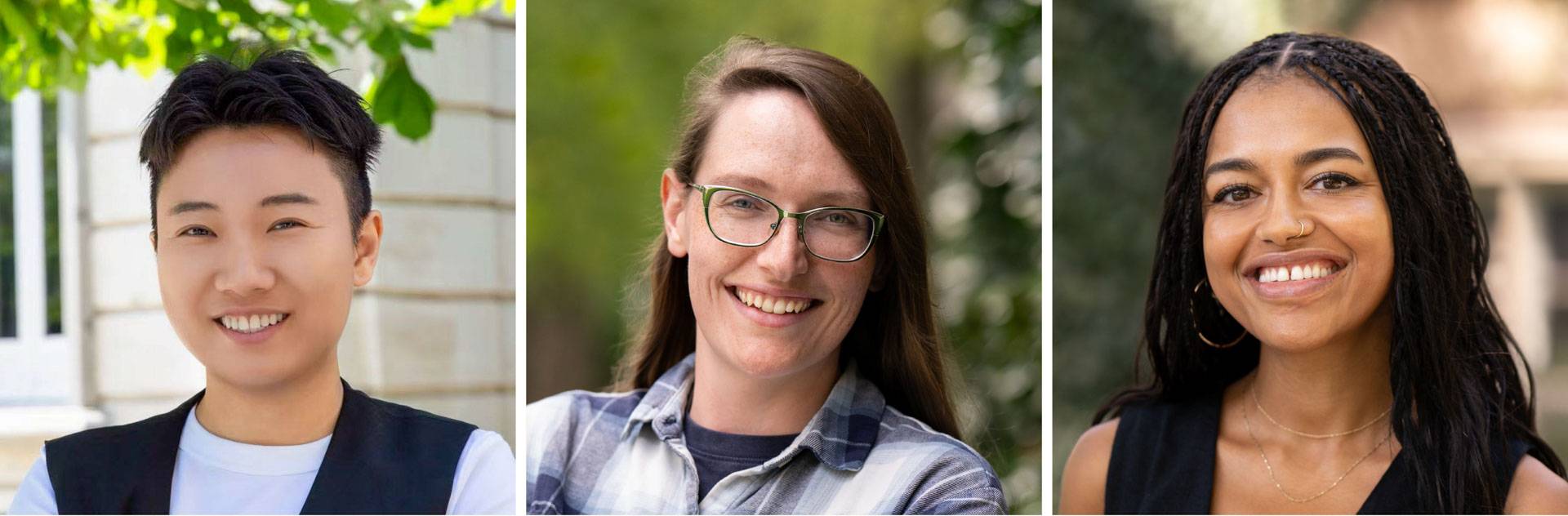
(Left to right) Yao Lu, Bailey Nebgen and Yasmina Price.
Yao Lu joins the Department of Sociology with research focusing on race, ethnicity and state formation in post-independence Africa. Lu investigates why Zambia’s racial and ethnic classification became increasingly ethnicity-based after independence, while Zimbabwe returned to colonial racial categories. Lu holds a Ph.D. and M.A. in sociology from the University of California-Davis, an M.Phil. in social science and an M.S. in global China studies from Hong Kong University of Science and Technology, and a B.S. in business administration from Marquette University. She is advised by Benjamin Bradlow, assistant professor of sociology and international affairs.
Bailey Nebgen joins the Department of Chemistry with research interests in using fundamental physics mechanisms to describe, probe and understand complex chemical systems. At the Weichman Lab, she will focus on using microcavities and strong coupling of light and matter to understand polariton chemistry and explore new cavity-enhanced optical techniques. Nebgen received a Ph.D. in chemistry from the University of California-Berkeley, and a B.S. in chemistry from the University of Minnesota Twin Cities. She is advised by Marissa Weichman, assistant professor of chemistry.
Yasmina Price joins the Department of English with research concerning the study of African and Afro-diasporic visual culture, anticolonial cinema, aesthetic historiography and the politics of memory, with particular attention to experimental women filmmakers. Through a method informed by Black feminism, she will expand her work on the genealogy of Black women’s cinematic challenges to ruling representational regimes from the 1960s to the present. Price received a Ph.D. in Black studies and film and media studies from Yale University and a B.A. in comparative literature from Brown University. She is advised by Eduardo Cadava, the Philip Mayhew Professor of English and co-director of the Program in Media and Modernity, and Christopher Harris, professor of visual arts in the Lewis Center for the Arts.
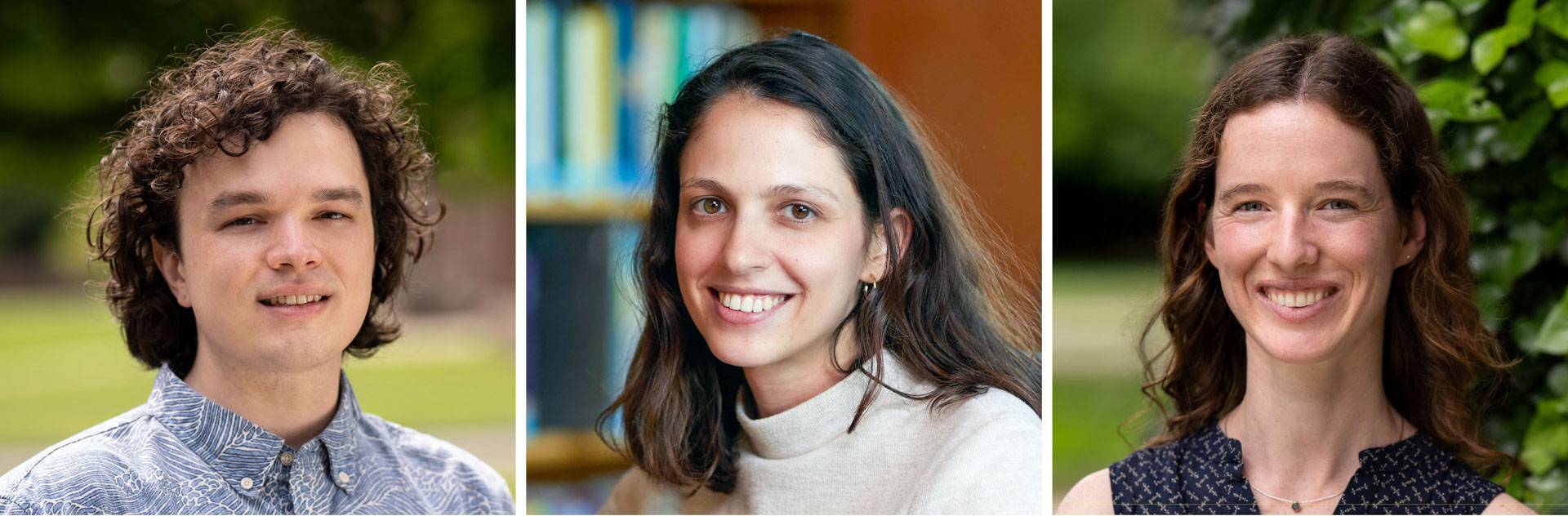
(Left to right) Will Rogers, Shiri Ron and Jane Sedlak.
Will Rogers joins the Department of Ecology and Evolutionary Biology with research focusing on the reciprocal relationships between behavior and parasitism. Understanding behavior as both a driver and consequence of infectious disease, often in wildlife systems, Rogers studies how social interactions and movement determine an individual’s exposure to parasites as well as their ability to cope with the costs of infection via immunity, stress and access to resources. Rogers received a Ph.D. in ecology and evolutionary biology at Yale University and a B.S. in conservation biology and ecology from Montana State University. They are advised by Gerald Carter, associate professor of ecology and evolutionary biology.
Shiri Ron joins the Department of Computer Science with a research focus on algorithmic game theory, at the intersection of theoretical computer science and economics. Her dissertation explored auction design under two key restraints: settings with rich bidder preferences and bounded rationality. Her research tests what is achievable under these constraints, with recent expansions into algorithmic contract theory and social choice theory. Ron received a Ph.D. in mathematics and computer science from the Weizmann Institute of Science and a B.S. in computer science and psychology from the Hebrew University of Jerusalem. She is advised by Matt Weinberg, associate professor of computer science.
Jane Sedlak joins the Department of Geosciences with studies surrounding the fractionation of nontraditional stable isotopes, such as potassium, in biological systems. Her goal is to develop a better understanding of ion transport in these systems and how they respond to environmental stress. Sedlak received a Ph.D. in chemistry from the University of California-San Diego, and a B.A. in chemistry from Oberlin College. She is advised by John Higgins, professor of geosciences.
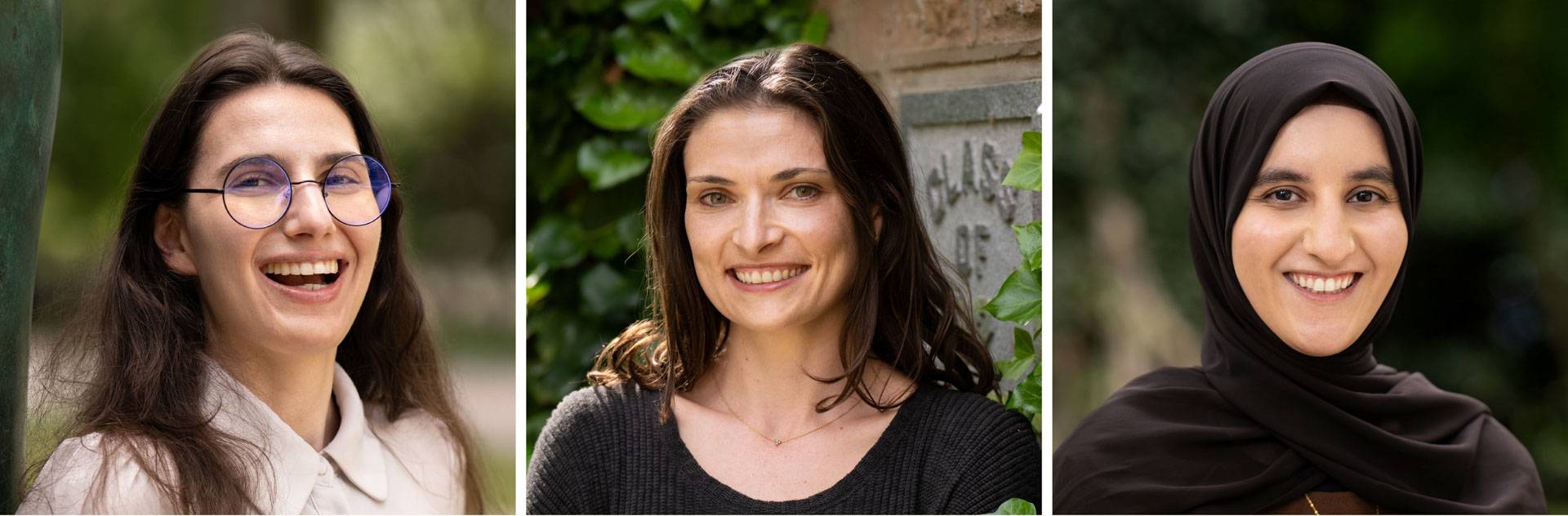
(Left to right) Emily Siff, Amy Weissenbach and Marwa Abdulhai.
Emily Siff joins the departments of Physics and Neuroscience and the Lewis-Sigler Institute for Integrative Genomics with a research focus on developing quantitative, multiscale frameworks for understanding death as a distinct biophysical state. In previous work with fruit flies (Drosophila), Siff identified a conserved biochemical signature of death and found striking molecular patterns associated with death and near-death experiences. She aims to understand how exposure to dead kin shapes the brains and bodies of the living. Siff received a Ph.D. in neuroscience and an M.S. in biomedical engineering from Yale University. She also earned an M.S. in cognitive science, a B.S. in literary arts and a B.A. in neuroscience from Brown University. She is advised by Joshua Shaevitz, professor of physics and the Lewis-Sigler Institute for Integrative Genomics, and Andrew Leifer, associate professor of physics and neuroscience.
Amy Weissenbach joins the Department of Sociology, studying personal narratives of precarity in the United States through qualitative and computational methods. Her current work analyzes over 10,000 personal appeals for financial help sent to Warren and Doris Buffett. She examines writers’ explanations of crisis and need and the intersecting layers of social structure that shape their stories. Weissenbach received a Ph.D. in sociology from Columbia University, an M.Phil. in the history and philosophy of science from the University of Cambridge and a B.A. in English literature from Stanford University. She is advised by Mitchell Duneier, the Gerhard R. Andlinger ’52 Professor of Social Sciences and professor and chair of sociology.
Marwa Abdulhai joins the Department of Computer Science, studying what it means to preserve human agency in artificial intelligence interactions, as AI systems begin to act on behalf of people in settings such as writing and negotiating. Her broader research focuses on building goal-directed agents that operate within the complexities of the real world, including improving the performance of large language models in multiturn dialogue, developing simulators of human behavior and understanding how to protect against deception in AI systems. Her doctoral research was supported by the Quad Fellowship, the UC Berkeley AI Policy Hub, OpenAI Research, and the Cooperative AI Ph.D. Fellowship. Abdulhai holds a Ph.D. in computer science from the University of California-Berkeley, and an M.Eng. and B.S. in computer science from the Massachusetts Institute of Technology. She is advised by Benjamin Eysenbach, assistant professor of computer science.