Four innovative projects selected for 2025 Schmidt Transformative Technology Fund awards
“Across engineering, computer science, chemistry and geosciences, the research teams supported by the Schmidt fund are developing novel solutions to persistent, thorny problems,” said Princeton's dean for research, Peter Schiffer. “Their work holds great promise to spark transformative change that will make a meaningful difference in people’s lives and for our collective future.”
Four research projects — focused on small molecule structure determination, sustainable energy storage, natural hydrogen gas generation, and tropical marine ecosystem mitigation — have received funding through the Eric and Wendy Schmidt Transformative Technology Fund.
The goal of the fund is to enable researchers to make leaps rather than incremental advances in the natural sciences and engineering. It supports projects that lead to the invention of a disruptive new technology that can have a major impact on a field of research, or to the development of equipment or an enabling technology that will transform research in a field.
The fund was created in 2009 through a gift from Eric and Wendy Schmidt. Eric Schmidt is Executive Chairman and CEO of Relativity Space, co-founder of Schmidt Sciences, The Schmidt Family Foundation, and Schmidt Ocean Institute, the former Chief Executive Officer of Google, and former Executive Chairman of Alphabet Inc., Google’s parent company. Wendy Schmidt is co-founder of Schmidt Sciences, and president and co-founder of The Schmidt Family Foundation and Schmidt Ocean Institute. Eric Schmidt earned his bachelor’s degree in electrical engineering from Princeton in 1976 and served as a Princeton Trustee from 2004 to 2008.
“Across engineering, computer science, chemistry and geosciences, the research teams supported by the Schmidt fund are developing novel solutions to persistent, thorny problems,” said Princeton University Dean for Research Peter Schiffer, vice president for the Princeton Plasma Physics Laboratory and Class of 1909 Professor of Physics. “Their work holds great promise to spark transformative change that will make a meaningful difference in people’s lives and for our collective future.”
The winning proposals were selected by an anonymous panel of faculty reviewers.
The four winning technologies are highlighted below.
New AI system to transform how scientists identify small molecules

Mohammad R. Seyedsayamdost (left) and Ellen D. Zhong (right) seek to develop an algorithm that can automate the process of determining small molecule structure from nuclear magnetic resonance (NMR) spectral analysis.
- Ellen D. Zhong, assistant professor of computer science
- Mohammad R. Seyedsayamdost, professor of chemistry
Determining the 3-D structure of small molecules, a class that includes hormones, vitamins, and most FDA-approved drugs, is essential for understanding how they function and interact in cells. However, current techniques require painstaking and time-consuming experimentation. In this project, the researchers seek to develop an algorithm that can automate the process of determining small molecule structure from nuclear magnetic resonance (NMR) spectral analysis.
In preliminary work, the researchers developed a machine learning algorithm that reliably translated one-dimensional NMR spectra of five-residue peptides into precise molecular structures. The current project will expand this approach to include broad classes of small molecules of various sizes and structure types. The project has three aims: to compile a database of NMR spectra for large-scale deep learning, to develop an algorithm that incorporates context-dependent considerations, and to apply the algorithm to the discovery of novel small molecules.
The researchers anticipate that the open-source release of this algorithm will significantly benefit scientists in many disciplines and transform drug discovery.
Soft, flexible materials for next-generation batteries and electronics

A project led by Craig Arnold (left) and Rodney Priestley (right) aims to advance sustainable battery design through the development of improved hydrogel electrolytes.
- Rodney Priestley, dean of the Graduate School and the Pomeroy and Betty Perry Smith Professor of Chemical and Biological Engineering
- Craig Arnold, Susan Dod Brown Professor of Mechanical and Aerospace Engineering and vice dean for innovation in the Office of the Dean for Research
In this project, the researchers aim to advance sustainable battery design through the development of improved hydrogel electrolytes. Hydrogels offer advantages over conventional battery electrolytes, but they bring challenges as well, including structural weakness, instability at low temperatures, and incompatibility with nonaqueous battery systems.
This project builds on the researchers' previous work on hydrogels, in which they developed a dehydration-rehydration method that successfully improved the materials' strength and recyclability but did not address thermal stability. The current project will evaluate hydrogels produced through a promising new method that replaces water with a green Deep Eutectic Solvent consisting of choline chloride and glycerol. Researchers will assess the viability and commercial potential of the improved hydrogels by testing their performance in zinc- and lithium-based prototype batteries.
The team's proposed hydrogel-based energy storage system represents a breakthrough in sustainable battery technology, with potential applications in the renewable energy, transportation and soft robotics industries.
Speeding up natural hydrogen generation for clean energy
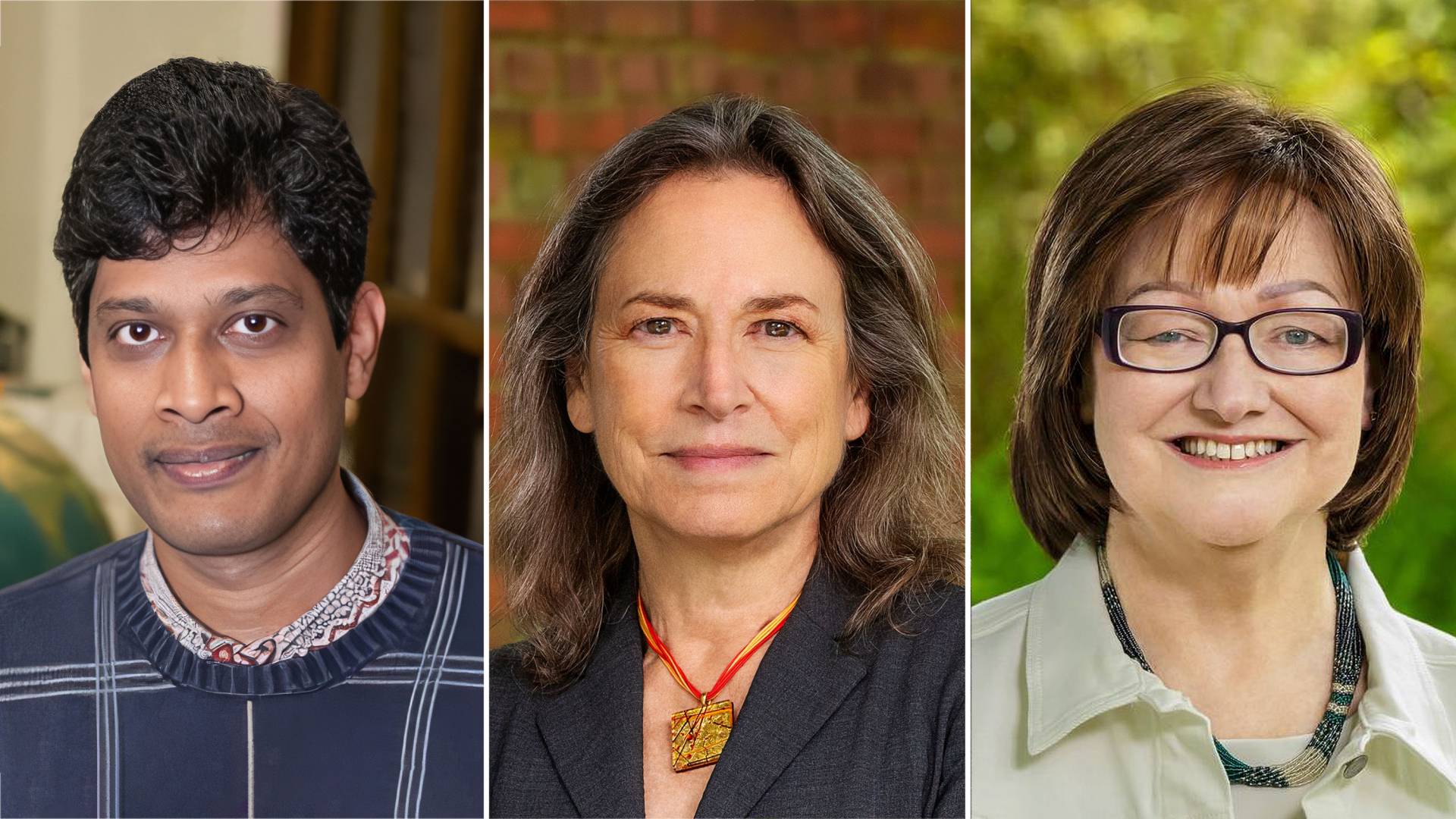
Satish Myneni, Emily Carter and Catherine Peters (pictured left to right) aim to study mineral-driven H2 generation and to test strategies to accelerate this process.
- Catherine Peters, the George J. Magee Professor of Geological Engineering, professor of civil and environmental engineering, and director of the Program in Geological Engineering
- Satish Myneni, professor of geosciences
- Emily Carter, senior strategic advisor and associate laboratory director for applied materials and sustainability sciences at the Princeton Plasma Physics Laboratory and the Gerhard R. Andlinger Professor in Energy and the Environment and a Professor of mechanical and aerospace engineering, the Andlinger Center for Energy and the Environment, and applied and computational mathematics
Natural hydrogen (H2) gas, which can be harvested without an electric power source, presents a promising renewable alternative to fossil fuels. The researchers aim to study mineral-driven H2 generation and to test strategies to accelerate this process. They propose research in three areas, with the first focused on identifying reaction conditions and cascading pathways to achieve near 100% iron oxidation, which would lead to an order of magnitude increase in H2 generation. The second project area will examine molecular-level processes that control macroscale kinetic and thermodynamic properties of H2-generating mineral reactions. Third, the researchers will investigate the conditions necessary for H2 generation with simultaneous carbon dioxide mineralization. Discovering how to couple and control these processes could make natural H2 production carbon-negative rather than simply carbon-neutral.
Overall, this project has enormous potential for generating knowledge to help scale the production of sustainable H2 gas — a key step toward decarbonizing the nation's energy system.
Underwater robots to map threats to coral reefs and marine life

Curtis Deutsch (left) and Noelle Lucey (right) will design, build and test a low-cost autonomous vehicle system to measure hydrographic data in challenging coastal environments.
- Curtis Deutsch, professor of geosciences and the High Meadows Environmental Institute
- Noelle Lucey, former associate research scholar, High Meadows Environmental Institute
To address the lack of observational data on coral reefs, the research team will design, build and test a low-cost autonomous vehicle system to measure hydrographic data in challenging coastal environments. SeaWASP (Winched Autonomous Sensor Profiler) is capable of traveling to and remaining at precise locations, navigating uneven terrain and storm conditions, and recording measurements at multiple depths.
Following its test deployment on a coral reef off the coast of Puerto Rico, SeaWASP’s data will be used to train machine learning algorithms to relate local variability measurements to broader ocean and meteorological conditions and to map the effects of key stressors. Finally, the team will use observational data to build a trait-based habitat model that can provide real-time assessments of reef health and forecasts of near- and long-term threats, in the hope of facilitating adaptive practices and policies to mitigate these threats.
By bringing together innovative design engineering, cost efficiency, and advanced machine learning techniques, this project promises to revolutionize data collection and analysis in coastal reef environments and greatly enhance reef conservation, management and policy efforts around the world.