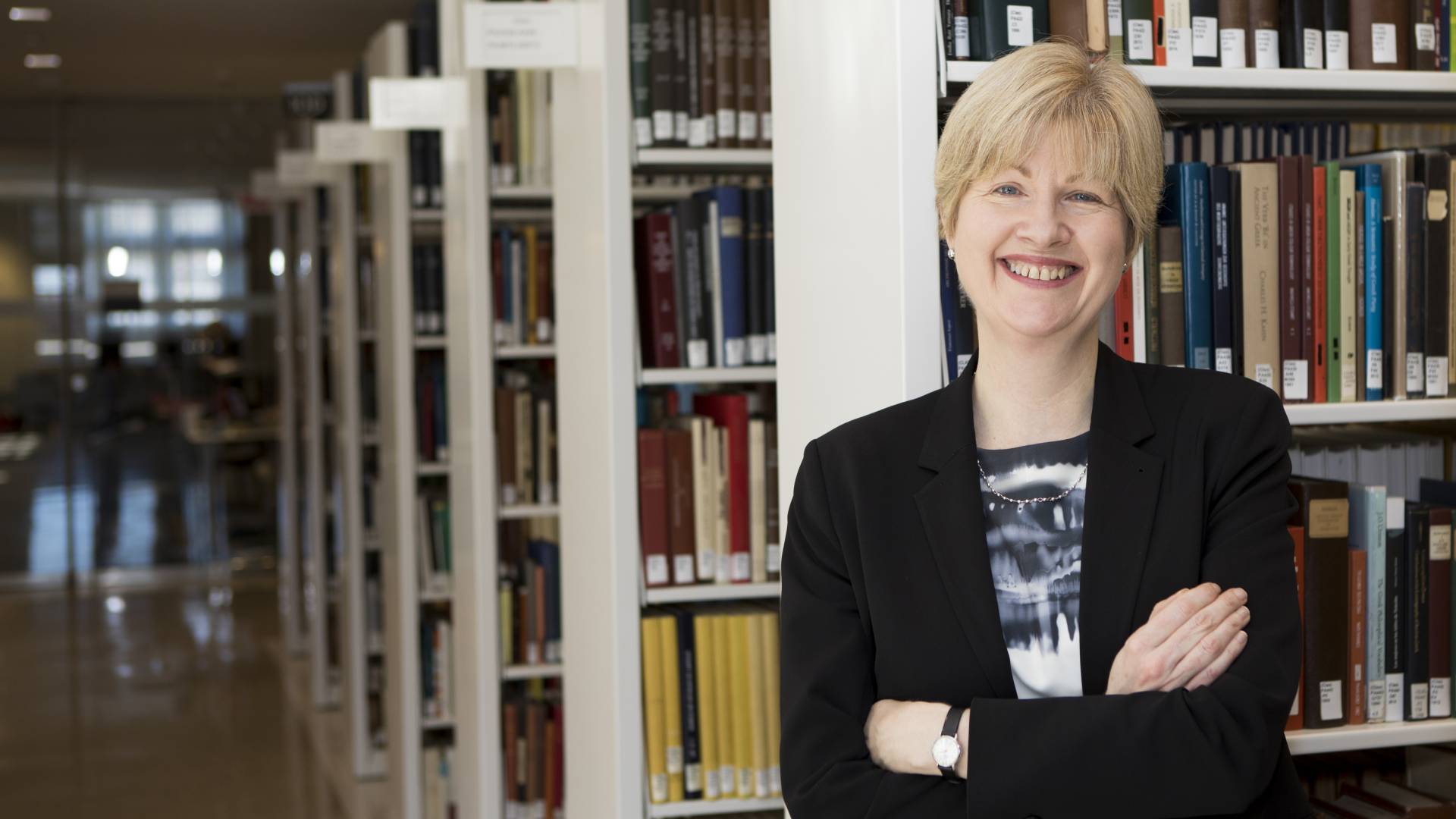
Anne Jarvis to retire after a decade as University Librarian
Anne Jarvis
Anne Jarvis, a distinguished academic librarian who has led Princeton University Library through a decade of growth and transformation, will retire later this summer, concluding her tenure as dean of libraries and the Robert H. Taylor 1930 University Librarian.
Since arriving at Princeton in 2016, she has guided one of the world’s foremost research libraries — comprising the Harvey S. Firestone Library and nine branches — through an era of rapid change in scholarship, technology and user needs, positioning the Library as a dynamic leader in research, learning and discovery.
“Anne Jarvis has led Princeton’s libraries with distinction at a pivotal time when digital technologies are changing how students and faculty read, study and perform research,” President Christopher L. Eisgruber said. “Anne’s devotion to learning and scholarship, her exceptional collegiality and her dedication to the people of this University made her a spectacularly good University Librarian. We are fortunate that she came from Cambridge to Princeton, and we are better because of what she has accomplished here.”
With more than 35 years of experience at premier academic libraries, including at the University of Cambridge in England, Jarvis brought a global perspective and a deep commitment to service. At Princeton, she championed initiatives that expanded access to collections, advanced research and data services, and launched programs that redefined what a modern academic library can be.
“A great research university needs a great library, and a great university librarian,” Provost Jennifer Rexford said. “Anne is widely respected by her colleagues at Princeton and her peers around the world. She led our library through a time of unprecedented innovation in the modes of scholarship, while always keeping her keen eye on what our faculty and students most need to support their scholarship and learning.”
Jarvis led the development of the Library’s first strategic planning process, which focused on user experience and data-driven decision-making to meet the evolving needs of scholars, researchers, students, faculty and community members. The strategic plan led to the Library’s first teams for user experience and for communications, organizational effectiveness and assessment.
“The Library plays a key role in Princeton’s commitment to teaching and research,” Jarvis said. “It has been a pleasure to work with so many wonderful colleagues to develop and deliver a world-class library service that is innovative, efficient and impactful.”
Jarvis also expanded access to the Library’s extraordinary physical and digital resources, oversaw program development and created new partnerships, all of which contributed to an enhanced patron experience.
“From card index systems to AI, I have witnessed tremendous changes within libraries during my career,” Jarvis said. “The last 10 years at Princeton have been marked by an exciting and ever-wider range of activities to support the research, teaching, learning and student experience. Our response has been to be as agile as possible and to embrace change.”
Jarvis said she is especially proud of the Library’s commitment to supporting how knowledge is created, discovered and curated for current and future generations — whatever the format.
“This task is of course daunting, but it is also inspiring and exciting,” Jarvis said. “I believe that Princeton University Library’s continued success will happen because it can and will build on great professional traditions. It has the flexibility to adapt to a world that will continually surprise us and the humility to work with others who complement library staff’s expertise.”
Transforming library spaces, collections and services
Jarvis successfully oversaw major renovation and building projects across multiple library spaces on campus, including the Seeley G. Mudd Manuscript Library; the Marquand Library of Art and Archaeology in the new Princeton University Art Museum; the Commons Library, which opened last fall as part of the new ES + SEAS complex; and the Engineering Library, which was renovated to include a Makerspace, a Maps and Geospatial Information Center and a data visualization lab.
Under Jarvis’ leadership, the University also completed its major renovation of Firestone Library in 2019, turning the massive 1940s-era building into a modern library that serves as a campus hub for undergraduates, graduate students, postdoctoral scholars and faculty and as an exceptional resource for researchers from across the globe.
“A common feature of these spatial innovations is that they reflect the evolution of the library system itself,” Jarvis said. “The Makerspace, for example, is an informal learning space, open to faculty, students and staff from all disciplines, while the new Commons Library serves as a curiosity-driven crossroads space that connects people and knowledge from across the disciplines to advance new knowledge.”
Jarvis also spearheaded the transformation of Special Collections, which houses the Library’s rare books, manuscripts and archives. She helped hone the department’s focus on access and education and expanded its exhibition program to integrate teaching with the collections, providing more opportunities for undergraduate and graduate students to learn firsthand from the extraordinary materials housed in Special Collections.
Special Collections holdings range from an Egyptian Book of the Dead (circa 1250 B.C.E.) to an original printing of the Declaration of Independence and the papers of Nobel Prize laureate Toni Morrison, which were the subject of a landmark 2023 exhibit at Firestone’s Milberg Gallery.
Jarvis also supported the Library in working more closely with partners across campus, seeking innovative ways for library staff to build connections and launch new programs, such as the Princeton Research Data Service and Digital Scholarship Services. In addition, she developed new national and international partnerships.
Professional leadership and service
While at Princeton, Jarvis has chaired the Ivy Plus Libraries Confederation and served on the Johns Hopkins Library Advisory Board and the NorthEast Research Libraries Consortium Executive Board. She currently serves as a member of the Board of Directors of the Council of Library and Information Resources, the Board of Governors for the Research Collections and Preservation Consortium, and the Board of Trustees of Princeton University Press.
“It has been a joy to see my Library colleagues demonstrate their expertise to guide critical conversations about new technology, resources, services and programs,” Jarvis said. “For example, Special Collections now share and make available that which was once reserved for a privileged few, embracing approaches that are more inclusive and democratic. Similarly, it has been rewarding to see how the Library has reapplied its expertise with our extraordinary printed and manuscript collections to the digital world, in the process expanding the definition of what constitutes collections and who can use them.”
A transatlantic career
Prior to her role at Princeton, Jarvis served as university librarian at the University of Cambridge for seven years, having previously held the role of deputy librarian for nine years. She was the first female university librarian in Cambridge’s 800-year history. At Cambridge she also was a fellow of Wolfson College, where she served as vice president from 2006 to 2009. Prior to Cambridge, she worked at Dublin City University Library and at Trinity College Library in Ireland.
A native of Ireland, Jarvis plans to return there following her retirement. Reflecting on her career at Princeton, she noted that she will miss working with extraordinary colleagues and is grateful to have met many wonderful people. “I will leave Princeton with countless happy memories,” she said.
Dean of the College Michael Gordin will lead the search for Jarvis’ successor, with the goal of having a new University Librarian in place for the fall 2026 semester.


