Crockett, Seung, win major prizes from National Academy of Sciences
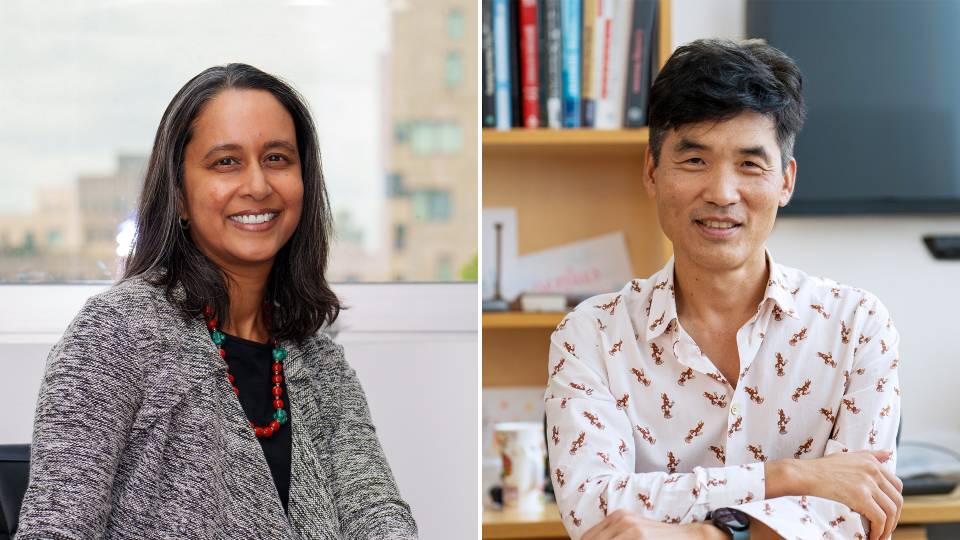
Molly Crockett and Sebastian Seung
Molly Crockett, a professor of psychology and the University Center for Human Values, and Sebastian Seung, the Anthony B. Evnin ’62 Professor in Neuroscience and Computer Science, are winners of two of the most prestigious honors from the National Academy of Sciences. They will be presented with their awards at a ceremony on April 26 during the National Academy of Sciences’ 163rd annual meeting.
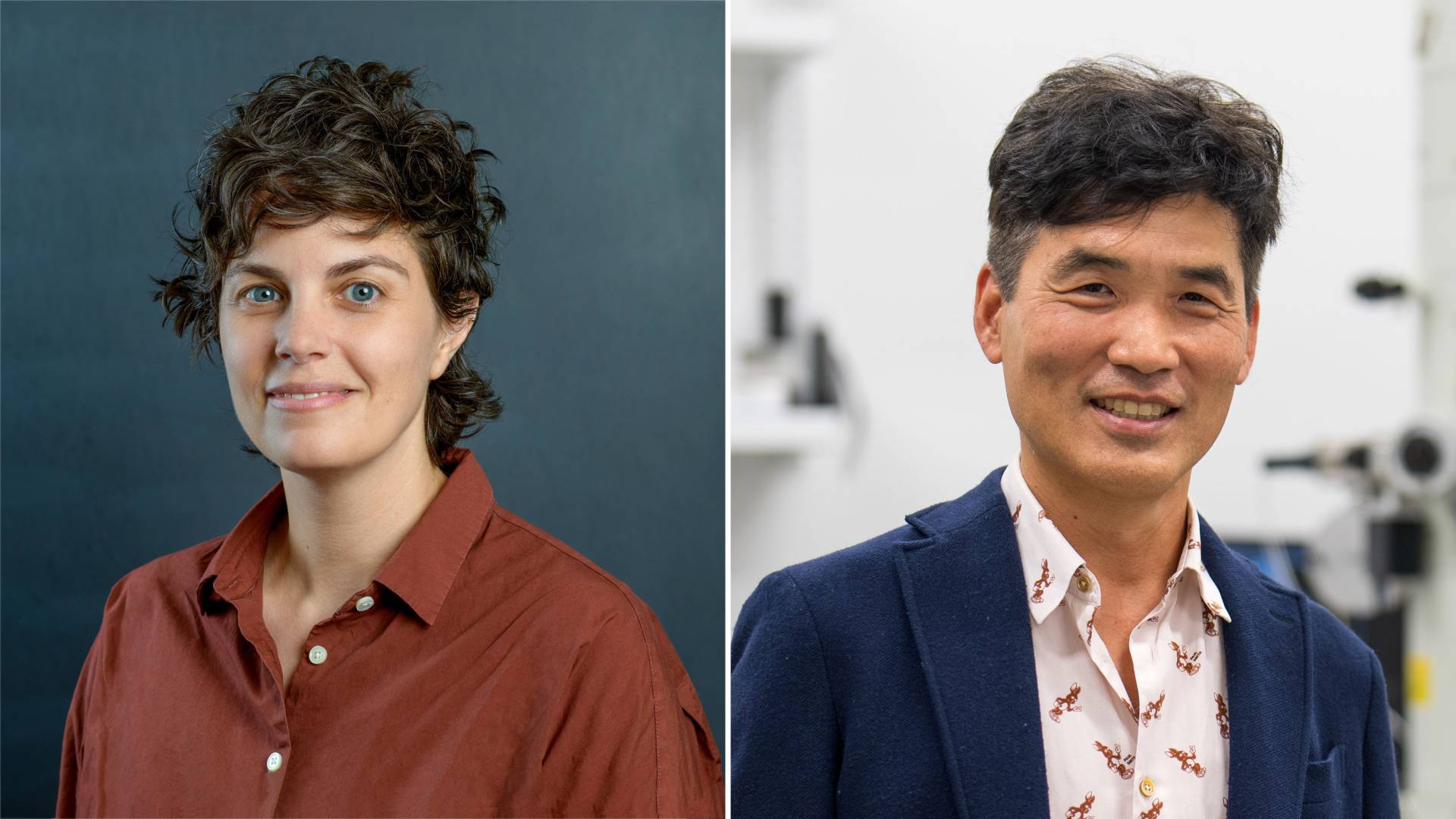
Molly Crockett
Crockett won the Troland Research Award, which provides $75,000 each to two early-career researchers “to recognize unusual achievement” and “to further empirical research within the broad spectrum of experimental psychology.”
The NAS honored Crockett “for their pioneering contributions to a mechanistic theory of moral cognition.”
The citation reads: “Through timely and elegant empirical studies, Crockett’s work has elucidated the role that learning and decision processes play in diverse moral behaviors and has shown how technologies such as social media can exploit these processes to erode trust in communities. Crockett’s work has significantly advanced our understanding of moral cognition, not only through original empirical discoveries, but through an expansive and interdisciplinary approach that is reshaping how psychologists think about morality in real-world contexts.”
“I am especially honored to receive the Troland Research Award during a time when scientific research faces serious threats, resulting from the same political dynamics my lab has investigated over the past decade,” said Crockett. “This recognition will support my team’s future work exploring how systems of power shape the ways we understand the world, including the work we do as scientists.”
Prior to joining Princeton in 2022, Crockett was an associate professor of psychology at Yale University, an associate professor of experimental psychology at the University of Oxford and a fellow at Oxford’s Jesus College. They hold a B.Sc. in psychobiology from the University of California-Los Angeles and a Ph.D. in experimental psychology from the University of Cambridge, and completed a Wellcome Trust Postdoctoral Fellowship with economists and neuroscientists at the University of Zurich and University College London.
Among Crockett’s many previous awards and honors are the Distinguished Scientific Award for an Early Career Contribution to Psychology from the American Psychological Association, the Janet Taylor Spence Award for Transformative Early Career Contributions from the Association for Psychological Science, and the Early Career Award from the Society for Neuroeconomics.
The other 2026 recipient of the Troland award is Jason Yeatman of Stanford University.
Sebastian Seung
Seung has won the Pradel Research Award, which honors a mid-career neuroscientist for major contributions to understanding the nervous system. The award comes with a $50,000 prize to support ongoing neuroscience research.
The academy recognized Seung’s work for having “fundamentally reshaped modern neuroscience and computational biology, transforming our understanding of how neural circuits are reconstructed, analyzed, and interpreted.”
The award citation noted that his work transformed connectomics — studying the trillions of connections among billions of neurons — “from a concept into a powerful field of discovery and redefined understanding of how brain structure gives rise to function.”
“For over 20 years, many dedicated researchers around the world have worked to realize the dream of connectomics,” Seung said. “I’m especially indebted to the talented members of my laboratory, past and present, and to Princeton University for its wonderful intellectual environment. It's been my privilege to live a life in science.”
Starting in the 2000s, Seung and his students applied the growing field of machine learning to trace the “wires” of the brain in electron microscopic images to reconstruct neuronal wiring diagrams of brains, or “connectomes.”
As the technology improved and the datasets grew, Seung and his colleagues within the Machine Intelligence from Cortical Networks (MICrONS) Consortium reconstructed a wiring diagram from a cubic millimeter of brain tissue in a mouse’s visual cortex.
Seung also joined forces with Mala Murthy, the Karol and Marnie Marcin ’96 Professor of Neuroscience and director of the Princeton Neuroscience Institute, to lead the FlyWire Consortium — a globe-spanning group of 75 laboratories and a team of citizen scientists. They completed the first wiring diagram of a fruit fly’s 140,000 brain cells and the tens of millions of synapses connecting them — a resource now used worldwide by neuroscientists.
Seung previously held positions at the Massachusetts Institute of Technology and Bell Laboratories and has served as president of Samsung Research. He earned both his bachelor's and doctoral degrees in physics at Harvard University, followed by a postdoctoral appointment at the Hebrew University of Jerusalem.