IMAP opens a new era for heliosphere science and space weather
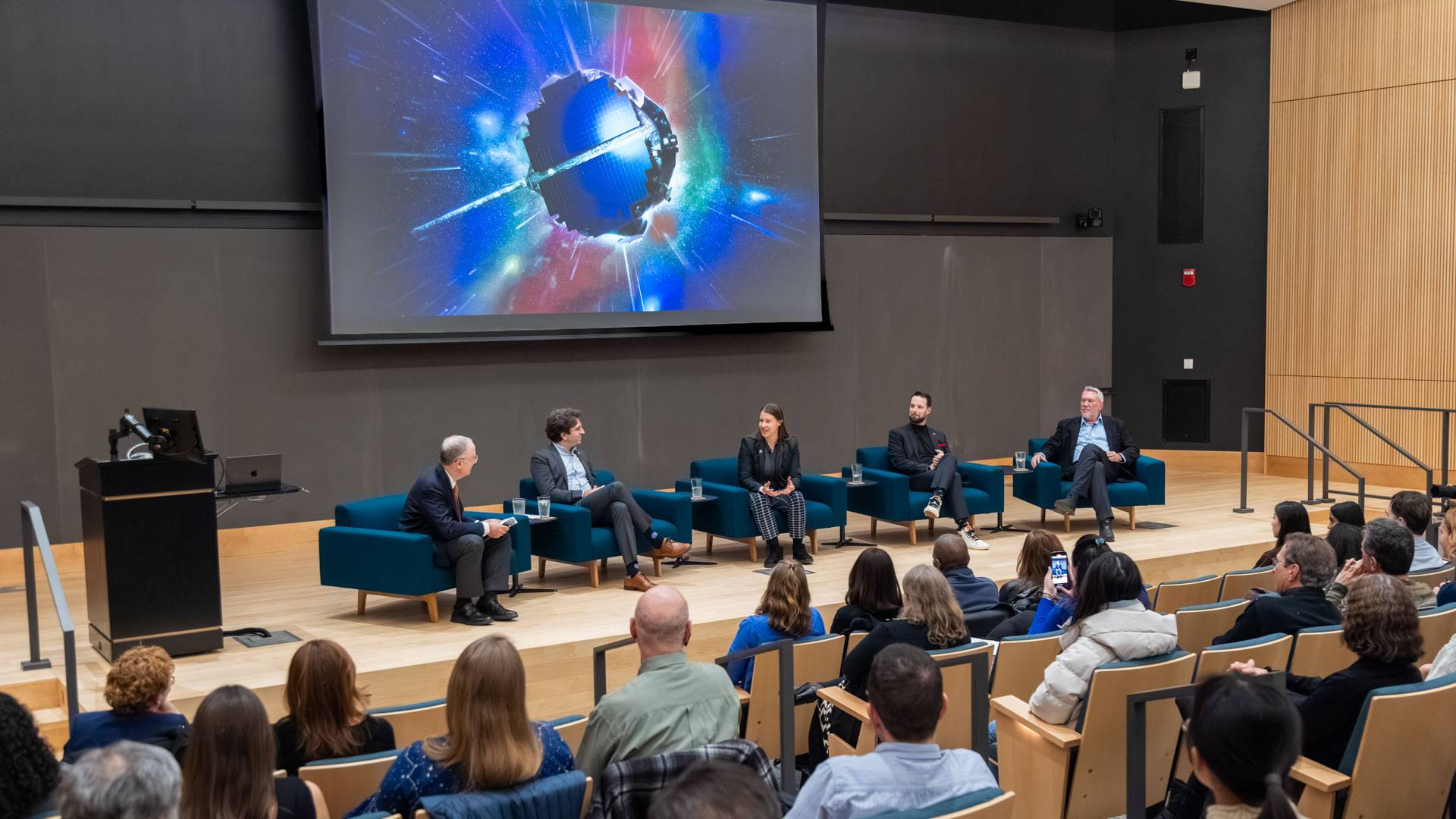
From left: Dean for Research Peter Schiffer (left) moderated a panel discussion about NASA's IMAP (on screen) with Jamey Szalay, Jamie Rankin, Joe Westlake and David McComas.
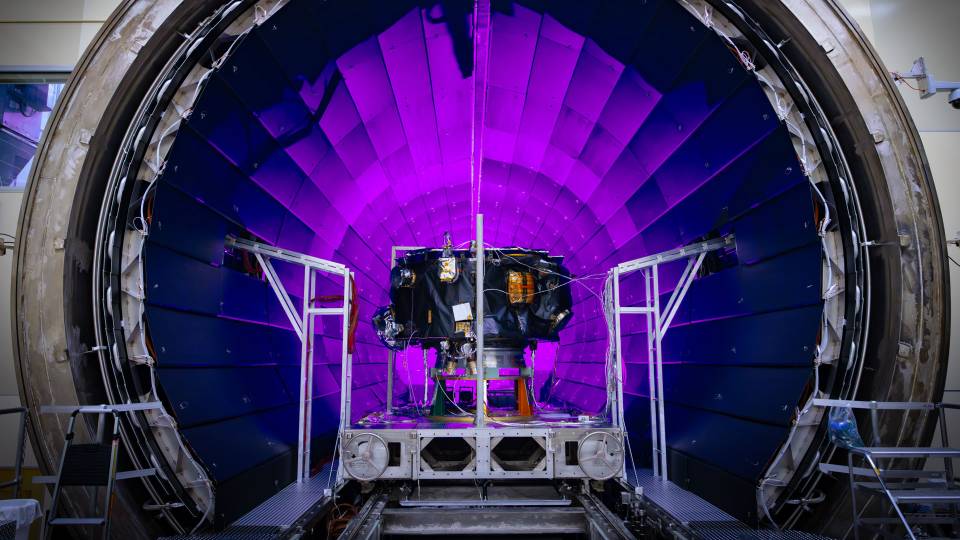
The Interstellar Mapping and Acceleration Probe, a Princeton-led NASA mission to study the Sun and everything it touches, has officially begun its science mission. Princeton marked the occasion with a panel discussion of IMAP leaders, science talks and a reception on Thursday, Feb. 26, hosted by the Center on Science and Technology.
Princeton University President Christopher L. Eisgruber appeared in a video welcome to the event. “IMAP is a multi-institutional effort that spans 82 U.S. partners in 35 states, plus partners in the United Kingdom, Poland, Switzerland, Germany and Japan,” he said, noting that it “exemplifies what a successful partnership between government, industry and higher education can achieve.”
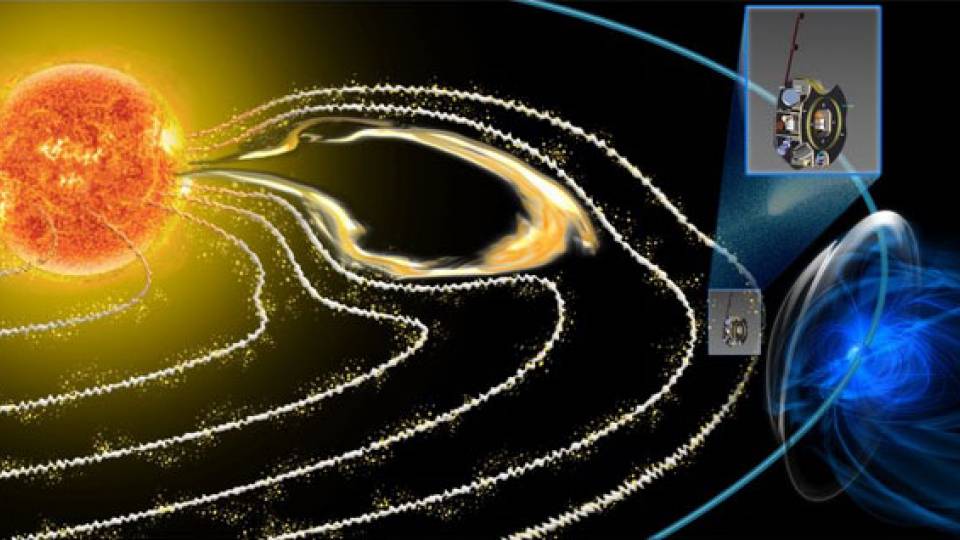
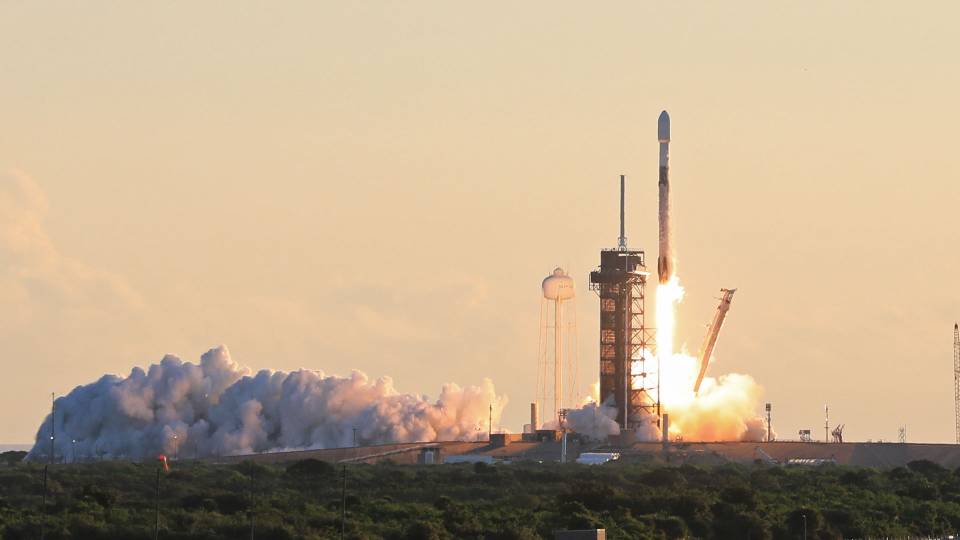
On Sept. 24, IMAP launched from Cape Canaveral, beginning its journey to a point in space a million miles from Earth known as Lagrange Point 1, or L1, a gravitationally balanced spot between the Earth and Sun. IMAP will orbit around L1 for years to come, traveling around the Sun at the same rate the Earth does and remaining a million miles Sun-ward of Earth throughout its mission.
“From L1,” Eisgruber said, “it will investigate the outermost boundary of the heliosphere — the cosmic shield that protects our solar system from harmful cosmic radiation — and will play a central role in advancing heliophysics and space weather prediction for the next era of space exploration.”
Dean for Research Peter Schiffer moderated a panel discussion that included David McComas, the principal investigator of the mission and a professor of astrophysical sciences at Princeton, along with other mission leaders: Jamie Rankin, a research scholar and lecturer in astrophysics at Princeton; Jamey Szalay, also an astrophysics research scholar at Princeton; and Joe Westlake, director of NASA’s Heliophysics Division.
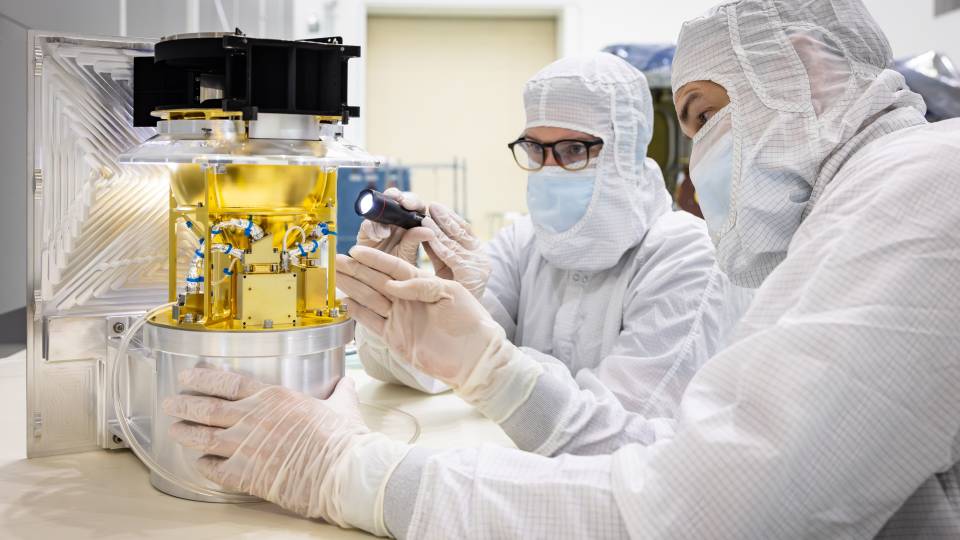
Schiffer noted that SWAPI — the Solar Wind and Pickup Ion instrument onboard IMAP — was built on campus, in the Space Physics Laboratory. He asked McComas how constructing space hardware fits into the University’s educational mission.

David McComas, principal investigator of the IMAP mission and a professor of astrophysical sciences at Princeton
“This is one of my favorite parts, because the whole time we were building these flight instruments and calibrating these flight instruments, we were also teaching,” said McComas. “Jamie Rankin and I teach a class together in the space lab … where we integrate the teaching experience for the students who really want to get their hands on some flight hardware.”
Schiffer asked Westlake what he was most excited to see from IMAP.
“I’m in it for the discovery,” Westlake said. “This IMAP data is going to really revolutionize how we understand our home in space.” He also spoke about the importance of IMAP for human spaceflight, especially as the Artemis II astronauts prepare for launch. “We’re sending astronauts around the Moon for the first time in many, many years with Artemis II, and IMAP data is going to help protect those astronauts.”
The discussion alternated with clips from a new IMAP documentary.
“I really am happiest when I’ve learned something new every day,” McComas said in the video. “And when I say something new, I don’t mean something I didn’t know in the morning. I mean something that nobody knew in the morning, something truly new, a new piece of knowledge for humanity.”
During the panel discussion, McComas explained that IMAP carries 10 instruments, a few of which have more than one “head” collecting data. All 13 heads of the 10 instruments have successfully turned on and begun collecting data, he announced to applause from the crowd.
The five instruments focused on the solar wind and the Sun's magnetic field send some data to Earth in real time, to provide advance warning of incoming solar flares and coronal mass ejections. All of the instruments send their full science data every few days.
So far, the instruments have collected what they were expected to, said McComas, and — most excitingly for astrophysicists — they’ve also already found things that scientists had not anticipated. Those data “are not analyzed yet, so we’re not sure what they mean, but they are definitely ‘discoveries’ that go beyond what we knew and hoped we’d find,” he said.
Rankin is the instrument lead for SWAPI, which collects charged particles emitted from the Sun — the semi-steady flow known as the solar wind — and also captures particles from the outermost edge of the heliosphere, which is about a hundred times as far from Earth as the Sun is.
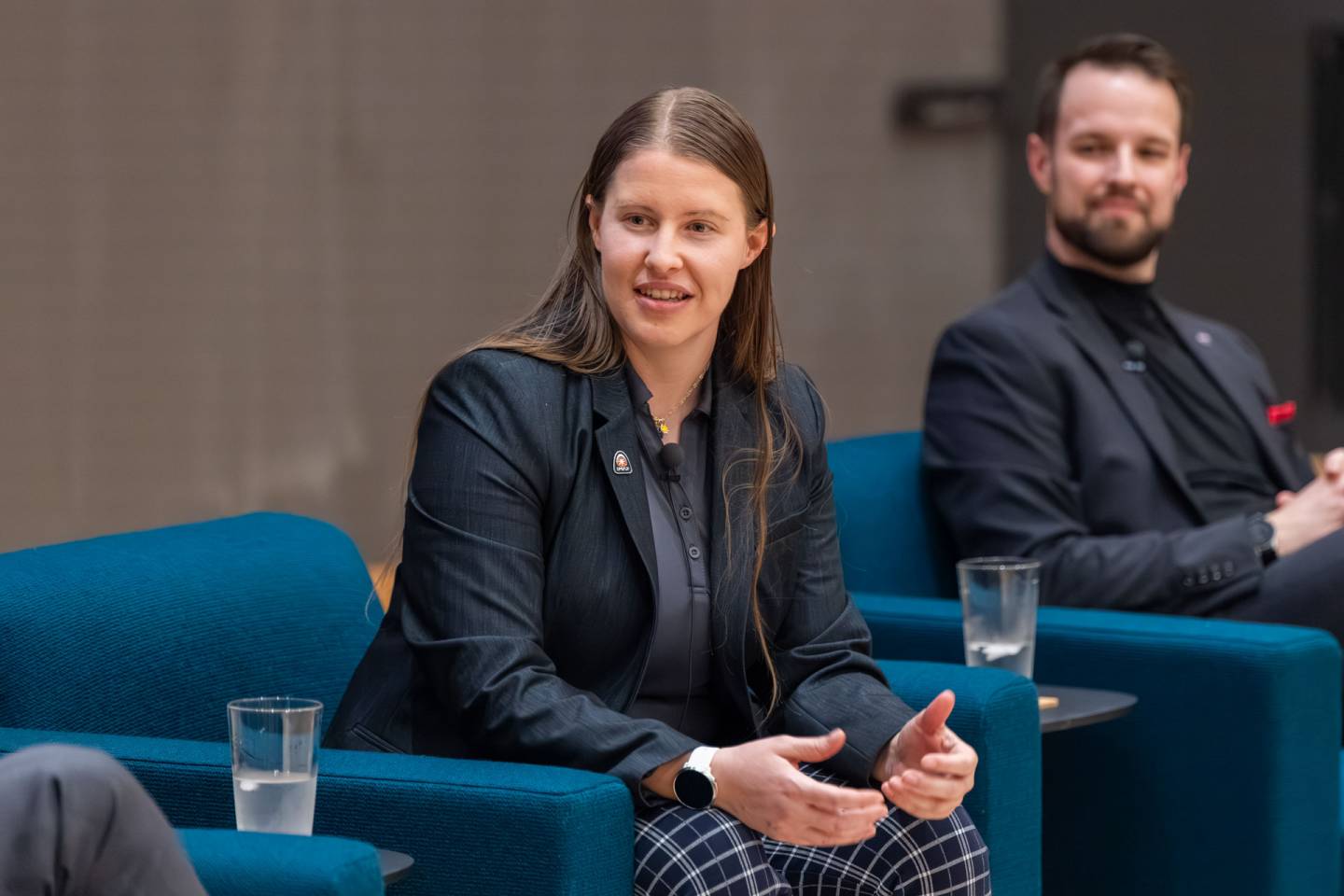
Astrophysicist Jamie Rankin (left) is a co-investigator of IMAP and the instrument lead for SWAPI, the Solar Wind and Pickup Ion instrument. Joe Westlake (right) is the head of NASA's Heliophysics Division.
SWAPI was one the first of the mission instruments to turn on, which Rankin described as “the real moment of truth, to see if it was all that we had envisioned it to be.” It began gathering science data soon afterward.
“A couple days later, some large space weather activity passed by, and it was incredible,” she said, noting that SWAPI’s performance was “an order of magnitude better than we expected.”
Szalay leads IMAP’s Combined Access Visualization and Analysis (CAVA) Tool, which helps interested scientists look at IMAP data without needing any special equipment or programming skills. CAVA allows for what Szalay calls “integrative science” among the 10 IMAP instruments, combining multiple instruments’ observations into a comprehensive scientific picture.
Szalay is also an expert in interplanetary, cometary and interstellar dust particles, so he fielded a question about IMAP’s dust instrument IDEX, the Interstellar Dust Experiment, for which he is a co-investigator.
“Cosmic dust is not like the stuff we vacuum. Cosmic dust is shooting stars,” said Szalay. “It tells us about the formation of our solar system, and it tells us about our interaction with our local galactic environment. It’s also important for space weather, because if it’s going to rain rocks, maybe the astronauts shouldn’t be outside.”
After the panel, Michael Strauss, chair of the Department of Astrophysical Sciences, noted that McComas had built both the Space Physics Program and the lab in which SWAPI was built “completely from scratch” over the past 10 years. The lab was constructed during the COVID-19 pandemic in the basement of the building that previously housed the UNOW Childcare Center.
“It was really quite a remarkable decade — to start with nothing, in the basement of a daycare center,” Strauss said, “and now he’s built a team of astonishingly accomplished individuals … to build up something truly audacious, as you just heard, a satellite that is mapping the solar wind and the heliosphere and having such an amazing impact.”
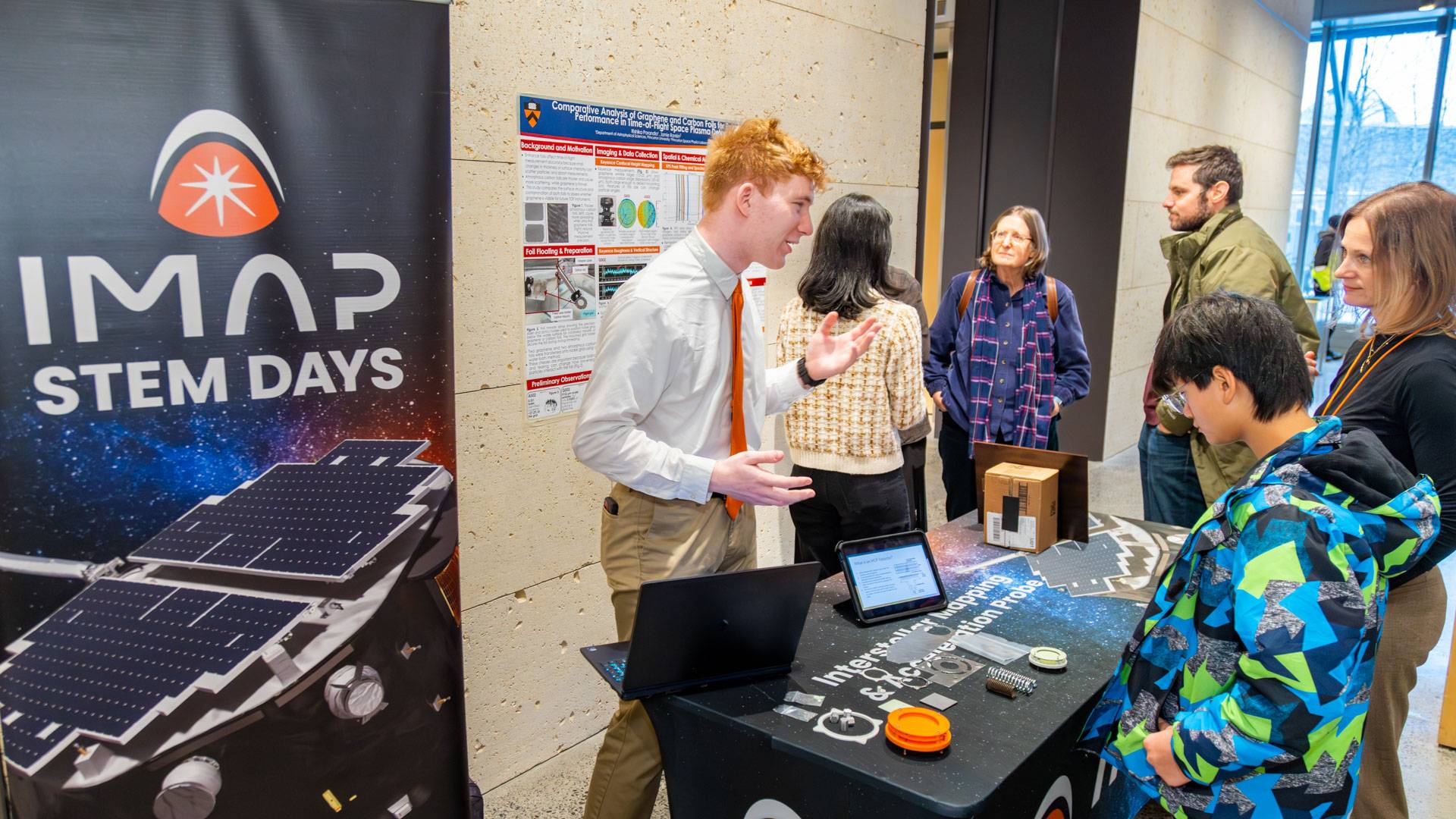
Before and after the panel, undergraduates in Princeton's Space Physics Program presented posters and demonstrations of their research projects, many of which will become junior papers or senior theses.