Senior thesis spotlight: A scholarly look at black holes and relativity by a student whose other universe is jazz
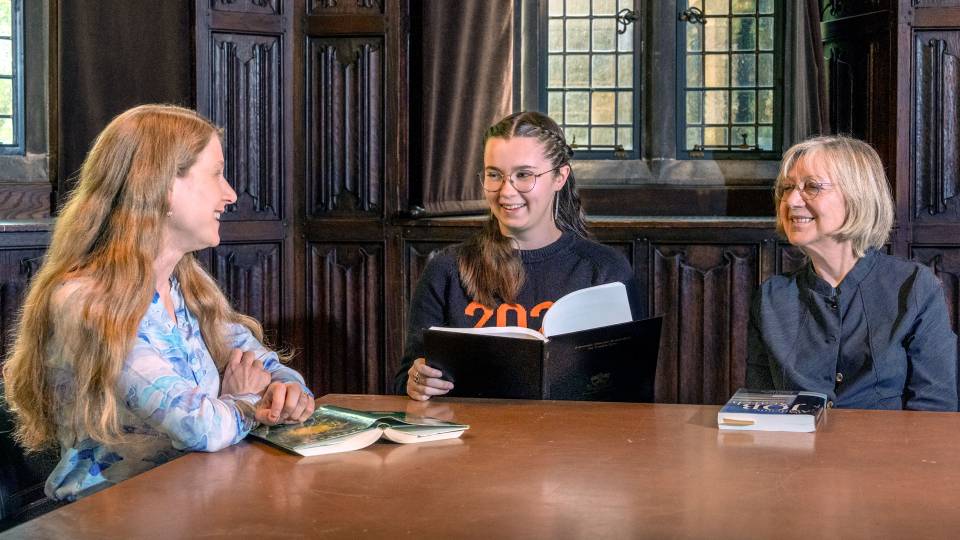
For her senior thesis, Sophia Varughese (left) explored the subject that had first drawn her to astrophysics: black holes and relativity. Astrophysicist Neta Bahcall (right) advised her on the work.
When Sophia Varughese came to Princeton, she expected to major in economics and minor in music performance so that she could have a successful business career and then, maybe, eventually, pursue her love of French horn performance.
But then she fell in love with the wonders of the universe, and then jazz singing, and she had to admit that path might not be right after all.
“Over the past few years, I’ve been trying to allow myself to love what I love,” said Varughese, an astrophysical sciences major from Delray Beach, Florida — “something that you wake up every day excited to do.”
In her case, that’s general relativity, especially its connections to black holes. And singing jazz with a smoky voice reminiscent of USO tours.
During Varughese’s first year at Princeton, she took “Black Holes,” an astrophysics course taught by Eliot Quataert, Princeton’s Charles A. Young Professor of Astronomy on the Class of 1897 Foundation.
“My eyes were opened in a way that they never had been before,” Varughese said. “Learning about black holes and being presented with the idea of general relativity — I was just so excited. I remember calling my mom and telling her what I was learning in class, and telling my friends, and realizing that I was more academically excited than I’d ever been before.”
She especially loved studying under a professor who was himself a leader in the field, and who is, like so many Princeton scientists, actively expanding the sum of human knowledge.
“Something so special about this science is that we don’t know everything,” Varughese said. “It’s still an emerging field, and new things are being discovered every year. It felt so special to learn from someone who was also a student of the science, at the forefront of scientific discovery.”
For her fall junior paper, she focused on gathering and analyzing data from the Sloan Digital Sky Survey, one of the world’s largest astronomical surveys. For her spring junior project, she discussed possible topics with Neta Bahcall, Princeton’s Eugene Higgins Professor of Astronomy and the director of undergraduate studies for the Department of Astrophysical Sciences. Bahcall suggested a project on black holes.
When it was time to do her senior thesis, Varughese wanted to continue working with Bahcall on the subject that had first wooed her into astrophysics: black holes and relativity.
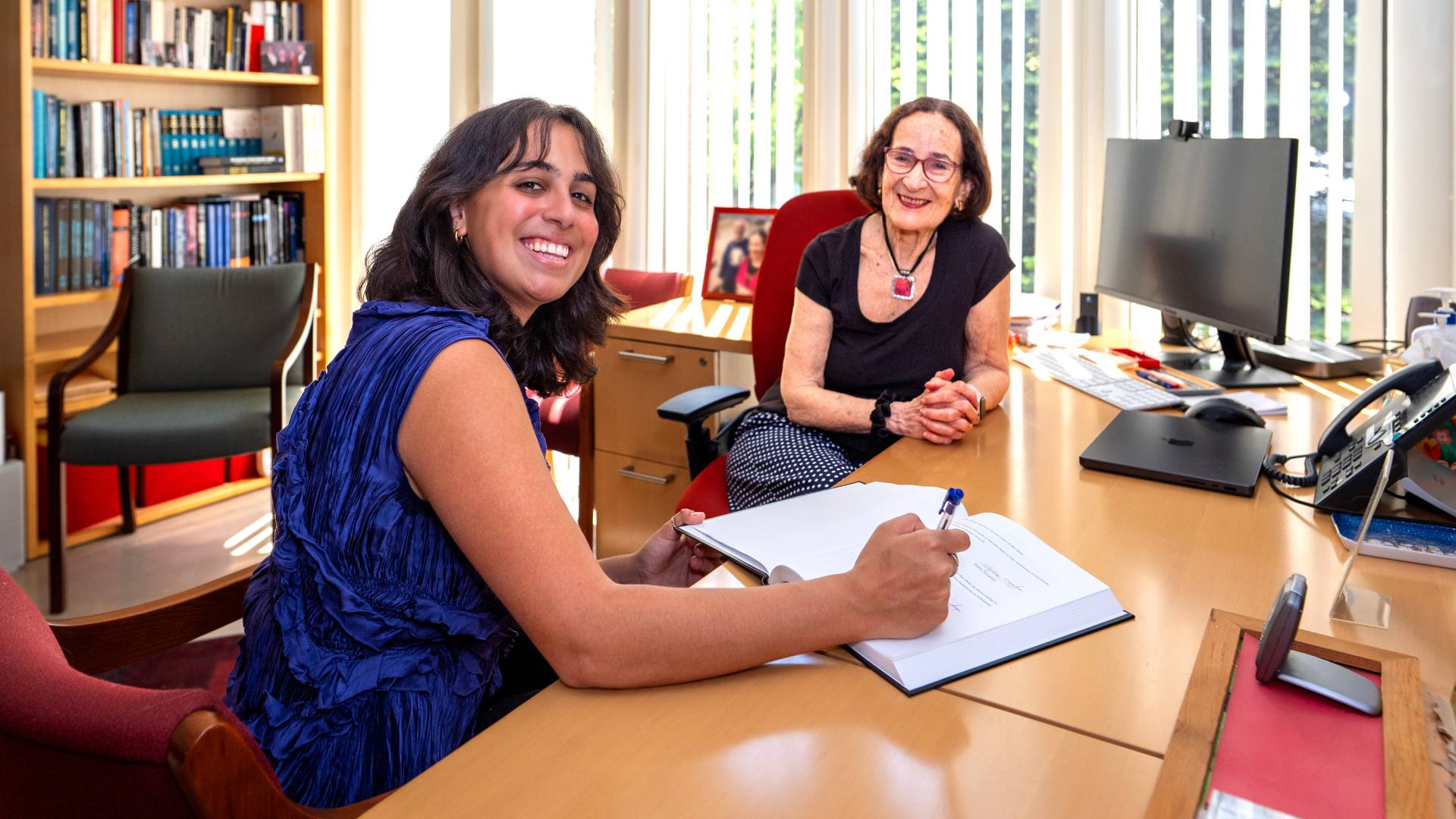
Bahcall mentored Varughese through her thesis: "The Point of Departure: Black Holes and the Causal Limits of General Relativity."
“Sophia did an excellent job on a beautiful thesis,” said Bahcall, who has spent more than 50 years at Princeton. “She not only explained black holes and how the theory of black holes came to be, but how the discoveries came, leading to what we know today. And then, how can we use black holes to test relativity?
“That’s a very interesting topic,” Bahcall continued. “She’s not the first to suggest it, but she picked it up and developed it: How can we test some alternatives to general relativity? What in black holes can provide us some clues?
“It is very impressive for an undergraduate to think about such topics,” Bahcall said. “Sophia is always so enthusiastic, about everything. She comes to my office, and we talk, and the enthusiasm fills up the room.”
While the great majority of astrophysics theses involve observations, modeling and simulations, Bahcall said, it is not uncommon for a student to choose a more discussion-based theoretical thesis, especially when the student is as excited about it as Varughese was.
“Something I always thought was so interesting about black holes is that, while we have observational evidence for them now, they are a solution to the equations of general relativity,” Varughese said. “They were never even conceptualized before this theory came about.
“Einstein published his theory of general relativity,” she noted, “and then Karl Schwarzschild solved one of his equations and arrived at this unique solution that there must be a way for a gravitational body to have such a strong gravitational force that not even light can escape.”
Then came the twist: “When I learned about how black holes complicate and show the limits of general relativity, I realized there was a deep interaction between this theory and these astronomical bodies. I just couldn’t believe that the science could work together in such a beautiful way.”
Her other universe: jazz
While many astrophysics majors continue on to graduate school in astrophysics or a related field, Varughese doubled down on music: she will head to the Manhattan School of Music in the fall to study jazz vocal performance.
Though she came to Princeton as an instrumentalist, Varughese discovered singing here, and she has performed in three jazz ensembles and an a cappella group, as well as writing and editing for The Daily Princetonian.
“She likes black holes, but her passion is for jazz music, and she was accepted at top music graduate schools,” Bahcall said proudly. “Her thesis is a very interesting combination of not just astronomy, but black holes, which are very theoretical, and general relativity, which is complicated, and she was really fascinated by that.
“And yet, she’s also very musical, and she’s going to be a professional musician. I think that’s fabulous.”
Connections between music and science are as old as time, Bahcall noted.
Einstein, a talented violinist, famously said, “If I were not a physicist, I would probably be a musician. I often think in music. I live my daydreams in music. I see my life in terms of music.”
Bach was a mathematician as well as a composer and performer. Some 2,500 years ago, Pythagoras and Aristotle speculated that the sun, moon and planets move in specific orbits that create an inaudible, cosmic harmony that they called “the music of the spheres.”
Bahcall attended Varughese’s year-end vocal performance, smiling and applauding as her astrophysics student belted, crooned and scatted her way through a 10-song set of jazz tunes in Taplin Auditorium.
“When you combine different studies, it broadens your mind,” Bahcall said. “You can think about the whole world in a different way.
“Sophia will be a professional musician for the rest of her life, but she will always understand what’s out there in the vastness of the universe — the stars and galaxies and black holes and dark matter and dark energy. Combining humanities with science broadens one’s mind and perspective on both fields.”
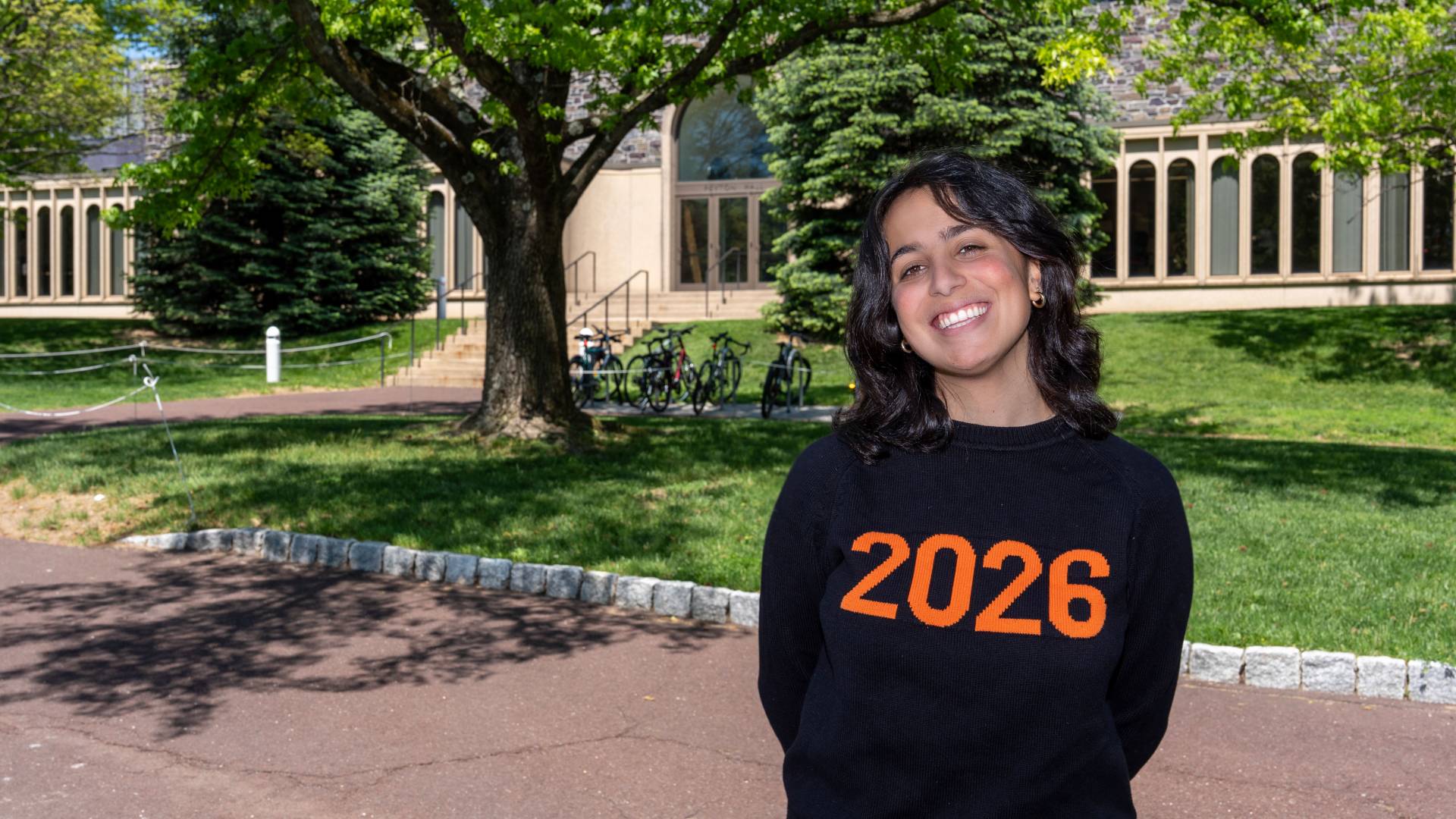
Varughese poses in front of Peyton Hall, home to Astrophysical Sciences. “Her thesis is a very interesting combination of not just astronomy, but black holes, which are very theoretical, and general relativity, which is complicated," said adviser Neta Bahcall. “And yet, she’s also very musical, and she’s going to be a professional musician. I think that’s fabulous.”