The American Physical Society (APS) announced today that four Princeton faculty members are among this year’s recipients of the society’s prestigious national awards recognizing “exceptional contributions to the physics community” in their fields of expertise.
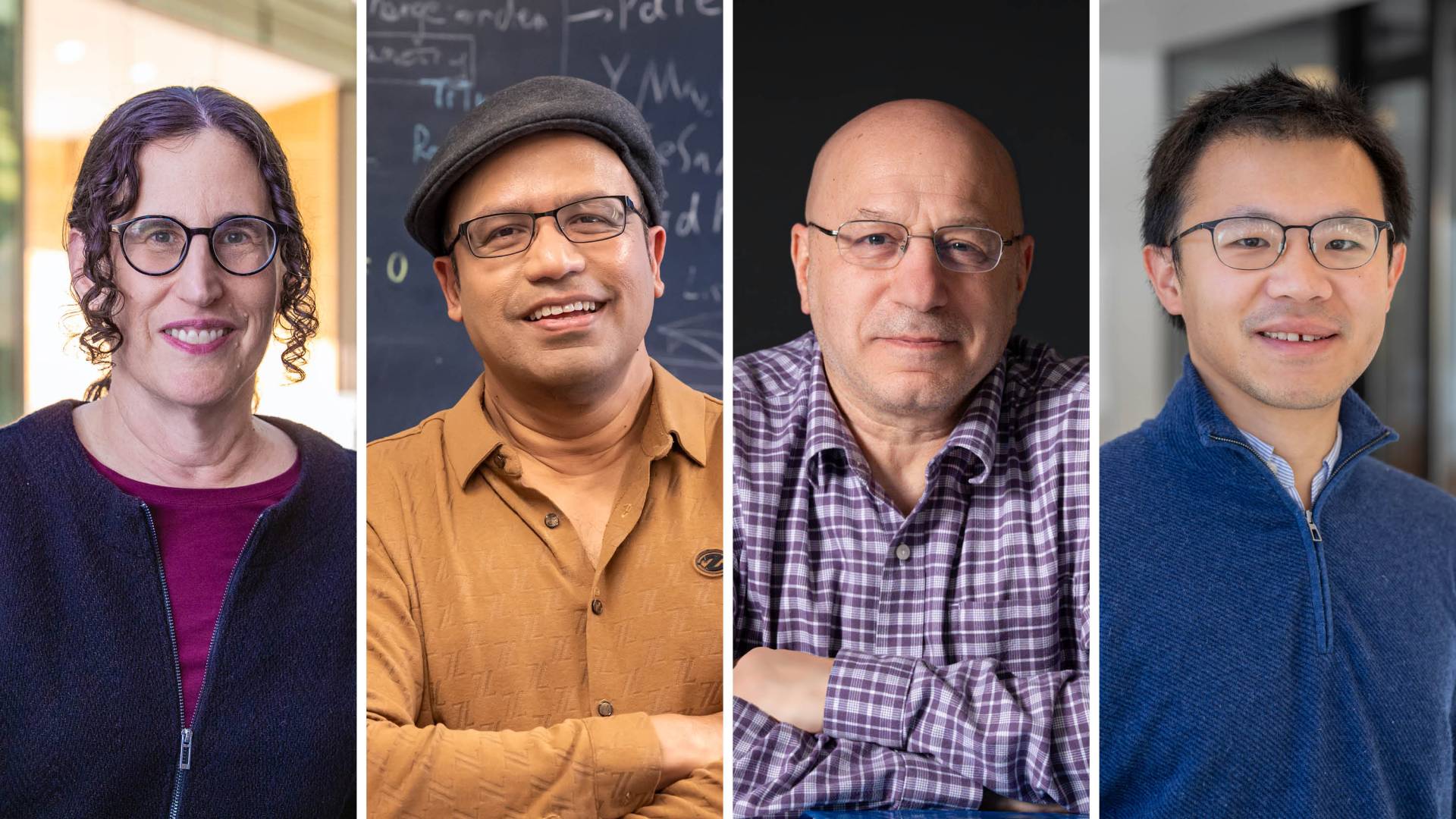
Sharon Hammes-Schiffer, M. Zahid Hasan, Howard Stone and Lawrence Cheuk (left to right)
Sharon Hammes-Schiffer, the A. Barton Hepburn Professor of Chemistry, is the recipient of the Irving Langmuir Award in Chemical Physics for “insights into the quantum nature of protons in molecular, biological, and material environments.”
M. Zahid Hasan, the Eugene Higgins Professor of Physics, is being honored with the Davisson-Germer Award in Atomic or Surface Physics “for the discovery of diverse topological states in quantum materials using state-of-the-art surface science techniques.”
Howard Stone, the Neil A. Omenn ’68 University Professor of Mechanical and Aerospace Engineering, is the recipient of the Julius Edgar Lilienfeld Prize “for defining and solving outstanding and relevant problems in fluid physics, fluid mechanics, and soft matter physics, and for exceptional skill in lecturing, both to experts and to the public, to convey the beauty and elegance of science.”
Lawrence Cheuk, assistant professor of physics, is the recipient of the I.I. Rabi Prize for early-career researchers in atomic, molecular, and optical physics for his “seminal work on ultracold atoms and molecules.”
In addition, Isabelle Connor, a first-year Princeton Ph.D. candidate in astrophysics, has been named the winner of the APS LeRoy Apker Award, which recognizes “outstanding achievement” as an undergraduate and “great potential for future scientific accomplishment.”
Sharon Hammes-Schiffer
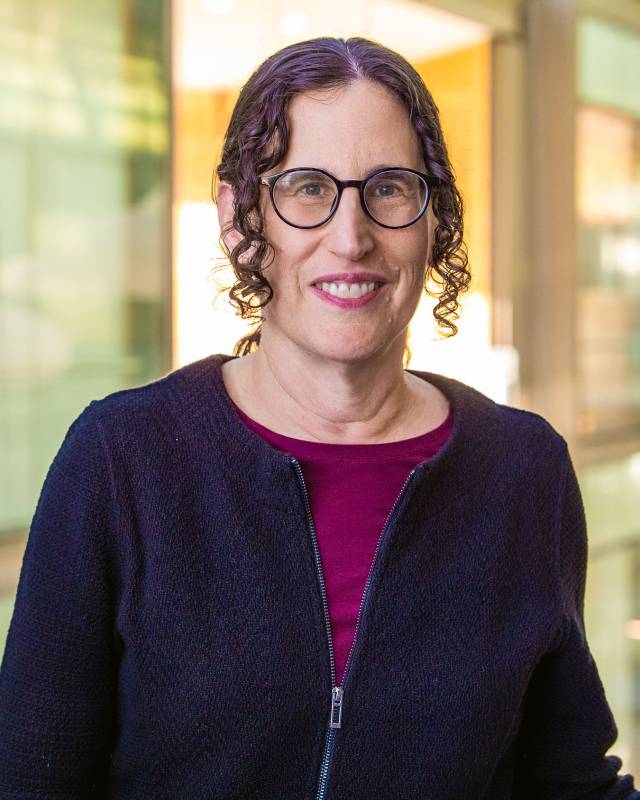
Sharon Hammes-Schiffer
Hammes-Schiffer’s award in chemical physics specifically recognizes her insights on “new theories of proton-coupled electron transfer and proton-coupled energy transfer, and the invention of the nuclear electronic orbital (NEO) method for quantum chemistry and dynamics.”
“I am honored to have been selected for this award, especially because it bridges chemistry and physics,” she said. “I have always considered myself to be on the boundary between these two fields; my group is highly interdisciplinary, combining chemistry, physics, biology, and computer science. It’s exciting to be recognized at this boundary.”
Hammes-Schiffer joined Princeton from Yale University in 2024. She has been investigating protons since the 1990s when scientists were developing quantum mechanical theories to study electrons, but much less attention was given to protons.
She was inspired by experiments showing that protons could also behave quantum mechanically, she said. “I realized that we needed to develop theories to understand the quantum nature of protons and to explain how behavior such as hydrogen tunneling can significantly impact chemical reactions in molecular, biological, and material environments.”
In addition to her pioneering theories of proton-coupled electron transfer, Hammes-Schiffer is also known for her invention of the NEO method, developed to describe specific nuclei — in this case protons — quantum mechanically. “I am excited to see that other groups are now using it to study systems that would have been out of reach five years ago,” she said.
Among her many other awards, she has received the American Chemical Society Award in Theoretical Chemistry, the Royal Society of Chemistry Bourke Award and the International Academy of Quantum Molecular Science Medal.
Hammes-Schiffer is a member of the National Academy of Sciences, the American Academy of Arts and Sciences, and the International Academy of Quantum Molecular Science. She is a fellow of the American Association for the Advancement of Science, the American Chemical Society, and the American Physical Society.
She is a summa cum laude graduate of Princeton’s Class of 1988 and holds a Ph.D. from Stanford University.
M. Zahid Hasan
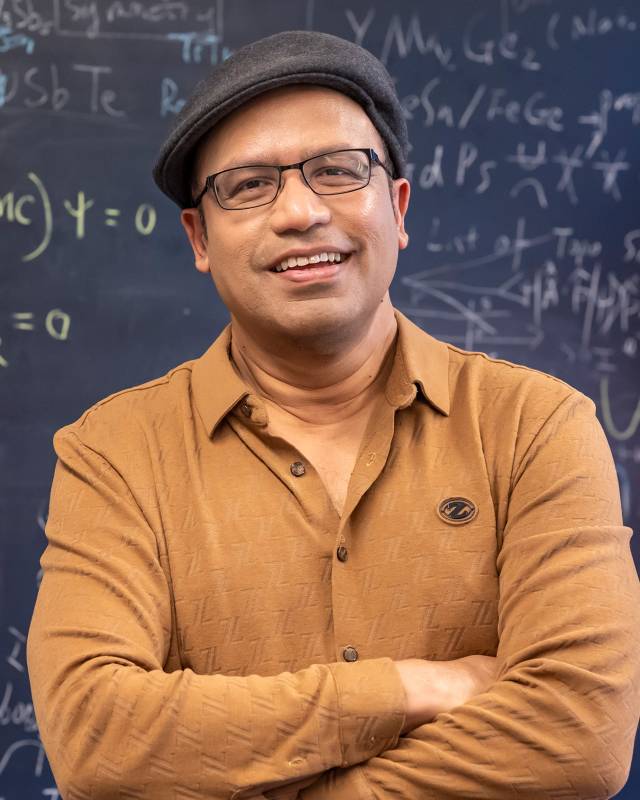
M. Zahid Hasan
Hasan has made numerous seminal discoveries in topological quantum materials, including a 3D topological insulator that can resist the flow of electricity through its interior but can conduct electricity freely on its surface and host a number of exotic quantum phenomena.
This groundbreaking research has also revealed a new quantum material called a Weyl semimetal, in which electrons in crystals behave like massless particles known as Weyl fermions, first predicted by Hermann Weyl in 1929. The discovery, which was patented in 2019, helped launch a new field of research that has yielded dozens of novel quantum materials and opened new frontiers in quantum science and engineering.
“Professor Hasan embodies the scientific creativity and ingenuity that originally inspired this prestigious award” [named for Clinton Davisson, a Nobel Prize-winning physicist who earned his doctorate at Princeton in 1911] and the long tradition of excellence in the Princeton physics department,” said department chair James Olsen, the Eugene Higgins Professor of Physics. “The physics department is thrilled to congratulate Professor Hasan on this well-deserved award recognizing his groundbreaking research.”
“I feel tremendously honored to have received an APS award that carries this legacy,” Hasan said, calling Davisson “one of my scientific heroes who was one of the founders of experimental quantum physics.”
Hasan’s many honors include the U.S. Department of Energy Ernest Orlando Lawrence Award, a National Science Foundation ACI Innovation Fellowship, and the David A. Shirley Award from the DOE’s Lawrence Berkeley National Laboratory. He has been a Sloan Research Fellow and an EPiQS Investigator for the Betty and Gordon Moore Foundation, and is a fellow of the APS and the American Academy of Arts and Sciences. In 2024 Hasan was invited to deliver lectures in foundational quantum physics for the international Bose-Einstein centenary.
Hasan joined Princeton in 2002 and was named the Eugene Higgins Professor of Physics in 2017. He has been the lead principal investigator of the Laboratory for Topological Quantum Matter and Advanced Spectroscopy at Princeton University since 2008. He is also affiliated with the Princeton Materials Institute and the Princeton Quantum Initiative.
Born and raised in Dhaka, Bangladesh, Hasan came to the U.S. as an undergraduate at the University of Texas-Austin, where he received a bachelor’s degree in physics. He earned a master’s in physics and a doctorate in applied physics from Stanford University, working at SLAC National Accelerator Laboratory.
Howard Stone
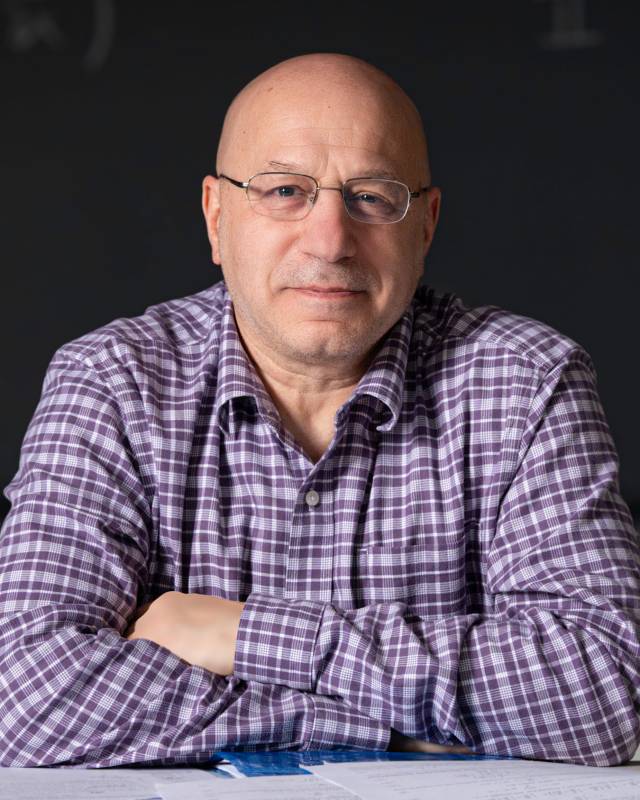
Howard Stone
Stone is internationally recognized for his pioneering research in fluid dynamics and its applications across engineering, chemistry, physics and biology.
Through his contributions to microfluidics — the study and control of the behavior of fluids on the microscale — Stone helped lay the foundation for lab-on-a-chip technologies used in rapid diagnostics and chemical analysis.
He has developed models to improve water purification and advanced understanding of microorganism movement and biofilm behavior, with implications for health and disease control. His research has also helped reveal the important role underground fungal networks play in the environment.
During the COVID-19 pandemic, Stone and his colleagues made direct visualizations of the fluid flows generated by speech, showing how such interactions can provide pathways for pathogen transmission by aerosols.
Stone joined Princeton in 2009 after teaching at Harvard University, where he established the Holiday Lecture series, an annual science outreach program. Now held at both Princeton and Harvard, the program draws more than 1,000 attendees each year and aims to bring the excitement of scientific research to young audiences. This December, the series will celebrate its 25th anniversary.
“I hope it has inspired some children to consider science and engineering as one path for their future,” said Stone.
Stone was elected a Fellow of the American Physical Society in 2004. He is also a member of the National Academy of Engineering, the American Academy of Arts and Sciences, and the National Academy of Sciences. He is a foreign member of the Royal Society of the United Kingdom.
He is an associate faculty member in the Princeton Materials Institute, the Omenn-Darling Bioengineering Institute and the Program in Applied and Computational Mathematics.
He received his B.S. in chemical engineering from the University of California-Davis and his doctorate from the California Institute of Technology. Stone was the Vicky Joseph Professor of Engineering and Applied Mathematics at Harvard before joining the Princeton faculty as the Donald R. Dixon ’69 and Elizabeth W. Dixon Professor of Mechanical and Aerospace Engineering.
Lawrence Cheuk
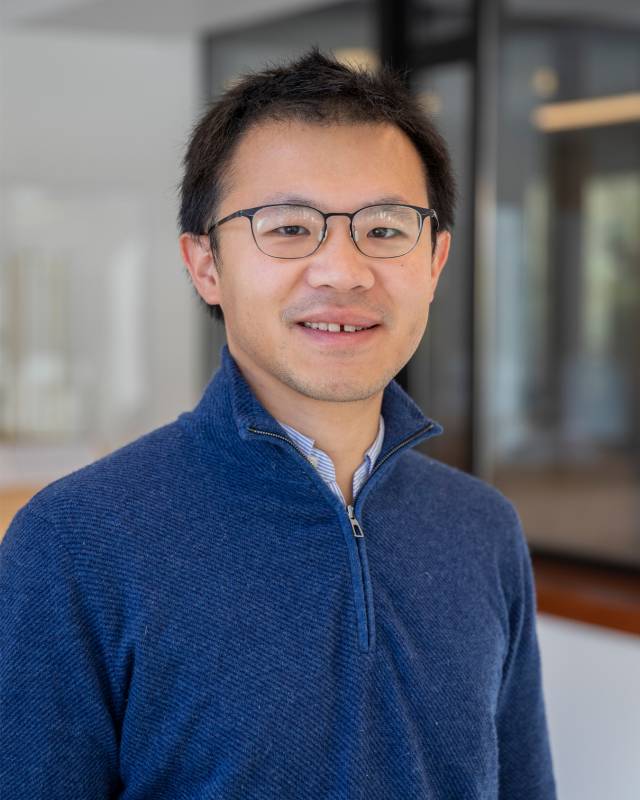
Lawrence Cheuk
The APS citation for Cheuk’s foundational work on ultracold atoms and molecules specifically noted his accomplishments in “the development of novel laser cooling techniques for molecules, the realization of on-demand entanglement of molecules in optical tweezer arrays, and their use as quantum simulators for many-body spin dynamics.”
“I feel very honored and humbled to be receiving this prestigious prize,” Cheuk said.
In 2023, Cheuk and his team were the first to demonstrate quantum entanglement and 2-qubit gates between pairs of molecules held in separate optical tweezers. Building on these results, his group has since assembled molecular arrays to explore quantum many-body physics, with recent work demonstrating molecular quantum simulators and quantum-enhanced metrology. His discoveries could find broad application in quantum information processing, quantum simulation and quantum sensing with molecules.
His previous awards include a Sloan Fellowship, an Air Force Office of Scientific Research Young Investigators Program Award and an Outstanding Young Researcher Award from the International Organization of Chinese Physicists and Astronomers, awarded to researchers of Chinese ethnicity working in North America, Europe or other regions outside Asia.
He serves on the Program Committee of the American Physical Society’s Division of Atomic, Molecular and Optical Physics.
Cheuk joined the Princeton University faculty in 2020. He earned his bachelor’s degree in physics from Princeton in 2010 and his Ph.D. in atomic physics from the Massachusetts Institute of Technology in 2017. He was a Max Planck/Harvard Quantum Optics postdoctoral research fellow at Harvard University from 2017 to 2019.
Isabelle Connor

Isabelle Connor
Connor’s undergraduate award citation commended her work with numerical simulations of stellar feedback, “including the discovery of a universal turbulent cascade connecting galactic disks to large-scale winds and the establishment of foundational temporal scalings for supernova-driven turbulence.”
Connor graduated in 2026 with highest honors from the University of California-Santa Cruz with a bachelor’s degree in physics. At Princeton, she is working with Romain Teyssier, professor of astrophysical sciences and applied and computational mathematics to develop new numerical techniques to solve equations of magnetohydrodynamics. The research awarded the APS prize was co-advised by James Beattie, a former Princeton postdoc and current NASA Hubble Fellow at the Institute for Advanced Study.
Connor is also an American group rhythmic gymnast who represented the U.S. at the Summer Olympics in Tokyo in 2021.
Emily D'Alessandro in the Office of Engineering Communications, Jeanne Jackson DeVoe in the Office of Communications, and Wendy Plump in the Department of Chemistry contributed to this story.


