Three Minute Thesis competition showcases Princeton graduate student research
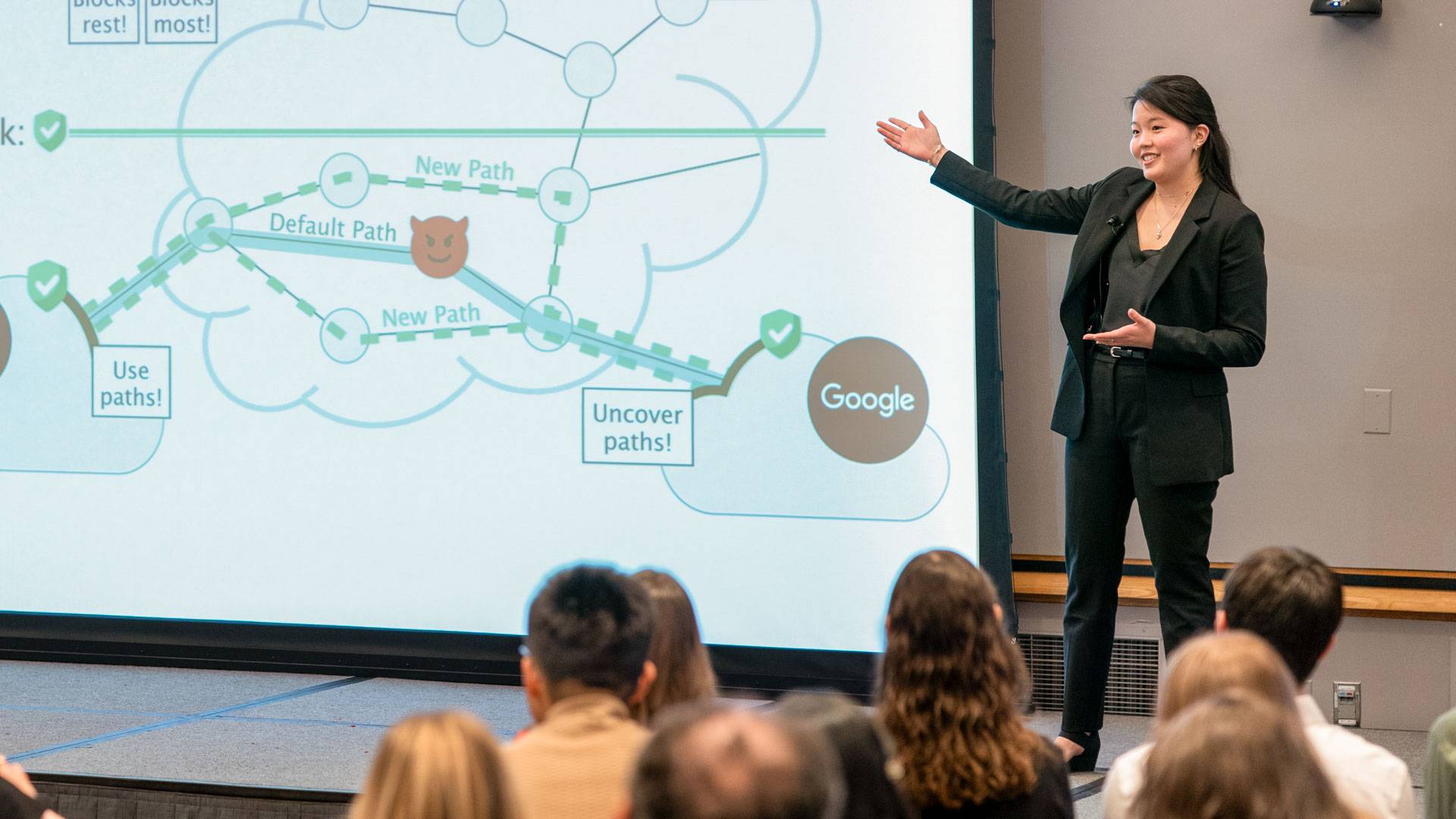
Sophia Yoo in electrical and computer engineering presents her Three Minute Thesis, “Cooperative Network Systems for Protecting Internet Users.” Yoo was one of 10 finalists competing in this spring's 3MT Final Showcase spotlighting Princeton graduate student research.
Take years of detailed, often technical academic research. Now, explain it to a general audience.
You have three minutes.
Ten Princeton graduate students arrived at Frist Campus Center on March 25 to meet that challenge in the Final Showcase round for Princeton’s first Three Minute Thesis (3MT) competition.
The students had boiled down their original scholarship to a three-minute talk, plus one static slide. They had survived an earlier round of close competition against dozens of other Princeton grad students. And now they were ready to be judged.
3MT is an international competition that originated at the University of Queensland in Australia and has since spread to universities around the world. The tightly defined rules challenge graduate students to present their research clearly and concisely, without jargon or multimedia elements.
The concept proved to be popular in its debut here. Fifty-two graduate students applied to compete. More than 200 students, faculty, administrators, alumni and community members attended to cheer on the 10 finalists — advanced doctoral students from nine different graduate programs:
- Edan Daniel-Hertz, neuroscience
- Alma Paola Hernandez Gonzalez, chemistry
- Hasan Hameed, history
- Katja Kochvar, ecology and evolutionary biology
- Caleb Lammers, astrophysical science
- Yubin Lin, electrical and computer engineering
- Erica Passoni, German
- David Shlivko, physics
- Hannah Wiswell, mechanical and aerospace engineering
- Sophia Yoo, electrical and computer engineering
Princeton Graduate School Dean Rodney Priestley welcomed the capacity crowd. “This inaugural event is taking place during a truly special year as we celebrate the 125th anniversary of the Graduate School,” he said. “Throughout this year, we have sought to deepen awareness of the transformational role the Graduate School has played in the lives of its students, in the growth and prestige of Princeton University, and through our remarkable alumni, in the world. Today's competition is very much in that same spirit.”
“I believe deeply that [one’s] work is not fully finished until it has been communicated,” he said. “The ability to convey complex, original ideas to a broad audience is not a peripheral skill; it is central to achieving the impact your research deserves.”
Priestley was one of three judges for the competition, along with Dean for Research Peter Schiffer and Sarah-Jane Leslie, Class of 1943 Professor of Philosophy and a former dean of the Graduate School. Eva Kubu, senior associate dean and director of professional development at the Graduate School, served as emcee.
Topics ranged from “Harnessing the Power of Bioelectricity in Wound Healing” and “The Early Modern German Quest for the Human” to “The Day the Universe Broke Gravity,” “How Visual Experiences Can Reshape Our Brains,” “Discovering Nearby Planets with the Gaia Space Telescope,” “Turning CO2 From Air Into Fuels for the Future” and “Cooperative Network Systems for Protecting Internet Users.”
The presenters were practiced and poised after attending preliminary training workshops in January and receiving individual coaching as they advanced, all hosted and organized by GradFUTURES, the professional development team at the Graduate School. Videos of the presentations are on the GradFUTURES YouTube channel.
The crowd listened attentively to each student and applauded enthusiastically after every presentation.
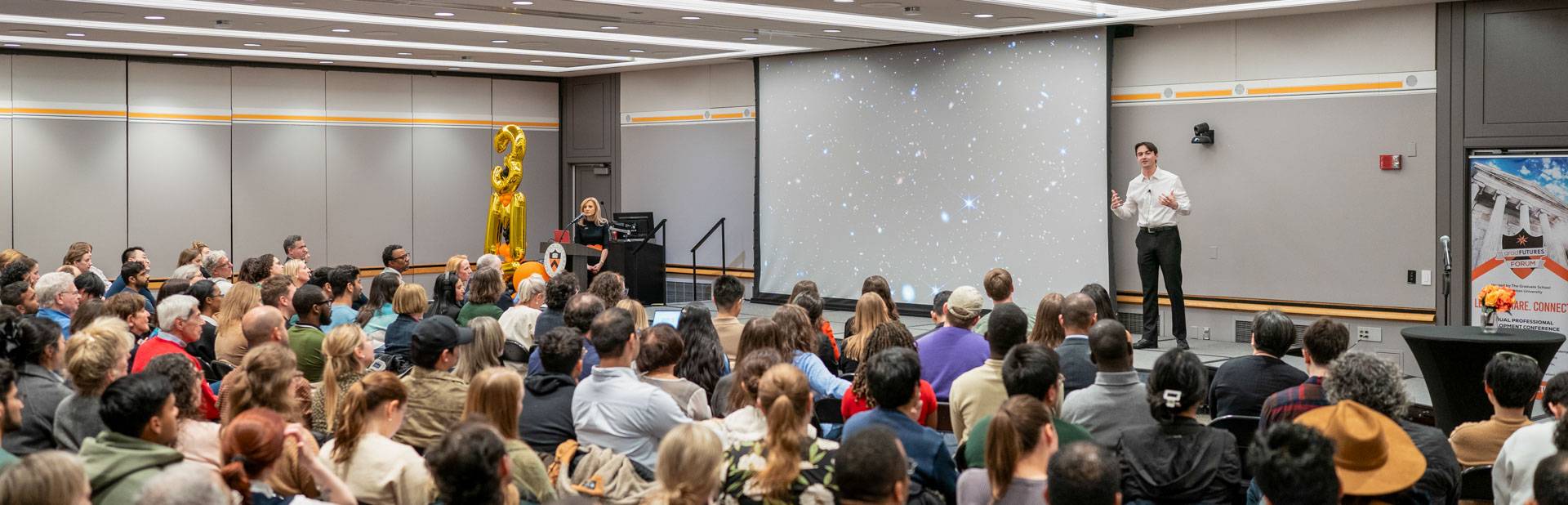
David Shlivko, in physics, presented his Three Minute Thesis, "The Day The Universe Broke Gravity: Shining Light on the Nature of Dark Energy," to a captivated capacity crowd.
When the 10 presentations concluded, the audience was asked to vote online for the People’s Choice award, and the judges went into a nearby room to select the winner and runner-up.
While the judges deliberated, three faculty members took the stage to demonstrate their own 3MT presentations. Sophie Gee, professor of English, presented on the value of uncertainty, deep reading and undisciplined knowledge in the humanities and beyond. Erika Milam, the Charles C. and Emily R. Gillispie Professor in the History of Science and a professor of history, spoke about the advantage of slow science. Daniel Cohen, associate professor of mechanical and aerospace engineering and bioengineering, presented on his team’s “shepherding living cells to better heal and grow.”
All three also spoke about the necessity for graduate students to talk about their sophisticated research in a compelling way — both to underscore for a general audience the impact and importance of that work, and to keep the big picture in mind when they hit rocky patches in the lab and the library. “Being able to tell your story, even to yourself, is valuable,” Cohen noted.
“In the public world, what’s at stake is understanding the purpose of universities, the richness of the knowledge that is being created in universities … and the nature of that knowledge,” Gee said.
We have a winner
When the judges re-emerged, Hannah Wiswell, a student in mechanical and aerospace Engineering, was named Princeton’s first 3MT winner for her presentation, “Avian-Inspired Engineering: Learning from Birds to Design Safer Aircraft for Humans.” Wiswell now advances to both the Northeast Regional 3MT competition on April 22 and the Ivy Plus competition, being hosted by Princeton on June 10. Both competitions will be virtual.
Katja Kochvar, from ecology and evolutionary biology, was recognized as runner-up for her presentation, “Hummingbirds Have Dialects Too.” (Wiswell would later remark it was “a good day for birds and bird-loving folk.”) Hasan Hameed, from the Department of History, was crowned the People’s Choice for his presentation, “The Ethics of Erotics: Beyond the Binary.”
Afterward, Wiswell gave credit to her adviser, Associate Professor Aimy Wissa, for always underscoring the necessity for scientists to communicate creatively and effectively about their work. “Trying to convey my thesis topic in an engaging way in three minutes or less seemed like the perfect opportunity to put her training to the test,” Wiswell said.
Kochvar thanked GradFUTURES for the workshops and the coaching, and for feedback on her presentation from the judges in the preliminaries. “All of that combined to really take it to the next level.”
Finalist Alma Paola Hernandez Gonzalez in chemistry, who gave the CO2 presentation, acknowledged that the competition had pushed her out of her comfort zone. “3MT forced me to think about my research from a different lens, what I want to achieve, and it honestly gave me new ideas.”
Beyond the skills developed by 3MT, the finalists said they enjoyed an afternoon set aside to celebrate graduate student research. Finalist Sophia Yoo in electrical and computer engineering, who gave the cooperative network systems presentation, was impressed by “the really amazing energy and excitement.” Yoo will receive her Ph.D. in electrical and computer engineering this spring and is taking a faculty position at Amherst College.
Finalist Erica Passoni, in German, who presented on the quest for the human, said she found it gratifying to answer questions posed by audience members. “People from all walks of life wanting to know more about my research reminded me that outside of the libraries and archives where I have spent much of the last year and a half, there is a whole world eager to engage with what we do at places like Princeton.”
The Princeton Three Minute Thesis is an initiative of the Princeton Graduate School, with support from Princeton Engineering, the Princeton Humanities Initiative and the Center on Science and Technology.
Kirstin Ohrt in Art & Archaeology, Wendy Plump in Chemistry, and Steven Schultz, Wright Seneres and Molly Sharlach in Engineering Communications contributed to this story.
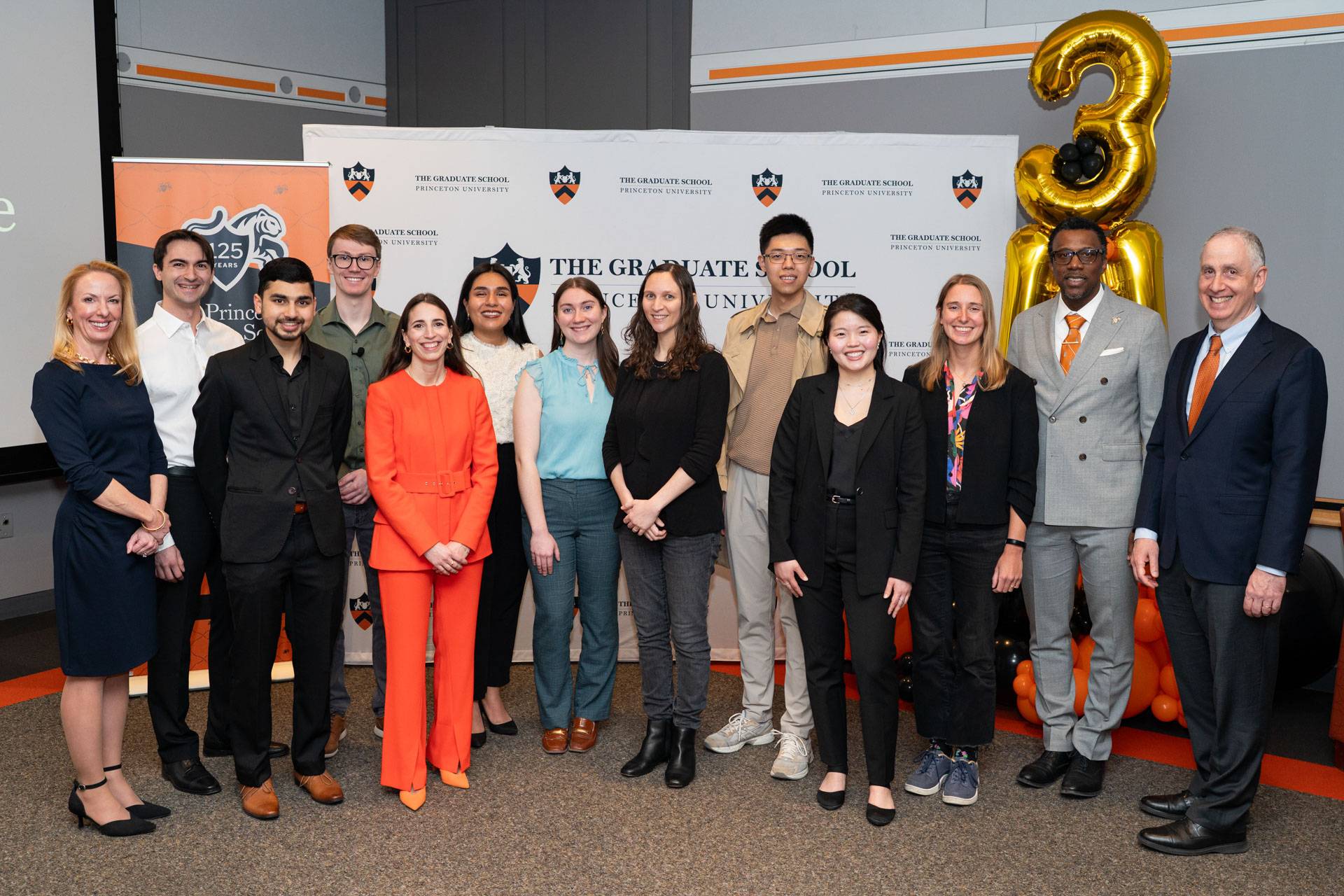
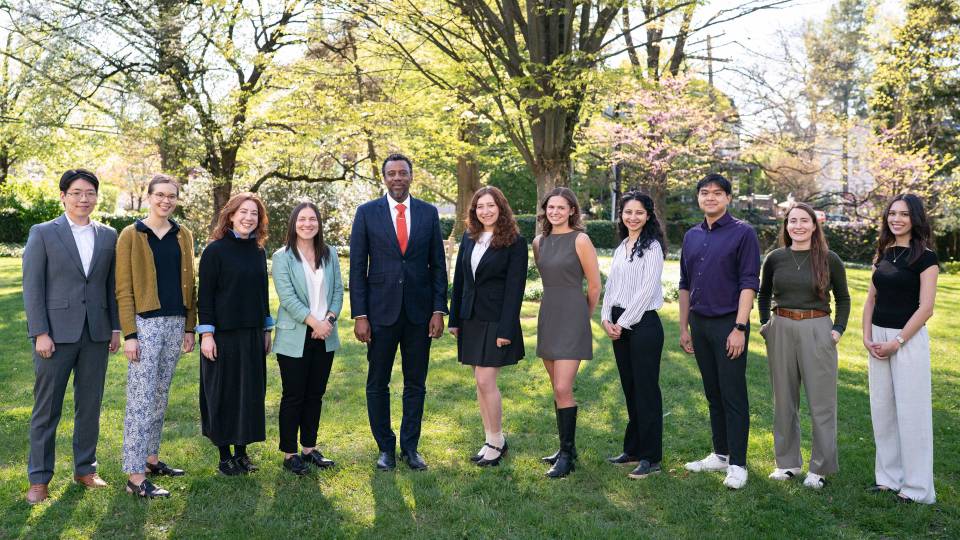
Graduate student presenters and judges gather before Princeton’s first Three Minute Thesis Final Showcase. (L-R), Professor Sarah-Jane Leslie, former dean of the Graduate School; David Shlivko; Hasan Hameed; Caleb Lammers; Erica Passoni; Alma Paola Hernandez Gonzalez; Hannah Wiswell: Edan Daniel-Hertz; Yubin Lin; Sophia Yoo; Katja Kochvar; Rodney Priestley, dean of the Graduate School; and Peter Schiffer, dean for research.