DOE and Princeton University extend, strengthen partnership
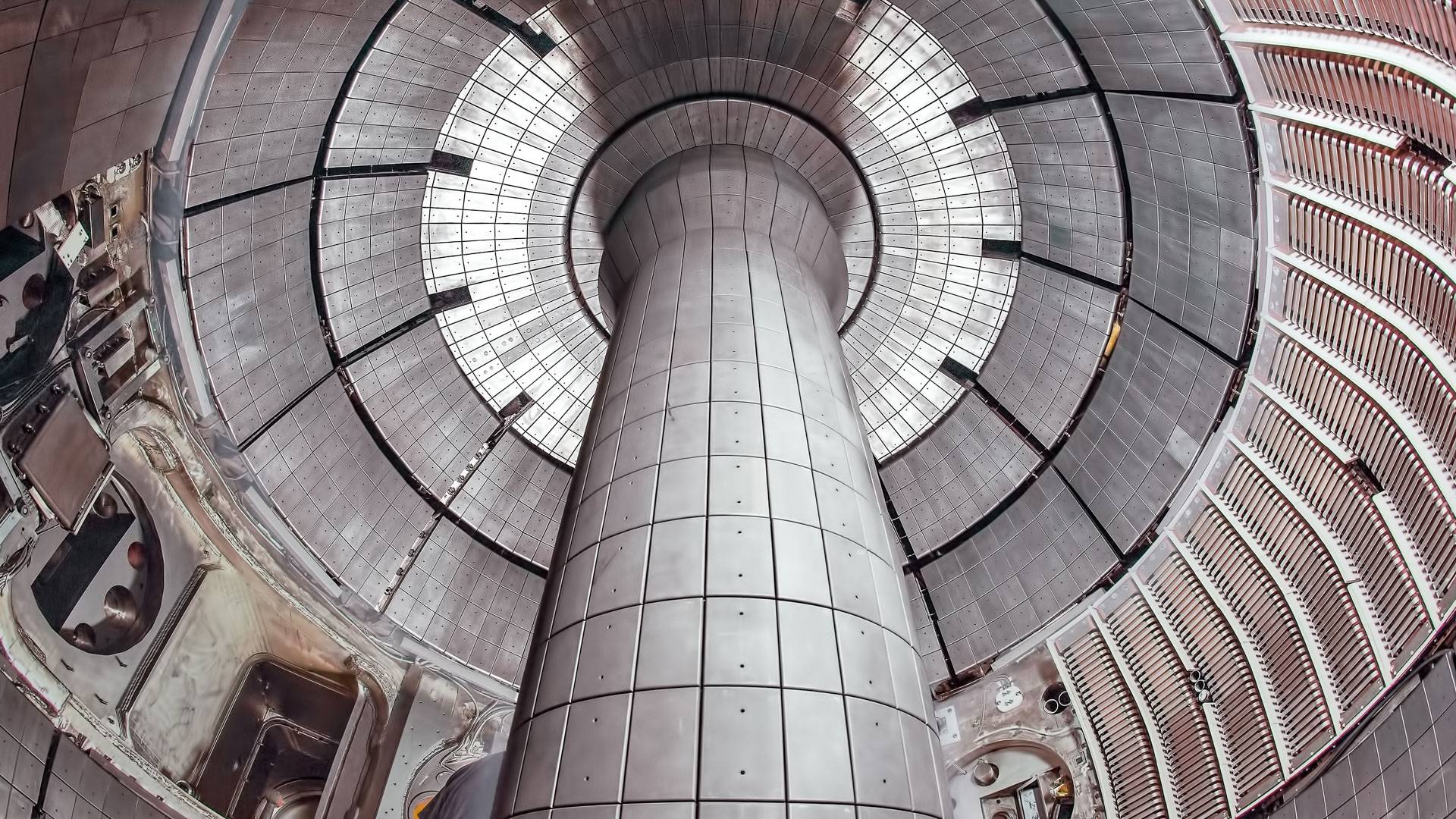
PPPL’s primary fusion experiment is the National Spherical Torus Experiment-Upgrade (NSTX-U), which is designed to be the world’s most powerful spherical tokamak.
The U.S. Department of Energy (DOE) and Princeton University have extended the contract for Princeton’s management and operation of the Princeton Plasma Physics Laboratory (PPPL), located on the University’s Forrestal Campus in Plainsboro, New Jersey.
“Princeton is proud to continue its longstanding partnership with the U.S. Department of Energy, building on a shared commitment to scientific excellence,” said Peter Schiffer, the University’s dean for research and vice president for PPPL. “PPPL is renowned for innovative and world-leading plasma research and advancing the science and engineering needed to realize fusion energy.”
“At PPPL, we have big ideas and do big science that reverberates around the world and through history,” said Steve Cowley, PPPL laboratory director. “We're excited to continue that tradition through our renewed partnership with Princeton University, enabling us to pursue groundbreaking science for years to come.”
PPPL’s historic focus on plasma and fusion research has recently expanded to include substantial research efforts in microelectronics, quantum computing and artificial intelligence. PPPL’s primary fusion experiment is the National Spherical Torus Experiment-Upgrade (NSTX-U), which is designed to be the world’s most powerful spherical tokamak. The Laboratory is also home to the Facility for Laboratory Reconnection Experiments, a national collaborative research facility studying magnetic reconnection.
Under the five-year contract extension, which commences April 1, 2027, the University expects to invest in increasing collaborations with Princeton faculty, exploring a next-generation facility for fusion energy research, and enhancing site infrastructure and safety for the next phase of operations.
PPPL partners with industry and research institutions to advance the development of fusion and plasma technologies. As one of the select participants in DOE’s Genesis Mission, the Laboratory pioneers artificial intelligence and high-performance computing to accelerate fusion research. It also collaborates with private companies through DOE’s Innovation Network for Fusion Energy (INFUSE) program, the Milestone-Based Fusion Development program and through other partnership channels. PPPL is also working with the New Jersey Economic Development Authority and venture capital firm SOSV to launch the NJ HAX Plasma Forge to accelerate plasma technology commercialization and start-up development in New Jersey.
Princeton has operated PPPL since the Laboratory’s inception in 1951, when it was called Project Matterhorn and under the leadership of founding Director Lyman Spitzer. PPPL is one of 10 National Laboratories stewarded by DOE’s Office of Science, and one of only 17 DOE laboratories nationwide. Together, these laboratories comprise a preeminent federal research system that provides the nation with strategic scientific and technological capabilities.