Jacobus Fellows: Decker, Geadah, Kapoor and Rozinov win Princeton’s top graduate student honor
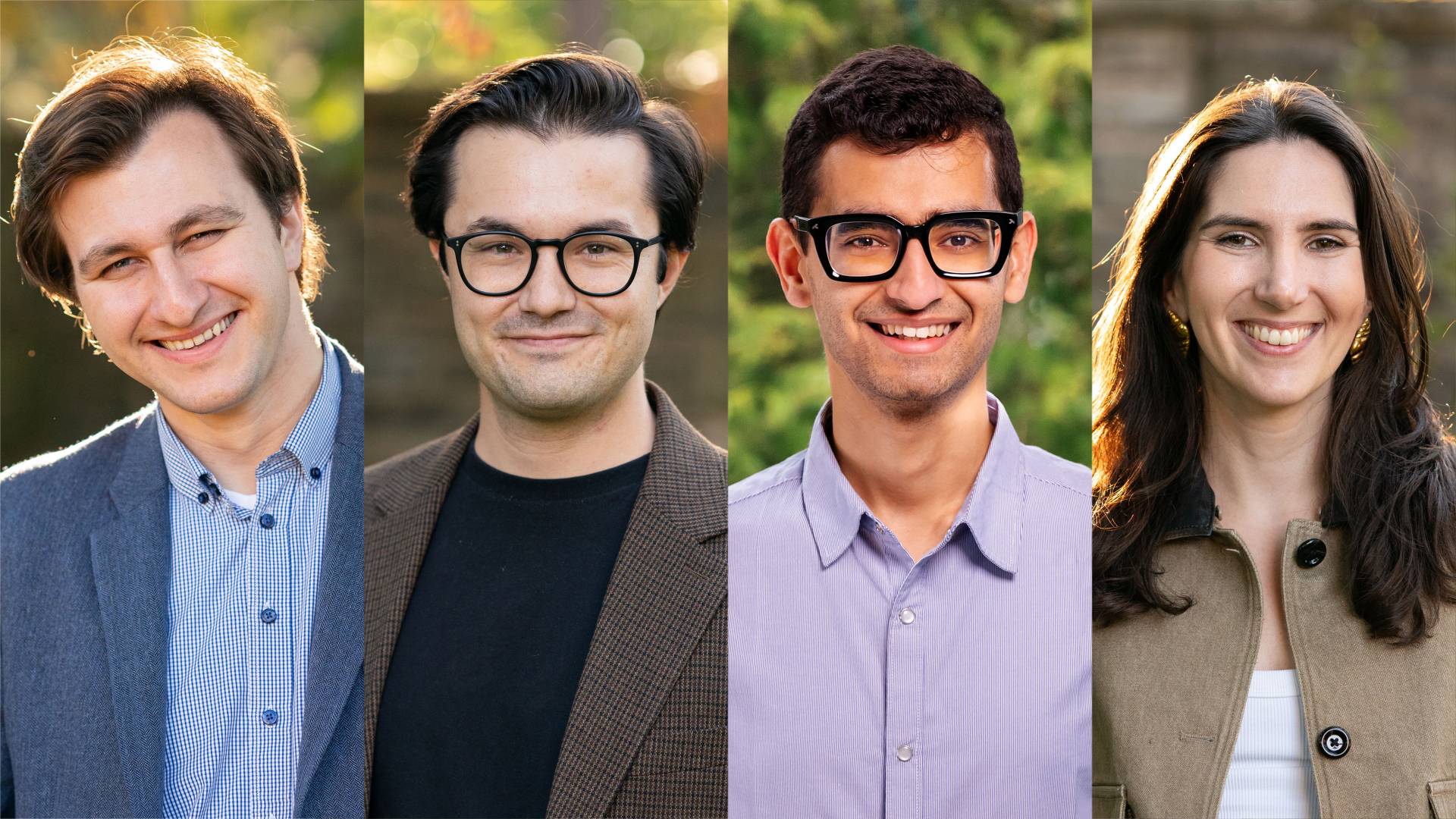
Philip Decker, Victor Geadah, Sayash Kapoor and Eliana Rozinov
Historian Philip Decker, mathematician Victor Geadah, computer scientist Sayash Kapoor, and literary scholar Eliana Rozinov are this year’s Porter Ogden Jacobus Fellows, Princeton’s top distinction for graduate students.
The Jacobus Fellows will be honored at Alumni Day ceremonies on Saturday, Feb. 21.
Established in 1905, just five years after the Graduate School was founded in 1900, the Jacobus fellowship is Princeton’s most prestigious fellowship. Jacobus Fellowships are awarded to one Ph.D. student in each of the four divisions — humanities, social sciences, natural sciences, and engineering — whose work demonstrates the highest scholarly excellence. The Jacobus Fellowship supports a student’s final year of study at Princeton.
“Throughout this 125th anniversary year of the Princeton Graduate School, we have been reflecting on the transformational impact of Princeton graduate education on our students, the University and the world,” said Rodney Priestley, dean of the Graduate School. “This year’s Jacobus Fellows exemplify that legacy. Their research topics range from how we can build trustworthy, accountable AI amid rapid adoption, to using mathematical modeling to examine how the brain makes decisions, to revisiting Freud through contemporary feminist insight, to illuminating a previously overlooked dimension of a pivotal moment in European history. What unites them is rigor, imagination and a commitment to scholarship with impact far beyond their fields."
Philip Decker
Decker, a sixth-year doctoral student in history, earned a bachelor of arts in history from Swarthmore College and an MPhil in International Relations from the University of Oxford.
His dissertation, “The Molotov-Ribbentrop Pact: A Cultural and Diplomatic History,” explores Nazi-Soviet relations before and after these states signed an infamous nonaggression treaty on Aug. 23, 1939. “The way this relationship is usually studied, it’s all about power: tanks, planes, oil, steel,” Decker said. “But, if you look for it, a cultural affinity is still there just beneath the surface.”
According to his dissertation adviser Yair Mintzker, professor of history, “One of the most remarkable things about Philip as a researcher, thinker, and historian is his pure archival skill.” Decker pored over thousands of diplomatic telegrams sent between Berlin and Moscow. He spent months traveling by train to archives across Germany, sifting through letters, newspapers, concert programs, forgotten plays, trade statistics, exhibition plans, and more. “It’s an extremely labor-intensive process,” Decker said. “But the spark of finding that one gem after hours bent over a box of old papers, that is what historians live for.”
Decker uncovered a wealth of documented instances of cultural exchange between the two regimes during the Molotov-Ribbentrop period (1939-41), including the swapping of musical repertoires, film screenings, tourism, Soviet participation in German trade fairs, and professional contact in fields ranging from horticulture to dentistry. It’s rare for an early-career researcher to say something new about one of the most heavily studied topics in history, but that is exactly what makes Decker’s work stand out. Mintzker still remembers the reaction when Decker presented his findings to a room full of historians for the first time: “Jaws literally dropped.”
“After Philip’s work, we will not think about those two crucial years in European history in the same way,” Mintzker said. “It is a truly pathbreaking work of scholarship — he opens a window into an incredibly rich world of cultural exchange between the two dictatorships.”
Decker has published five peer-reviewed journal articles and presented his work at more than 50 conferences around the world. At Princeton, he was a Centennial Fellow from 2020 to 2025 and taught as a preceptor for courses on modern Europe, Western warfare, 20th century Japan and the history of international order.
Decker’s scholarly work has been supported by grants from the German Academic Exchange Service (DAAD), University of Oxford, Central European History Society, Phi Beta Kappa, German History Society, Princeton Judaic Studies, and the Princeton Institute for International and Regional Studies (PIIRS). He is the recipient of the Hugdahl Memorial Award from New German Critique and the Susan Landau-Chark Award from the Canadian Society for Jewish Studies.
Victor Geadah
What is going on inside the brain when we learn something new? Geadah, a fifth-year Ph.D. student in applied and computational mathematics, is building statistical methods to provide more nuanced answers.
Before coming to Princeton, he completed Part III (master’s level) in applied mathematics from the University of Cambridge and a bachelor of science in pure and applied mathematics from the Université de Montréal.
In his dissertation, “Statistical Inference of Normative Processes in Neuroscientific Data,” Geadah develops statistical methods that offer individual single-trial insights into behavior and neural systems. “This work has profound ramifications both in neural interfaces and for psychiatric disorders, where behavior that appears non-neurotypical may actually arise from different internal processes and goals,” he said. “I try to build methods that not only describe what we observe, but go a step further to give us insight into the why.”
Rather than treating irregularities in neuroscientific data as noise to be removed, Geadah is creating mathematical models that help neuroscientists learn from those complexities — and then using those tools to make new discoveries about how the brain works. “It’s really rare to be able to do both of those things,” said his dissertation adviser Jonathan Pillow, a professor of Princeton Neuroscience Institute. “He’s unique in both his mathematical and theoretical rigor and his devotion to solving real-world problems.”
At Princeton, Geadah has gravitated toward applied, interdisciplinary work. “I think theory and experimental collaborations are the way forward in neuroscience, and I’ve been fortunate to be surrounded by people with incredible skills that are often different from mine,” he said.
An exceptionally industrious researcher, he has published seven papers (with five as first author) in the past two years. His work has appeared in international journals of engineering, control theory, computer science, machine learning, and neuroscience. “Part of what’s special about Victor is that he’s not narrowly attacking one small problem,” Pillow said. “He has such a wide-ranging intellect that his research spans a variety of different fields.”
Geadah is also a highly sought-after collaborator. “He’s often the go-to person when someone has a new idea,” Pillow said. “He’s so smart and creative that he reflects ideas back in a way that makes them stronger, and he’s incredibly fun to work with.”
These collaborations extend beyond academia through Geadah’s work at Meta CTRL-Labs and the Flatiron Institute in New York, where he explored how his methods could apply to decision-making behavior.
Sayash Kapoor
A computer scientist by training, Kapoor worked as a software engineer at Facebook before coming to Princeton in 2021. He’s a fifth-year Ph.D. candidate in computer science at Princeton’s Center for Information Technology Policy, and he earned his bachelor of technology in computer science from the Indian Institute of Technology Kanpur.
The core of Kapoor’s dissertation, “AI’s Impact on Science and Society,” is improving rigor in evaluations of artificial intelligence. “Imagine a world where cars were only tested by their manufacturers. That’s the world we’re in today with AI — it’s primarily AI developers that grade their own homework,” said his adviser Arvind Narayanan, professor of computer science. “Sayash is one of the leading people in the world trying to change that. He’s developing the science of AI evaluation.”
Kapoor’s work has revealed that in the rush to adopt AI and machine learning, many researchers are using these tools erroneously in their scholarly papers. The errors can be extremely subtle — in one case, he found a mistake in a single parameter in 10,000 lines of code. Yet the consequences can be devastating.
“Unfortunately, it’s leading to a false scientific consensus across different fields, from political science to medicine,” Kapoor said. “In some cases, the majority of papers that had adopted AI and machine learning were actually flawed.” He found similar problems in real-world deployment of AI systems. “In tools ranging from education to criminal justice to finance to hiring algorithms, these errors remained pervasive, and these failures could influence a person’s entire life trajectory,” Kapoor said.
To address this, Kapoor has brought together scientists from many disciplines to improve best practices for using AI in research. He is also building a framework that third parties can use to evaluate new claims about AI agents in ways that are transparent, scientifically rigorous, and inform public debate on these topics. “The work I do is driven by the belief that the public can and should have a voice in how these tools are deployed,” Kapoor said.
He is also moving the needle on public policy in AI, engaging with policymakers through public testimonies, offering feedback on draft legislation, and providing neutral, nonpartisan, technical expertise that’s often missing from conversations about AI. “His work is, in many cases, essential reading for policymakers on the topic of AI,” Narayanan said.
Kapoor is a senior fellow at Mozilla and was a Laurance S. Rockefeller Fellow in the Princeton University Center for Human Values. Named one of TIME’s 100 most influential people in AI, he has been cited over 3,000 times, and is coauthor, with Narayanan, of “AI Snake Oil,” one of Nature’s 10 best books of 2024.
Eliana Rozinov
A sixth-year doctoral student in the Department of English and the Program in Gender and Sexuality Studies, Rozinov came to Princeton after earning a bachelor of arts in comparative literature and English from Cornell University.
Her dissertation, “Riddles of Women: Mythical, Modernist, Freudian,” returns to the question that haunted Sigmund Freud for three decades: What does a woman want? Rather than endorsing Freud’s claim that women are “riddles,” Rozinov said that “women themselves are essential for deciphering enigmas of the psyche that Freud’s research left unanswered.” Her project engages modernist works by E.M. Forster, Katherine Mansfield, and H.D., which invoke and reimagine myths of Echo, Eve, and Athena, as fundamental to Freud’s understanding of sexual difference.
One of Rozinov’s dissertation advisers, Anne Cheng ’85, the Louis W. Fairchild Class of ’24 Professor of English, praises her creative and idiosyncratic approach. “Eliana’s work is really original not only in the ways in which it engages with Freudian theories, but also in how it brings contemporary feminist issues into dialogue with those theories,” Cheng said.
Although Freud is infamously known for the Oedipus complex, the first literary text to which he devoted a comprehensive study was actually about a woman: Gradiva. “The essay itself is the only time we see Freud engaging so closely with literature,” Rozinov said. “So I’m taking that quite seriously — that [Wilhelm Jensen’s “Gradiva”] is the text we need to be considering.”
A Roman bas-relief of a woman in mid-stride who turns out to be alive, Gradiva becomes a central figure in Rozinov’s dissertation. “Gradiva is really a mythical figure, a modernist figure, and a Freudian figure all at once,” she said. “We think we know what she is, but we don’t actually know, and that could be said of so many women and “gendered” and “raced” figures today.”
Following Gradiva as she traverses modernist, mythical and Freudian realms, Rozinov weaves a throughline between psychoanalytic theory, literature, and the works of contemporary feminist and queer theorists. “My goal is to show that these questions of identity that define our present were already being asked so many years ago; and that it is generative to look at the intersections between the two,” she said.
At Princeton, Rozinov has taught several courses in literary history and theory, including a seminar titled “A New Eve: Women, Myth, and Power” that she co-designed with another one of her dissertation advisers, Maria DiBattista, professor of English and comparative literature. In addition to being a serious scholar, “She’s a very animated, dynamic, fun person, and I think this is what makes her a good teacher, especially with undergraduates, because she really engages their minds,” Cheng said.
Rozinov received Princeton’s Brian Abel Ragen ’87 Graduate Fellowship in 2021-22. Beyond academia, she has published widely on women figures in film and popular culture.
Tracy Meyer at the Princeton Graduate School contributed to this story.
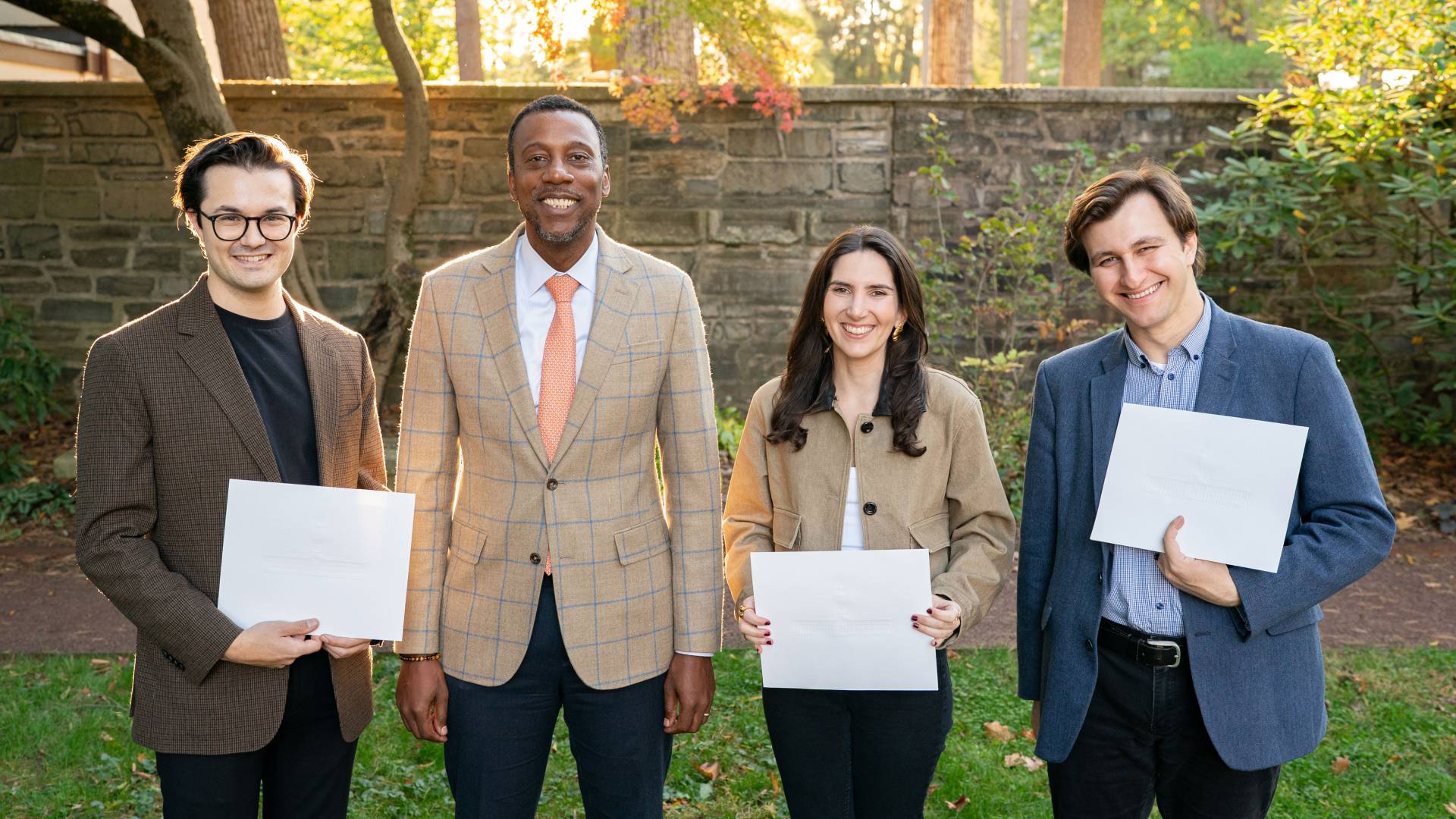
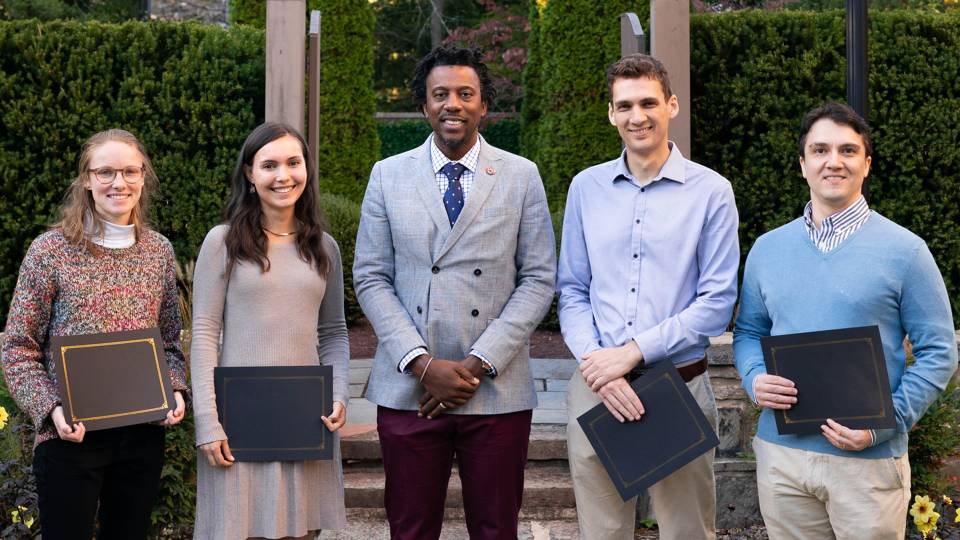
Graduate School Dean Rodney Priestley (second from left) with Jacobus Fellows (left to right) Victor Geadah, Eliana Rozinov and Philip Decker.