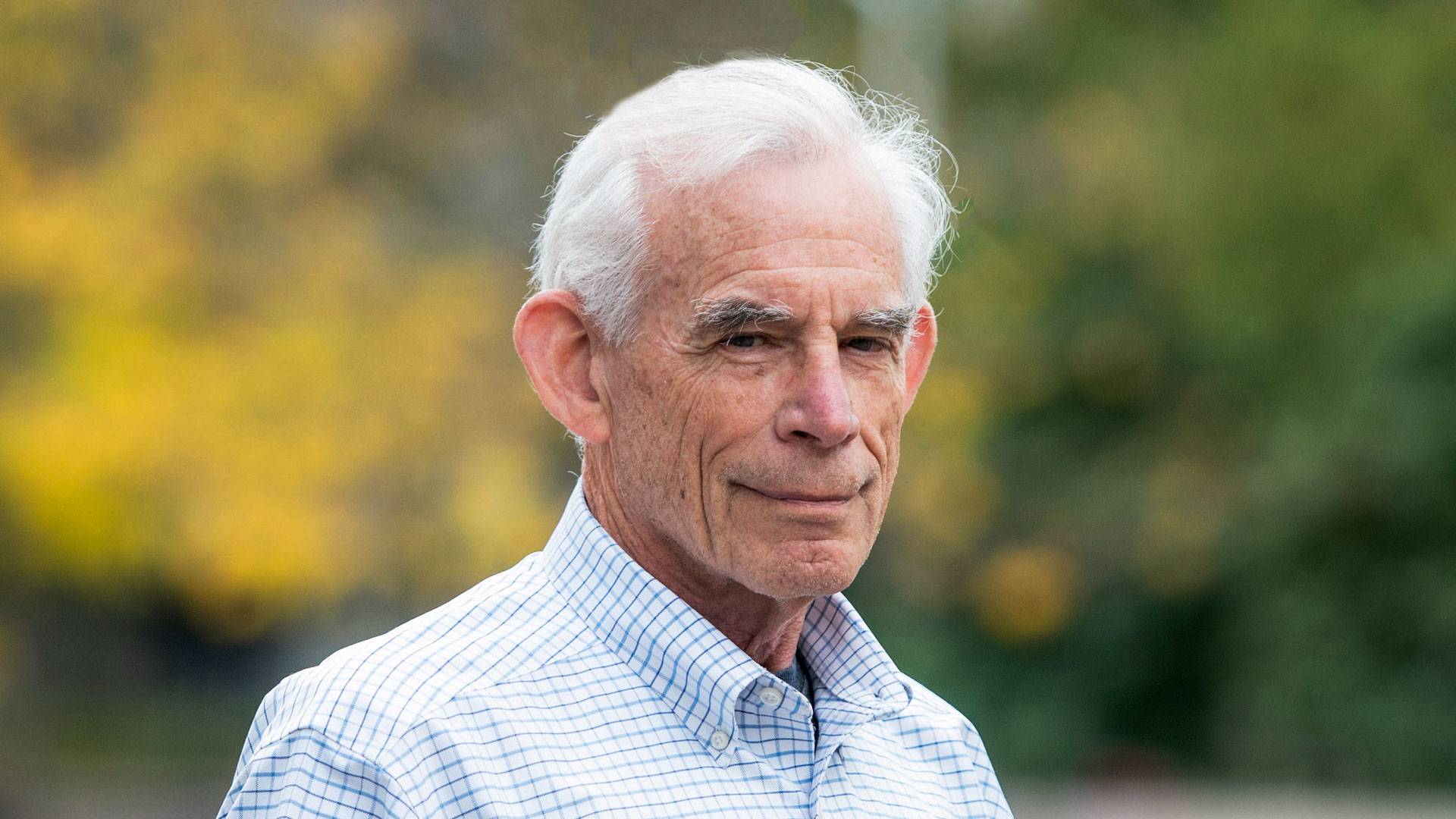
Christopher Sims, revolutionary macroeconomist, Nobel laureate and generous mentor, dies at 83
Christopher Sims
Christopher Sims, the John J. F. Sherrerd ’52 University Professor of Economics, Emeritus, and a Nobel laureate whose work transformed how central banks and government leaders understand the economy, died on March 14. He was 83.
Sims joined Princeton’s faculty in 1999, following appointments at Harvard University, the University of Minnesota and Yale University, and transferred to emeritus status in 2021. Sims, along with New York University’s Thomas Sargent, won the 2011 Nobel Prize in economics for their “empirical research on cause and effect in the macroeconomy.” The tools each developed became essential to economists around the world.
“Christopher Sims was a pioneer of macroeconomics and his scholarship helped revolutionize both his field and real-world policymaking,” President Christopher L. Eisgruber said. “He was also a devoted professor and generous adviser, famously teaching an undergraduate precept at Princeton just hours after winning the Nobel Prize.”
Sims is credited with transforming macroeconomics by developing the structural vector autoregression (SVAR) framework, a data-driven model for predicting the evolving dynamics of economic variables, like inflation, in relation to each other and over time.
“As an economist, he was an absolute superstar,” said Alan Blinder, the Gordon S. Rentschler Memorial Professor of Economics and Public Affairs.
Markus Brunnermeier, the Edwards S. Sanford Professor of Economics and director of the Bendheim Center for Finance, started at Princeton the same year as Sims and the two became close friends in the two decades that followed.
He described Sims as “a giant of macroeconomics” but an equally kind, humble person. A self-described “iconoclast,” according to Brunnermeier, Sims’ nontraditional approach to economics often incorporated his first love of statistics and seamlessly combined data with theory.
“Over many long conversations … you came to realize that, and as many others eventually did, that Chris was ultimately always right. He had a much deeper way to penetrate problems and see it at a much deeper level than many, many others,” Brunnermeier said.
Wolfgang Pesendorfer, the Theodore A. Wells ’29 Professor of Economics and chair of the Department of Economics, described Sims as a “wonderful colleague and an exceptionally dedicated adviser and mentor to his students.”
“He treated students as peers, never compromising on intellectual depth, and inspired tremendous enthusiasm for research in all who interacted with him,” Pesendorfer said.
At Princeton, Sims was named the Harold H. Helm ’20 Professor of Economics and Banking in 2004 and the John J. F. Sherrerd ’52 University Professor of Economics in 2012. He served twice as director of graduate studies for the Department of Economics and co-directed the Griswold Center for Economic Policy Studies from 2014 to 2021, where he remained on its faculty steering committee until 2024. Sims was also a faculty affiliate of the Bendheim Center for Finance and the Julis-Rabinowitz Center for Public Policy and Finance.
A pioneering economist
In awarding the 2011 Sveriges Riksbank Prize in Economic Sciences, the Nobel Foundation cited Sims and Sargent for their independent but complementary work. Using historical data about economic events, Sargent and Sims each helped to develop and critique models that analyzed the cause and effects of monetary policy. At the time, Sargent was a visiting professor at Princeton and the two were co-teaching a graduate course, which they held in addition to their respective morning classes just hours after the Nobel announcement.
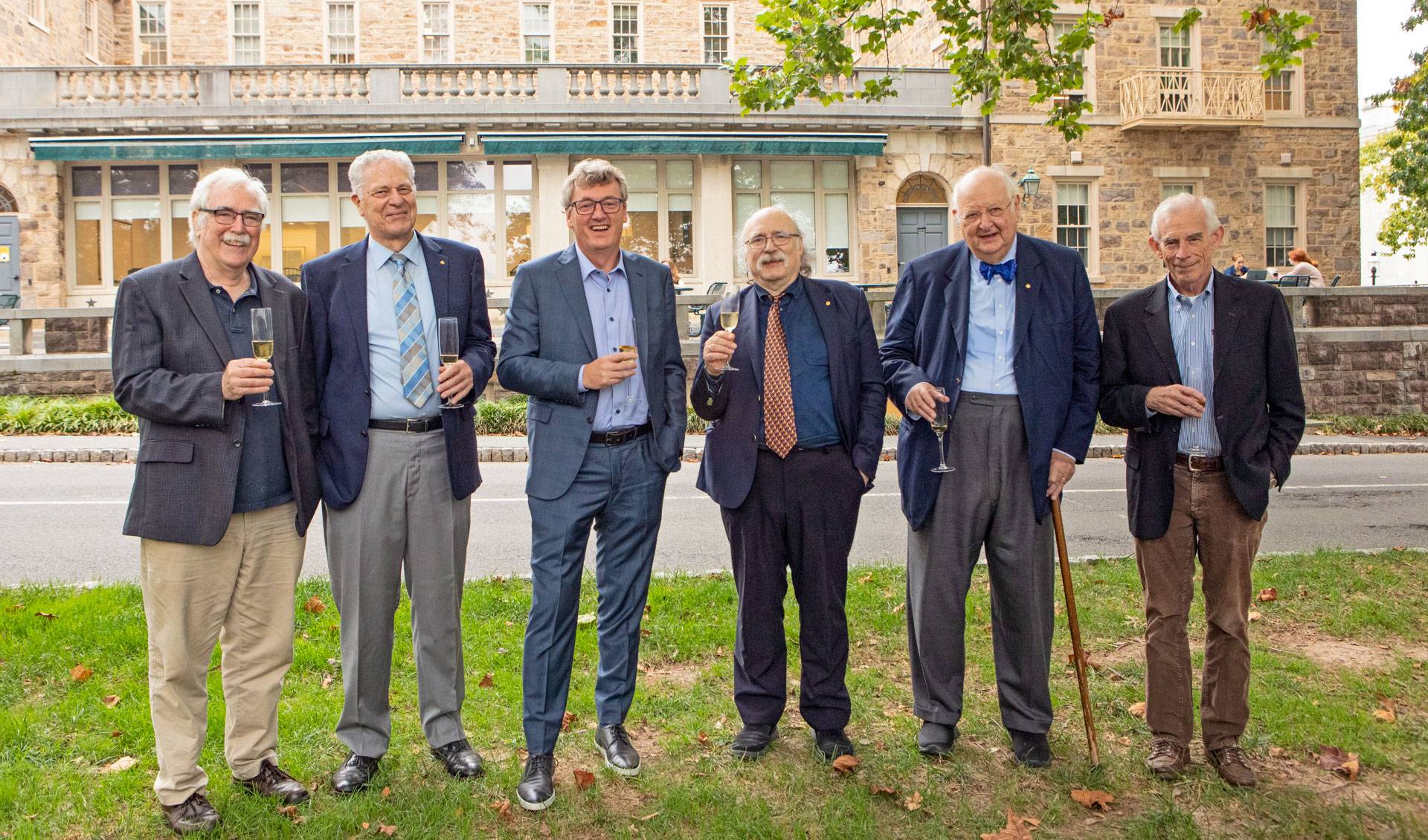
Sims (far right) with other Princeton Nobel laureates at a 2021 reception on campus. From left to right: Eric Wieschaus, the Squibb Professor in Molecular Biology and professor of the Lewis-Sigler Institute for Integrative Genomics, Emeritus; Joseph Taylor, the James S. McDonnell Distinguished University Professor of Physics, Emeritus; Dave MacMillan, the James S. McDonnell Distinguished University Professor of Chemistry; F. Duncan Haldane, the Sherman Fairchild University Professor of Physics; Sir Angus Deaton, the Dwight D. Eisenhower Professor of International Affairs, Emeritus, and professor of economics and international affairs, emeritus.
Sims is also recognized for his foundational work on the fiscal theory of the price level, which measures interactions between monetary and fiscal policy, as well as other research interests in time series econometrics, information theory and rational inattention in decision-making.
His best-known paper, “Macroeconomics and Reality,” was published in Econometrica in 1980 and introduced SVARs to combat the use of assumptions in existing economic models. It was around this time that Mark Watson, the Howard Harrison and Gabrielle Snyder Beck Professor of Economics and Public Affairs, first met Sims.
“He was 10 years my senior and already a star in economics. I was lucky to be able to work with him in the late 1980s and got to experience his amazing insights firsthand,” Watson said, adding the two later became Princeton colleagues. “He was both brilliant and down to earth, a tough critic who was always supportive, a wonderful adviser for our Ph.D. students, and a valuable mentor for junior (and senior) faculty.”
Giorgio Primiceri, a professor of economics at Northwestern University who earned his Ph.D. at Princeton in 2004, said he thought of Sims “as a sort of professional father.”
“Many years ago, in the acknowledgments of my dissertation, I wrote that ‘I really hope that his intellectual imprint will have a lasting impact on my work,’ and that ‘the interaction with Chris Sims will surely remain one of the best experiences of my professional life.’ Today, I — and I believe many of his students — still feel exactly the same way,” Primiceri said.
Blinder said other economists often turned to Sims for insight. While the two never formally collaborated on research, they had a shared interest in monetary policy. “If I got puzzled over something technical, Chris could always explain it to me and to others,” Blinder said. “He was very generous of his time. Everybody around here knew that when it came to econometrics, he was virtually without peer.”
Nobuhiro Kiyotaki, the Harold H. Helm ’20 Professor of Economics and Banking and professor of economics, said that Sims drew him to the University from his position at the London School of Economics and served as “a guidepost” for his own career.
“His style of economics is not the same as mine, but I understand and we respect each other’s style, and he was definitely one of the most important colleagues at Princeton,” Kiyotaki said.
Sargent, the William R. Berkley Professor of Economics and Business at New York University, remembered earlier in his career when he called Sims, already a towering figure on the faculty at Harvard, about confusing results he had found in his own research.
“I didn't know what I was talking about, but Chris was the kind of person you didn't have to know what you’re talking about. He would see virtue in what you said,” Sargent said. “I regard myself as a student of his.”
‘The definition of kind and graceful mentorship’
Throughout his teaching career, Sims’ status as a giant in his field did not deter him from serving as a mentor for countless undergraduate and graduate students, many of whom became his collaborators and leading economists in academia and policymaking across the globe.
“I don't think he ever saw a student that he didn't think was terrific,” said his wife, Cathie Sims.
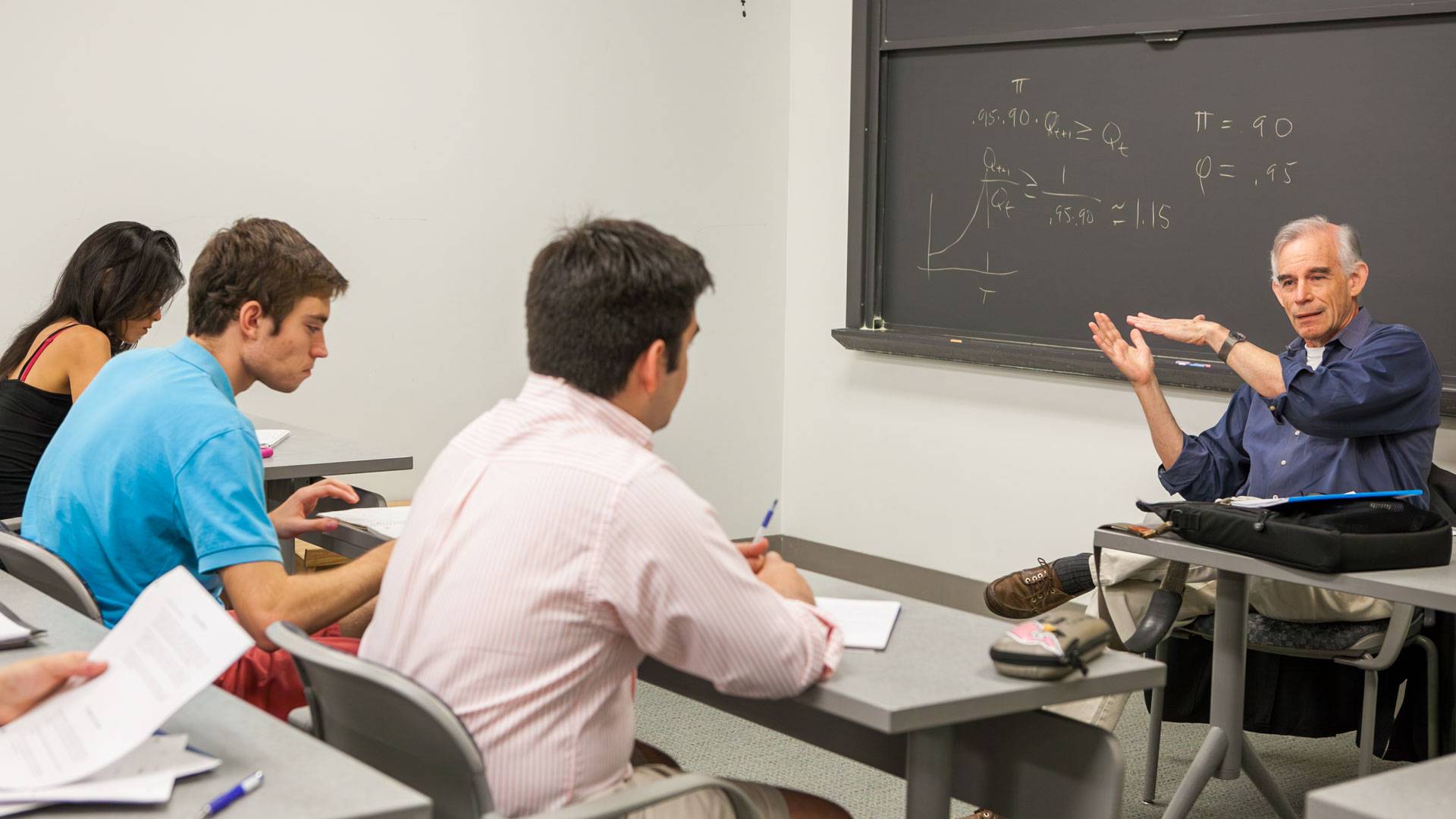
Sims, the John J. F. Sherrerd ’52 University Professor of Economics, Emeritus, taught a class in 2011 right after being awarded the Nobel Prize in economics.
“Chris was the definition of kind and graceful mentorship. He was and continues to be a really inspirational figure in my academic career,” said Karthik Sastry, an assistant professor of economics and public affairs who joined the faculty in 2023 after earning his undergraduate degree from Princeton in 2016.
Sastry took Sims’ “Econometrics: A Mathematical Approach” class in sophomore year and worked with him as a research intern and again for his senior thesis. He said being able to work closely with a Nobel-winning professor as an undergraduate was a special experience that only happens at places like Princeton.
Once Sastry joined the faculty, he and Sims presented their research to each other at the department’s internal workshops, now as colleagues. “The dynamic didn’t change, in a certain way, because he’s someone I knew I could turn to for scrutiny with really serious standards for perfection,” Sastry said. “But he always translated those standards to advice in a really encouraging and down-to-earth way.”
Gauti Eggertsson, now the Dupee Family Professor of Economics at Brown University, received his Ph.D. from Princeton in 2004 and recalled when Sims first came to campus in 1999 "as though a new force had arrived with the gravitational pull of the sun" and an open office door.
"I saw Chris as my ultimate role model,” Eggertsson said. “What Chris embodied to me was something rare: the pure intellectual — not the fame, not the status, but that fire. The excitement like that of a first-year graduate student about ideas, maintained perfectly intact into the most distinguished career in the field. That excitement burned hot all his life and showed no sign of cooling off.”
Among his many honors and awards, Sims was a fellow of the Econometric Society and a member of the American Academy of Arts and Sciences, the National Academy of Sciences and the American Philosophical Society. He held leadership roles as president of the Econometric Society in 1995 and the American Economic Association in 2012.
Sims was a resident scholar at the Federal Reserve Bank of New York from 2012 to 2013 and a visiting scholar at the International Monetary Fund in 2003, as well as at the Federal Reserve Banks of Philadelphia, New York and Atlanta. He also served on the editorial boards of numerous academic journals and was a member of various national scientific committees.
In 2013, he received an honorary degree from the University of Minnesota for his pioneering contributions to macroeconomics.
Sims was born in Washington, D.C., in 1942, to Albert and Ruth Sims. He grew up there and in Germany because of his father’s diplomatic career, as well as in Virginia and Connecticut.
He earned both his B.A. in mathematics in 1963 and his Ph.D. in economics in 1968 from Harvard University. He started his Ph.D. studies at the University of California-Berkeley and returned to Harvard, where he also began his academic career in 1967. He taught at the University of Minnesota for two decades. Before being appointed a professor at Princeton, Sims was the Henry Ford II Professor of Economics at Yale University from 1990 to 1999.
Sims is survived by his wife, Cathie Sears Sims; two daughters, Jody Nelson and Nancy Sims; a son, Benjamin Sims; a daughter-in-law, Katherine Prestridge; four grandchildren, Sophie Sims, Nathan Sims, Natalie Nelson, and Benjamin Nelson; a sister, Jennifer Sims; and a brother, William Sims. He is predeceased by a sister, Jody Sims Lawrence.
Donations in Sims’ honor may be made to the national and local affiliates of the American Civil Liberties Union (ACLU), the ACLU of Minnesota, and/or the Electronic Frontier Foundation.


