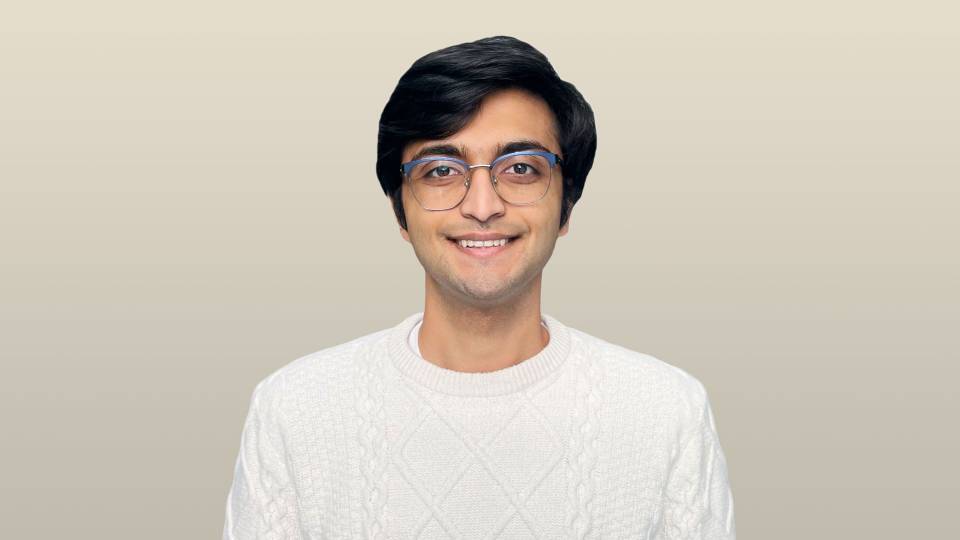
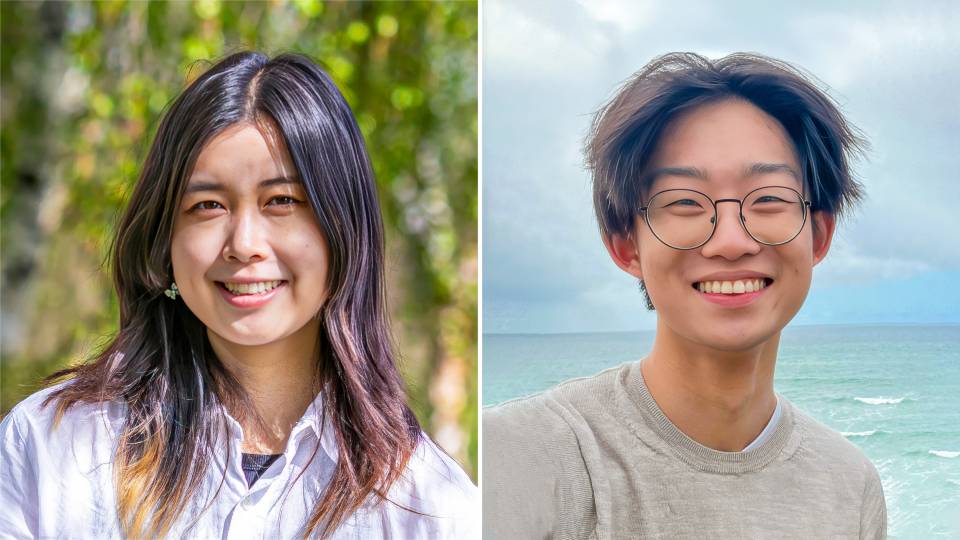
The Hertz Foundation announced that four Princetonians are among the 19 fellowship recipients in its 2026 cohort of Hertz Fellows: Tyler Hou, an incoming graduate student in computer science; Elizabeth Kozlov, a current graduate student in astrophysics; Zachary Siegel of the Class of 2025, now a graduate student in computer science at MIT; and Zain Zaidi, a current Princeton graduate student in theoretical and computational chemistry.
The competitive Hertz Fellowship provides up to five years of financial support for doctoral studies in the applied sciences, engineering and mathematics, including full tuition and an annual stipend, along with membership in a community of scientists and engineers working across disciplines.
"The strength of the Hertz Fellowship has always been its commitment to the long view — supporting fellows not just through graduate school but throughout their lives,” said Wendy Connors, president of the Hertz Foundation, in the fellowship announcement. “The 2026 class joins a community that spans generations and disciplines, and we are committed to their success.”
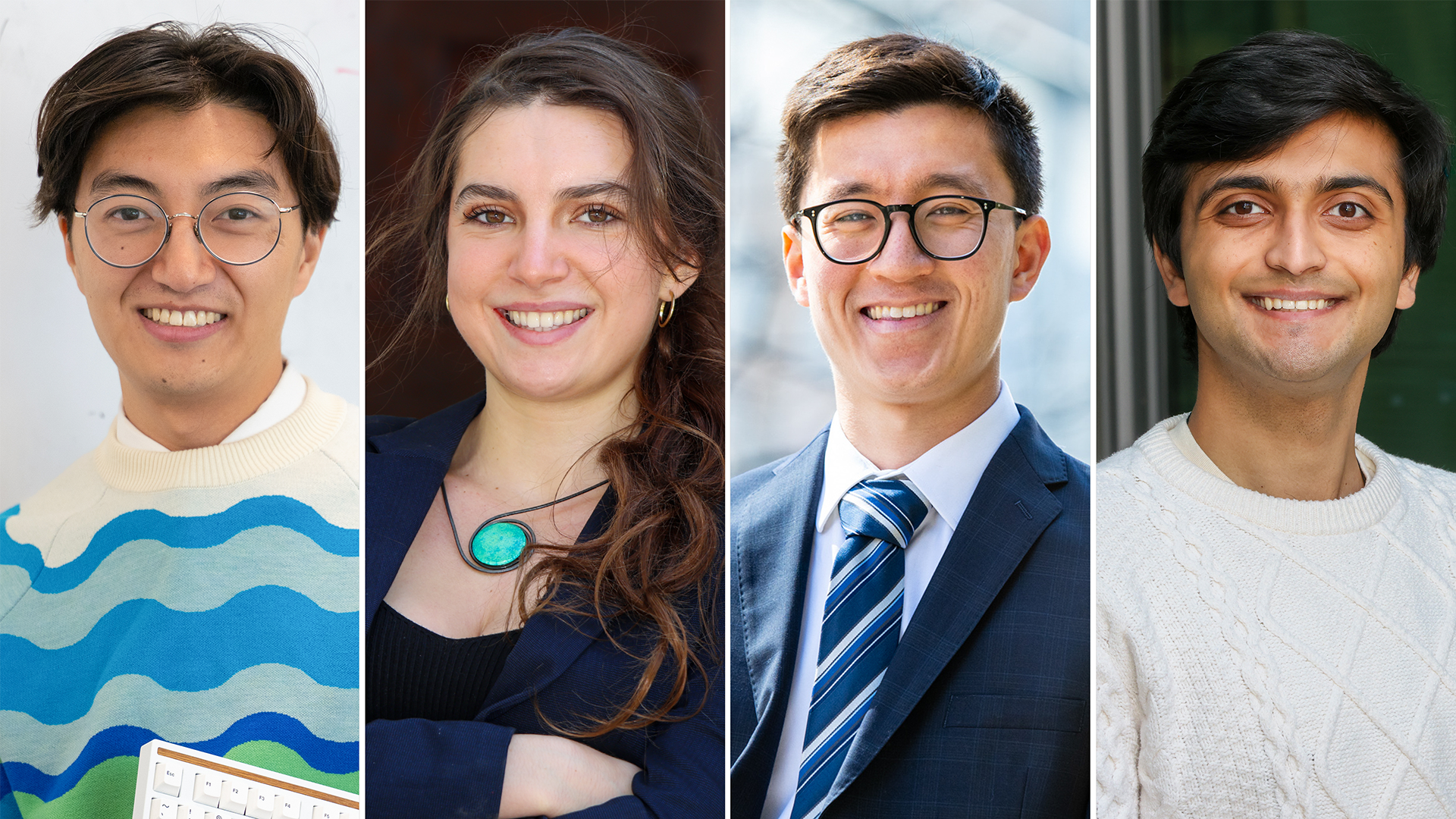
Tyler Hou, Elizabeth Kozlov, Zachary Siegel and Zain Zaidi
Tyler Hou
Hou, an undergraduate in mathematics and computer science at the University of California-Berkeley, applies logic and algebra to improve programming languages and distributed systems. He will begin doctoral studies at Princeton in the Department of Computer Science this fall.
After graduating from Phillips Exeter Academy, Hou worked on the search performance team at Google. He has also been a teaching assistant and volunteer at JamCoders, a free summer programming camp in Kingston, Jamaica, for high school students.
Elizabeth Kozlov
Kozlov, a first-year graduate student in astrophysics, studies the geometry of spacetime. Her research focuses on black holes, including investigating primordial black holes as relics of the early universe.
Her previous honors include Princeton’s Centennial Fellowship in the Natural Sciences and Engineering, and Harvard’s Carol Davis Prize, Herchel Smith Fellowship and Certificate of Distinction in Teaching. She has presented her research at a conference in Tokyo as well as locally.
Zachary Siegel
Siegel, of Princeton’s Class of 2025, is a graduate student in the Computer Science and Artificial Intelligence Laboratory at the Massachusetts Institute of Technology, where he works on robotics and cognitive science, including artificial intelligence.
At MIT, Siegel is working to design robotic systems that can learn from limited data and combine skills in new ways to solve new problems. At Princeton, he completed a B.S.E. in computer science and earned a certificate in philosophy. His college honors included Tau Beta Pi (the engineering honors society), Sigma Xi (the scientific honors society) and the Outstanding Computer Science Independent Work Prize.
Zain Zaidi
Zain Zaidi is a first-year graduate student in theoretical and computational chemistry at Princeton, where he works toward creating next-generation materials and technologies for sustainable energy applications through theoretical work on energy transfer within and between molecules and materials.
Zaidi graduated from Stony Brook University with a degree in chemistry. His previous honors include a Barry Goldwater Scholarship, the SUNY Chancellor’s Award for Excellence, and a recent Paul & Daisy Soros Fellowship for New Americans. While on the executive board of the Society of Physics Students, Zaidi co-developed a low-cost Mach-Zehnder interferometer kit and curriculum to expand hands-on optics and quantum mechanics education in high school classrooms.
This article includes material from the Princeton Department of Chemistry and the Princeton Graduate School.