Hans Aarsleff, a professor of English and renowned scholar of the history of the study of language, died July 1. He was 100.
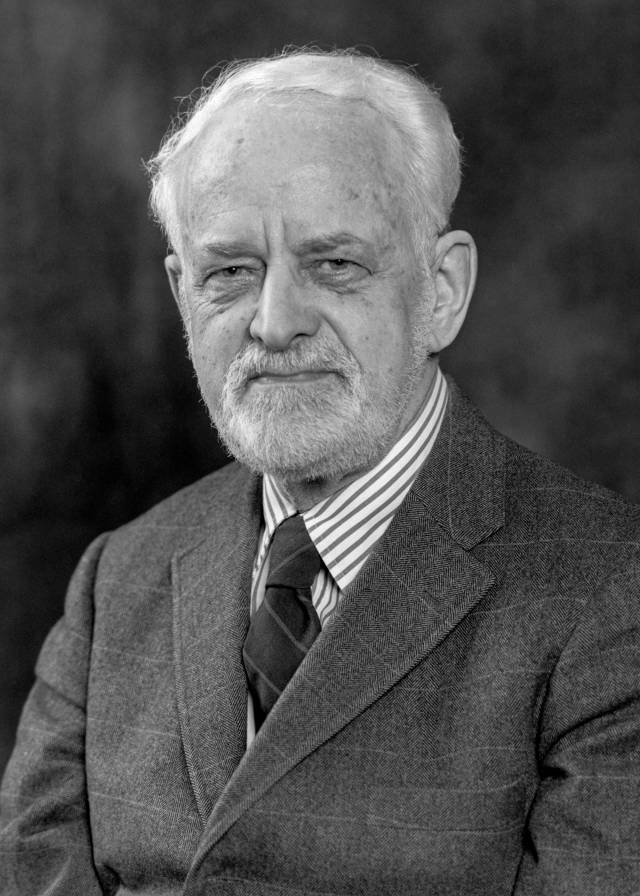
Hans Aarsleff
Aarsleff joined the Princeton faculty in 1956 and transferred to emeritus status in 1997, having inspired generations of students to explore the beauty and power of language across time and to examine how language itself is deeply intertwined with the history of ideas, philosophy, science, politics and religion.
His scholarship illuminated the impact of linguistic thought on the fields of philosophy and science, and established the importance of linguistic theory as an area of intellectual history. In 1994, he received Princeton’s Howard T. Behrman Award for Distinguished Achievement in the Humanities.
“Professor Aarsleff’s was a fearless, unique voice in the history of linguistics, whether he was grappling with influences on Wilhelm von Humboldt and Ferdinand de Saussure or taking a controversial stand on the work of Noam Chomsky,” said Robert Spoo, the Leonard L. Milberg ’53 Professor in Irish Letters, professor of English and department chair.
“He brought a feisty, winning wit to his research no less than to the classroom,” said Spoo, a 1986 Princeton graduate alumnus who took Aarsleff’s seminar in Old English. “His linguistic learning and etymological range turned every meeting into a lively comparative experience, well beyond the simple transmission of the language of ‘Beowulf.’”
Born in Rungsted, Denmark, Aarsleff was the middle child in a family of five children. He began his study of English language and literature at the University of Copenhagen and earned his bachelor’s degree in 1945, followed by a postwar year of service in the Danish army. During the war, he grew to love the jazz played on American Forces Radio, which spurred a desire to move to the United States. In 1948 he won a graduate fellowship to the University of Minnesota and completed his Ph.D. dissertation in 1960 after coming to Princeton.
At the start of his graduate studies, to both earn money and to work on his colloquial English, he joined a traveling amusement park in the summers, helping them set up in tiny towns through the Midwest and Plains states and selling hot dogs and ice cream. He recounted those adventures for his Princeton colleagues for decades to come.
Jeff Nunokawa, a professor of English, recalled a departmental retreat in the early 1990s, where everyone was asked to say a few words about themselves, in one minute or less.
“In a department filled with storytellers, Hans was in a league of his own,” Nunokawa said. “He was a good 15 minutes into his autobiography, when he got to the tale about the man, his wife and two children who were shot out of a cannon at the traveling carnival. At which point, Elaine Showalter, our chair at the time, turned to the colleague next to Hans: ‘Barbara,’ she said, ‘tell us a little about you.’”
A gifted scholar, treasured colleague and life-altering teacher
“He was a wonderful raconteur, and said, rightly, that he had seen a great deal more of America than I and other native-born professors had ever reached,” said Anthony Grafton, the Henry Putnam University Professor of History, Emeritus. “But he was also a dedicated scholar who never stopped exploring the historical records of western thought about language.”
Aarsleff’s dissertation, “The Study of Language in England, 1780-1860,” was published in 1967 by Princeton University Press (reissued in 1983) and became a foundational and widely cited text on the history of the study of language.
His published work included major essays on Gottfried Wilhelm Leibniz, John Locke, Étienne Bonnot de Condillac, Wilhelm von Humboldt, René Descartes and Johann Gottfried Herder, a selection of which was published in his book “From Locke to Saussure: Essays on the Study of Language and Intellectual History.”
He contributed essays on John Wilkins and Thomas Sprat, among others, to the “Dictionary of Scientific Biography,” edited by Charles Gillispie, the Dayton-Stockton Professor of History, Emeritus, and a trailblazer in the study of the history of science who established what is today Princeton’s Program in History of Science.
At Gillispie’s invitation in 1964, Aarsleff gave a series of lectures to a small group of faculty members. Grafton said that Aarsleff was not afraid to challenge widely received ideas and inspired his own scholarship. “His work guided me into the study of magic, mysticism and science in early modern culture — subjects that were considered esoteric then but are now recognized as vital parts of the history of premodern science.”
“Hans was a treasured colleague among medievalists at Princeton, a gifted lexicographer, and a formidable scholar of the writings of John Locke,” said William Chester Jordan, the Dayton-Stockton Professor of History, Emeritus, who enjoyed a 40-year friendship with Aarsleff.
One year, Jordan and Grafton decided to take Aarsleff’s Old Norse course alongside Ph.D. students in linguistics and Germanic languages and literatures. “It was wonderful to experience the medieval Icelandic sagas in the original,” Jordan said. “The twinkle in Hans’ eye and the lilt in his voice mirrored his delight in sharing his knowledge and insights with students and the two interloping faculty members.”
Gene Jarrett, Princeton’s dean of the faculty and the William S. Tod Professor of English, took Aarsleff’s course “The Literary Tradition: From the 14th to 18th Century,” the gateway course for English majors, in the fall semester of his sophomore year as an undergraduate in the Class of 1997.
“I enjoyed and excelled in the course, and he was the first department faculty member to encourage my concentration in English,” said Jarrett. When he applied to graduate school for literary studies, Aarsleff wrote a letter of recommendation. “I would not be here today without him.”
In an essay in Princeton Alumni Weekly in April 2024, “The Enduring Value of the Humanities,” Jarrett wrote that the courses he took with Aarsleff, Toni Morrison and Arnold Rampersad, among others, “changed my life.”
Transforming the study of language into a branch of modern intellectual history
Aarsleff gained international stature and recognition for his vast knowledge of the study of ideas about language, then an essentially new field. The Sorbonne once held a conference about his work.
“He understood how the science of language study grew through the ages, and how it was a product of its social context at any given point in history, and more specifically, of the philosophical ideas that prevailed at the time,” said Nigel Smith, the William and Annie S. Paton Foundation Professor of Ancient and Modern Literature and professor of English.
This larger cultural context, as Aarsleff himself wrote, included “developments in natural science, in philosophy, and even in political and religious thought.”
“His books are still landmarks in the history of the study of language and in European intellectual history,” said Claudia Johnson, the Murray Professor of English Literature, Emeritus. “He took on and took down some of the luminaries in the field, for he was a fierce and formidable arguer, all the more so because he always took care to be right.”
Aarsleff continued to publish for decades after his retirement. His last piece of scholarship, “An Essay on the Context and Formation of Wilhelm von Humboldt’s Linguistic Thought,” written with the assistance of his longtime colleague and friend, John Logan, literature bibliographer at Princeton University Library, was published in the journal History of European Ideas in 2016, when Aarsleff was 90.
“This is 78 pages of scholarship of the highest class,” said Peter Larsen, chief project manager at the Danish Ministry of Defence Acquisition and Logistics Organisation in Copenhagen, who earned his Ph.D. in history in 1984 and enjoyed a 45-year friendship with Aarsleff. “As a historian, I started out as a medievalist, which was of great interest to Hans,” he said.
Although they spoke regularly on the phone, their last in-person meeting was in April, in Princeton. “His health was frail, but his mind and memory were as strong and alive as when I first met him in 1981,” Larsen said. “Hans still had a detailed memory of places all over Denmark which he had visited on bicycle tours with his brother, Per, in the 1930s. His health did not allow us to go to his favorite place for lunch, the Lambertville Station Restaurant & Inn, where he would always ask for French onion soup served together with a handsome vodka martini.”
Aarsleff never lost his love of the Danish way of life. A good skier (Norway was his favorite destination for that), he walked and bicycled daily, and regularly turned the porch area between his small house and garage into a rural outdoor Danish experience where close friends enjoyed “his own simple, good food,” Smith said, and lively storytelling.
“Notoriously gruff in his manner, Hans was also a real wit, and his conversation was expansive, engaging, and often hilarious, turning readily from smoked fish to Condillac to circuses,” Johnson said.
“He was interested in everything,” said his niece, Karen Aarsleff, "not only in academic matters. He was a very inquisitive person, in the best sense of the word. And his memory was photographic.”
Smith said he always came away from those gatherings “gasping for air, but totally delighted and intellectually excited by the conversation.”
A generous mentor across the humanities
For more than 40 years, Aarsleff taught courses on American, English and European literatures, Old English, Old Norse, medieval literature, and the history of the study of language.
His graduate students adored him. “Graduate students are professors’ harshest critics,” Grafton said. “It never surprised me when the most brilliant and critical graduate students in humanities fields made Hans their mentor and interlocutor.”
Robert Norton, who earned his Ph.D. in Germanic languages and literatures in 1988, learned that Aarsleff had written an important essay on Herder — the focus of Norton’s dissertation — and was determined to meet him. After a chance encounter at the former Micawber Books on Nassau Street, the two forged “an intellectual friendship that lasted long after I left Princeton,” Norton said. “He scrupulously read and commented on every page [of my dissertation].”
“Hans' intellectual integrity, his blistering honesty, and his refusal to accept received wisdom have stood as my lodestars,” said Norton, the William P. and Hazel B. White Professor of German Studies with appointments in the departments of history and philosophy at the University of Notre Dame.
Eun Kyung Min, a professor of English at Seoul National University, earned her Ph.D. in comparative literature in 1998. She said Aarsleff “could have easily brushed me off" when she asked him to join her dissertation committee, since she wasn’t in the Department of English.
“Although at a distance he could seem gruff and opinionated, in all my interactions with him, however, he was generous, interested and kind," Min said. "He read my dissertation carefully and gave me helpful and detailed comments. He was never late to a meeting and usually came in with tousled hair, looking like he had enjoyed his bike ride. He had sharp things to say about many things but was refreshingly free of pedantry.”
T. Craig Christy, a 1980 graduate alumnus in Germanic languages and literatures and professor emeritus of German, linguistics and global studies at the University of North Alabama, said Aarsleff’s “expansive interest in the history of ideas encouraged me to ask difficult questions and explore aspects of linguistic history that seemed to have escaped widespread attention.”
They remained close friends for nearly 50 years until Aarsleff’s death, seeing each other at conferences and corresponding by phone and snail mail. “As Hans later regretted, he never made the switch from typewriter to computer,” Christy said. “He remained sound of mind right up to the end. We all incurred the loss of a towering member of our linguistic historiography community.”
“I remember him as a scholar and thinker of extraordinarily capacious learning that he shared generously,” said Margreta de Grazia, the Sheli Z. and Burton X. Rosenberg Professor Emerita of the Humanities at the University of Pennsylvania, who earned her Ph.D. in English in 1975.
Aarsleff was a fellow of the American Academy of Arts and Sciences, and a member of the Journal of the History of Ideas board of editors and board of directors, the advisory board of History of the Human Sciences, the American Philosophical Society, the Linguistic Society of America, and the Royal Danish Academy of Sciences and Letters, among others.
He is survived by his nieces, Karen Aarsleff and Ingrid Aarsleff, grandnieces Sofie Wille-Østergaard and Astrid Karen Wille-Østergaard, and grandnephews Kristian Wille-Østergaard and Niels Asger Wille-Jørgensen.