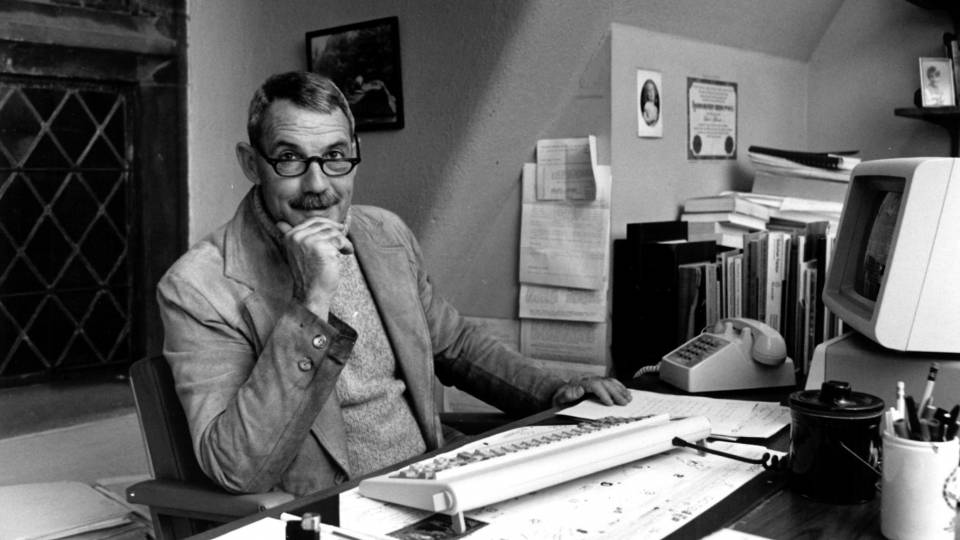
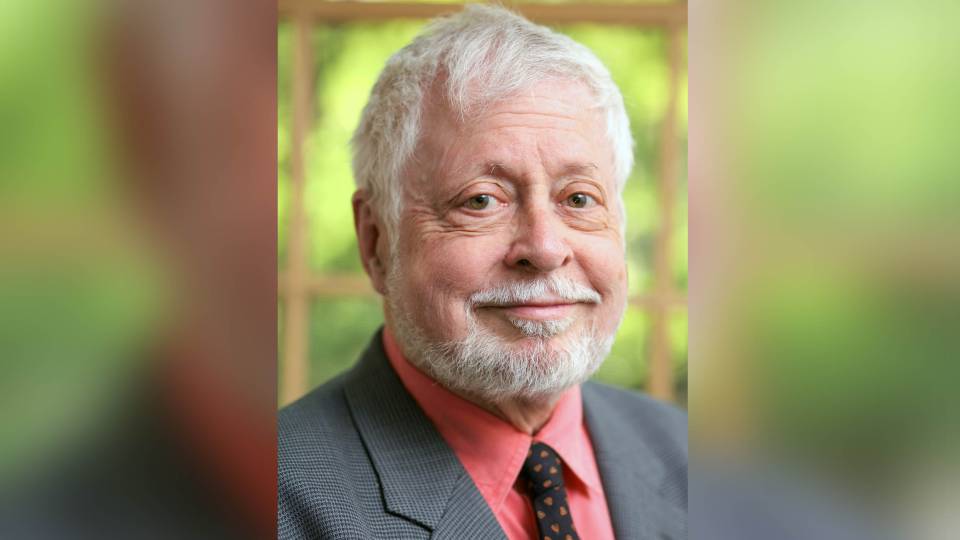
John Fleming, the Louis W. Fairchild ’24 Professor of English and Comparative Literature, Emeritus, legendary lecturer and renowned medieval scholar who published extensively in the fields of medieval English and European literature, medieval art history, and the history of Christian thought and spirituality, died on May 30. He was 90.
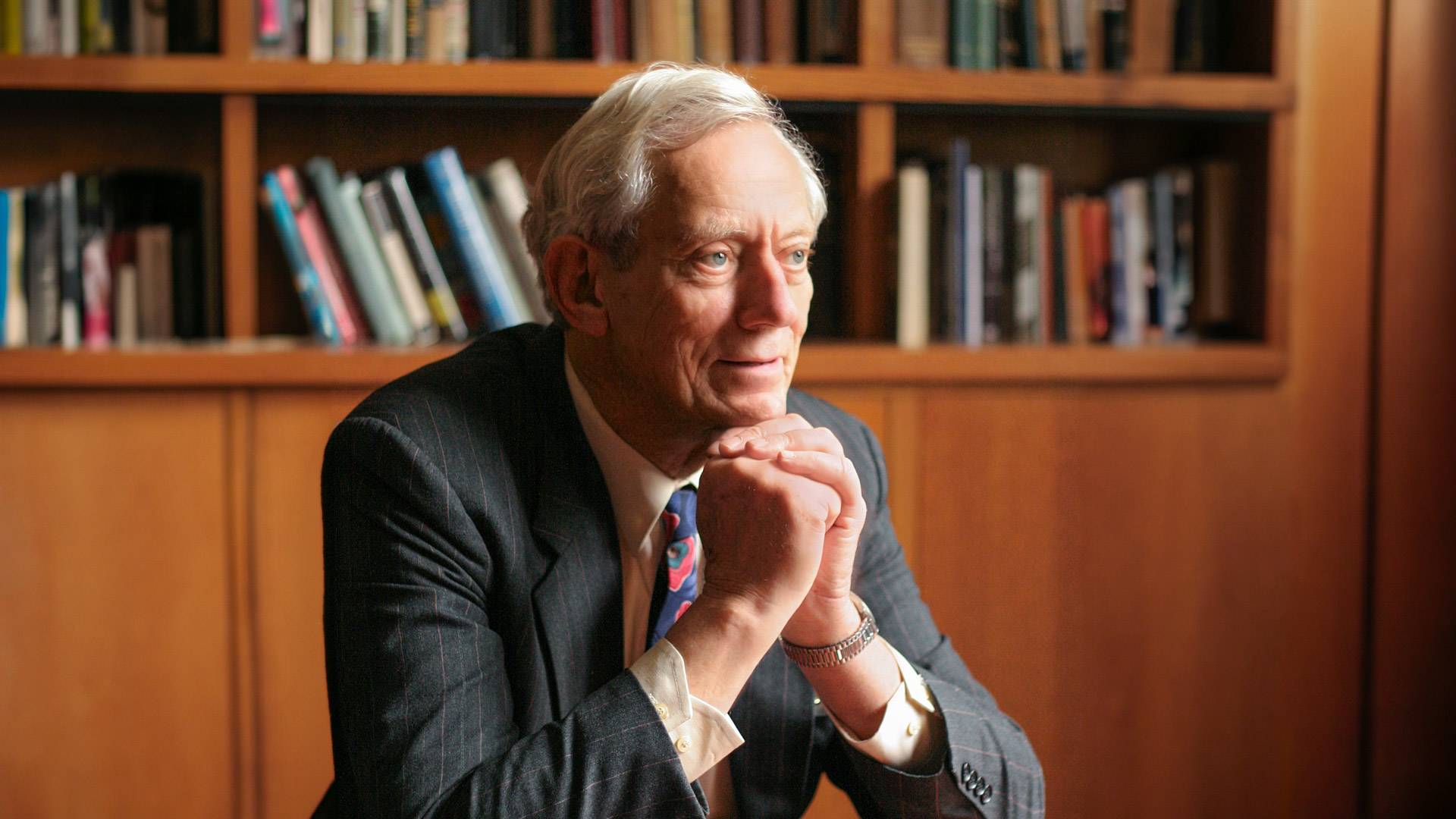
John Fleming in 2005
Fleming, a 1963 Princeton graduate alumnus in medieval studies, joined the faculty in 1965 and transferred to emeritus status in 2006.
During his 40 years at Princeton, he was a widely admired member of the University community, receiving the President’s Award for Distinguished Teaching, the Howard T. Behrman Award for Distinguished Achievement in the Humanities and the Phi Beta Kappa teaching award. In 2021, he was awarded an honorary degree from the University.
He was deeply engaged in University life, twice serving as head of Wilson College and delivering the Class of 2007 Baccalaureate address. He also served for two decades as chief marshal to lead the academic procession at major University events.
Fleming was the author of books on subjects including the works of Boccaccio, Dante, and Chaucer; the great 13th-century poem “The Romance of the Rose”; and the medieval Franciscan devotional tradition. He published important studies of Chaucer, Bellini, Ovid, and Portuguese poet Luís de Camões, and of Christopher Columbus as a subject in Franciscan literature.
“He was an immense presence in his own discipline and one of the principal architects of Princeton’s interdisciplinary Program in Medieval Studies,” said William Chester Jordan, the Dayton-Stockton Professor of History, Emeritus, and a colleague and friend of Fleming’s for more than 50 years. He recalled his friend’s famous sense of humor and his own “good fortune” to live in a house that abutted Fleming’s, where he and his family could enjoy “one of Princeton’s most beautiful flower gardens,” cultivated by Fleming himself.
Jordan remembers once watching his 3-year-old daughter in their yard, her eyes glued to Fleming working in the garden. Jordan had recently taught her a line of “Hamlet”: “There are more things in heaven and earth, Horatio, than are dreamt of in your philosophy.”
“She didn't know what it meant but she liked saying it,” Jordan said. “That morning, she shouted the line to John. He was flabbergasted and responded by quoting passage after passage from Shakespeare, which baffled her and almost made me die laughing.”
A teacher who “nurtured a deep rapport with students”
“John Fleming’s reputation as one of the major figures of medieval studies loomed large in the department, and one could not escape his presence as a scholar, a leader and, above all, as a teacher,” said Simon Gikandi, the Class of 1943 University Professor of English and department chair.
Fleming taught courses on medieval literature, the Bible as literature, Old English, the English novel, masterworks of European literature and American literature, among others, as well as Freshman Seminars on the Franciscan religious order and the history of the English language. His famed undergraduate course on Chaucer drew hundreds of students to McCosh Hall, year after year, decade after decade.
Gikandi said alumni who had taken the course routinely stopped by McCosh seeking out Fleming long after he had retired. “I remember meeting a grandmother, a mother and a daughter who had all taken John’s Chaucer class at one point in the 40 years he taught at Princeton.”
From 1996 until his retirement, Fleming wrote a weekly column for The Daily Princetonian titled "Gladly Lerne, Gladly Teche," a reference to a line in the general prologue of Chaucer’s “Canterbury Tales.” Through these columns, Gikandi said, Fleming “nurtured a deep rapport with students, something many of us envied.” After his retirement, he converted the column to a blog of the same name, faithfully publishing posts every Wednesday until just a few months before his death.
Alumna Elizabeth Valvano Feeney, an English major from the Class of 2004, likened Fleming’s Chaucer class to being “caught unawares and thinking ‘I had no idea,’ as when you hear a great piece of music for the first time, or find yourself the beneficiary of extraordinary kindness, because you had no idea that literature could be read with such depth.
“Professor Fleming taught us that great effort went into crafting the text and similar effort is called for in reading it well, which requires patience, empathy and humility, not only for the text, but for life in general,” Feeney said.
Fleming was a founding member of the Department of Comparative Literature, which recently celebrated its 50th anniversary.
Leonard Barkan, the Class of 1943 University Professor of Comparative Literature, Emeritus, remembers how his colleague “conveyed a sense of the importance that comparative literature — that is, the mastering of diverse languages and texts — meant to the humanities.”
He marveled that Fleming was “both 100% ‘old school’ — after all, he is remembered for his magnificent work on Dante’s ‘Commedia’ — and [had] scholarly tastes so attuned to a tradition that is alive and well in the present day.”
Born in Gary, Indiana, and raised on a farm in Baxter County, Arkansas, in the Ozarks, Fleming graduated from Sewanee (the University of the South) in 1958 and was a Rhodes Scholar before entering Princeton’s doctoral program.
Setting “the gold standard”
Leah Whittington, the John P. Marquand Professor of English and professor of comparative literature at Harvard University and a 2011 Princeton graduate alumna in comparative literature, took “Chaucer and the Classical Tradition” in 2005, the last graduate seminar Fleming taught before he retired. They remained close friends until his death. Like Gikandi, she admired his garden.
“Gardening, for him, was a bit like scholarship: an entirely natural daily activity in and among the tufts and underbrush of previous vital growth,” Whittington said. “He especially loved it when students brought him plants and seeds from their gardens to populate his.”
Fleming’s emphasis on how writers grow from reading other writers — “that literature is nourished through engagement with the imaginative writing of the past” — has had a profound impact on her own scholarship and teaching, she said.
It wasn’t until long after he’d left Princeton that Robert Epstein, a professor of English at Fairfield University and a 1996 graduate alumnus, realized a charming byproduct of Fleming’s “inspired and unforgettable” dramatic readings he’d witnessed as a preceptor in the Chaucer course.
“I have been teaching Chaucer for nearly 40 years,” Epstein said. “And to this day, when I read the ‘Canterbury Tales’ aloud, it comes out with an Arkansan accent.”
Epstein and Will Robins, a 1995 graduate alumnus in comparative literature and an associate professor of English and medieval studies at the University of Toronto, co-edited one of two honorary festschrifts published after Fleming’s retirement, titled “Sacred and Profane in Chaucer and Late Medieval Literature: Essays in Honour of John V. Fleming,” with contributions by former students.
“I will remember John for displaying the brilliance of an intellectual virtuoso, the wit of a lively raconteur, and the loyalty of a true mentor and friend,” Robins said.
John Longo, a 1982 graduate alumnus in English, has held Fleming’s teaching style as “the gold standard” through his own career, teaching English at the K-12 Colorado Springs School for two decades, and at Colorado College. “He was a master teacher, and like all great lecturers, he had the soul of a showman.” As a dissertation adviser, he said Fleming “made me feel valued as a scholar, a teacher and a person.”
Fleming — who acquired the affectionate nickname Tweedy after being plucked by men’s fashion magazine Maxim for a photo shoot in which he donned a silk bowtie and wool suit — also advised dozens of undergraduates.
Emma Bloomberg ’01, an English major with a minor in medieval studies, fondly remembers how Fleming, her senior thesis adviser, challenged her in the best ways. Although she planned to return to Princeton for a Ph.D., her path took her in a different direction, still focused on education.
As the founder and CEO of Murmuration, which helps improve K-12 public education and access for all children, she said, “I often talk about my time at Princeton and studying medieval literature — it elicits a laugh from audiences, and fair enough. But the lesson to never take anything too literally has proven invaluable: almost any word in a medieval text must be considered for its etymology, usage, intention — words and sentences as puzzles to be deciphered.”
After taking Fleming’s Chaucer class, she asked her parents for a dictionary of etymology for her birthday. “Professor Fleming cultivated in me a love of language, of story, of history, of community. I am forever grateful,” she said.
P.G. Sittenfeld ’07, an English major and Cincinnati-based writer, remembers being in the packed-to-the-rafters lecture hall and “watching this erudite scholar with a commanding presence whip students into uproarious laughter. He made the Middle English sing, and he made learning a joy."
Fleming was a past president of the Medieval Academy of America, and a fellow of the American Academy of Arts and Sciences and of the American Philosophical Society. He served on the executive committee of the Alumni Council and the Association of Princeton Graduate Alumni, and in 2004 received the Alumni Council Award for Service to Princeton.
He is survived by his wife of 63 years, Joan Elizabeth Fleming; brother Richard Fleming; son Richard Fleming, a 1987 Princeton graduate (and wife Katherine Dixon); daughter Katherine Fleming (and husband Zvi Ben-Dor Benite); son Luke (and wife Melanie Dean); and grandchildren Ruby, Sophia, Lulu, Cora-Louise (a 2026 Princeton graduate), John Henry and Hazel.
A memorial and celebration of Fleming’s life, open to the public, will be held at the Princeton University Chapel at 1:30 p.m., Friday, Sept. 25.