Princeton University faculty members Hantao Ji, Egemen Kolemen, Josh Atkinson and Jürgen Hackl have been awarded grants to lead projects in the Genesis Mission, a nationwide initiative that was announced today by the U.S. Department of Energy (DOE), encompassing 278 projects to harness artificial intelligence for scientific discovery.
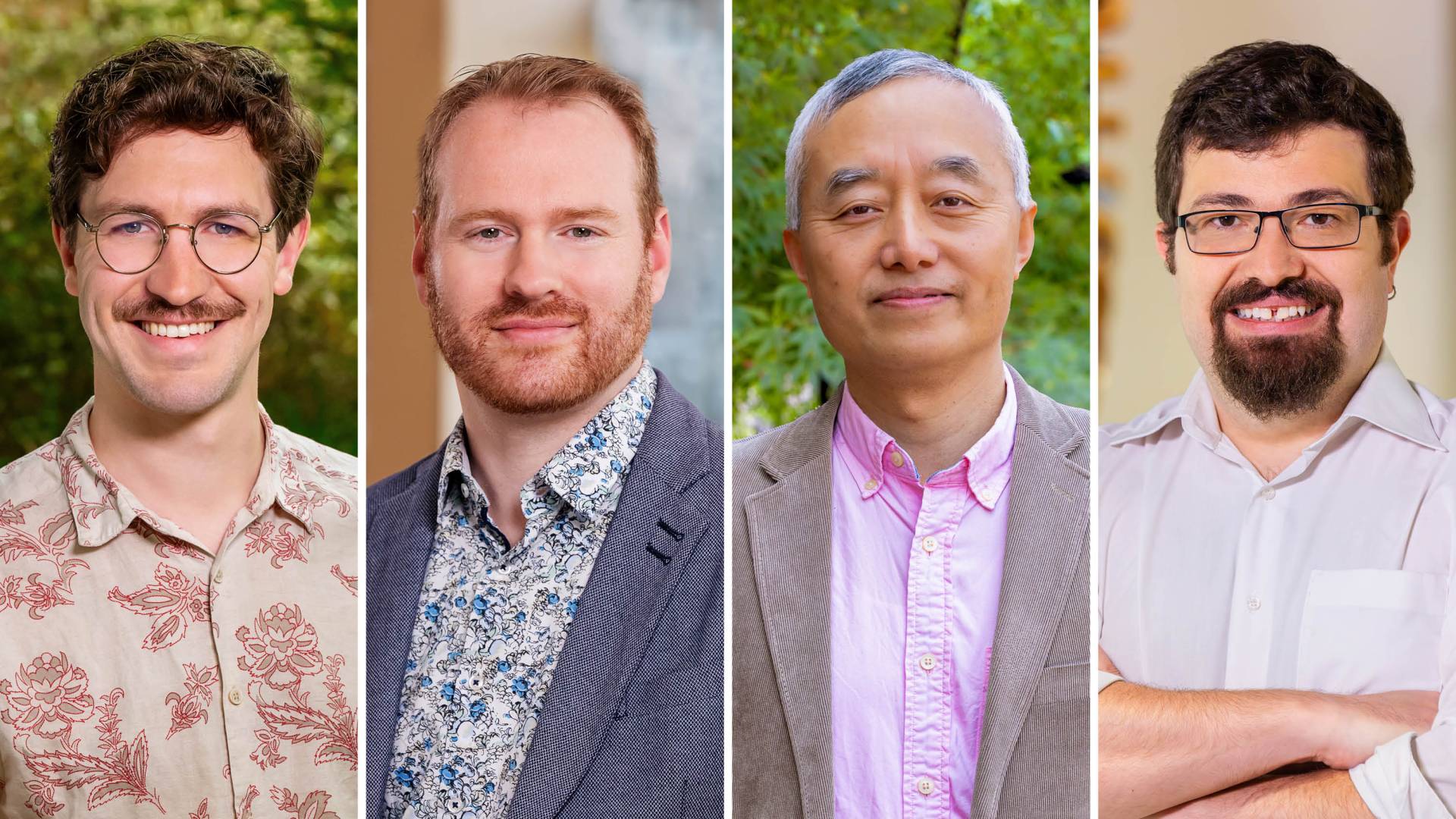
Josh Atkinson, Jürgen Hackl, Hantao Ji and Egemen Kolemen
“The national portfolio of research teams will help develop and demonstrate AI-enabled scientific workflows designed to accelerate breakthroughs in energy, discovery science, and national security,” the DOE said in its announcement. “Designed to double America’s scientific productivity, the Genesis Mission brings together DOE’s world-class scientific capabilities, advanced AI, high-performance computing, and the nation’s leading researchers to transform how scientific discovery is conducted and strengthen American leadership in science and technology.”
“The DOE mission and our Princeton researchers’ contributions will showcase the power of the scientific community to develop cutting-edge artificial intelligence techniques to advance discoveries that will benefit society,” said Peter Schiffer, Princeton’s dean for research and vice president for the Princeton Plasma Physics Laboratory.
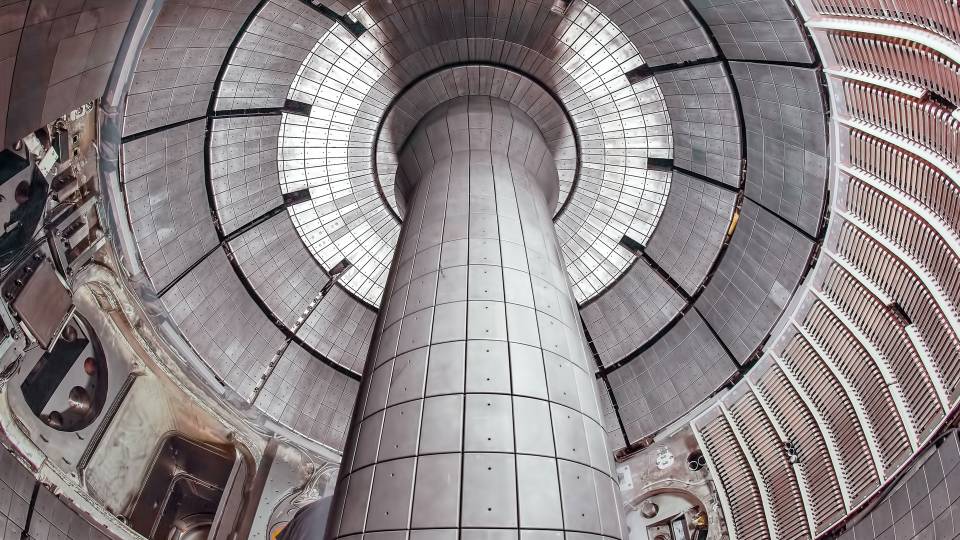
Hantao Ji is a professor of astrophysical sciences at Princeton University and a distinguished research fellow at the DOE’s Princeton Plasma Physics Laboratory (PPPL). He will lead a Genesis Mission project that aims to accelerate plasma physics and fusion research, and the ability to predict space weather events. It is centered around a process known as magnetic reconnection, which releases bursts of energy and radiation that can cause solar flares that damage satellites and telecommunications infrastructure. These bursts can also disrupt the fusion process in fusion energy devices like those at PPPL.
With collaborators from PPPL, Boston University, Los Alamos National Laboratory, UC-Santa Barbara and TAE Technologies, this project will train neural networks to model measurements that are too difficult or costly to make in the lab, and to identify critical plasma structures during multiscale magnetic reconnection on the Facility for Laboratory Reconnection Experiments (FLARE) at PPPL.
Egemen Kolemen is a professor of mechanical and aerospace engineering and the Andlinger Center for Energy and the Environment, and a staff research physicist at PPPL. The project he leads will aim to speed the development of commercial fusion power by building a multi-modal, multi-device AI model that predicts the behavior of plasmas inside fusion devices, far into the future, which significantly improves the control of plasmas. These super hot gases are so complex that traditional models often fall short.
In addition to PPPL scientists, the companies General Atomics and Next Step Fusion are collaborators on the project. The researchers will also use AI to build a “digital twin” that can simulate an entire experiment based only on a starting point and a set of controls. The digital twin helps with testing and optimizing many ideas in a matter of minutes, without the time required to build and test experimental devices.
Josh Atkinson is leading a team with Jürgen Hackl on a Genesis Mission project that aims to build a machine learning model that can predict how microbes transfer DNA. Atkinson is an assistant professor of civil and environmental engineering and the Omenn-Darling Bioengineering Institute. Hackl is an assistant professor of civil and environmental engineering.
DNA transfer among microbial communities is how antibiotic resistance spreads among bacteria and is also key to bioengineering microbes for beneficial uses, such as wastewater treatment and agriculture. Atkinson and Hackl, with colleagues at Oak Ridge National Laboratory, will build a machine learning model that predicts the pathways by which mobile DNA is transferred through bacterial communities and identifies which organisms are most likely to acquire it.
Princeton researchers are also playing leading roles in other institutions' Genesis Mission projects:
- Reed Maxwell, the William and Edna Macaleer Professor of Engineering and Applied Science and professor of civil and environmental engineering and the High Meadows Environmental Institute, is a principal investigator on a project led by Argonne National Laboratory that will use AI to help forecast groundwater levels, soil moisture, streamflow and water depths. The goal is to better predict the availability of water for people and crops, along with the risk for floods.
- Joshua Shaevitz, professor of physics and the Lewis-Sigler Institute for Integrative Genomics, is a principal investigator on a University of Missouri-led effort to transform synthetic-cell design from trial and error into predictive science. His team will use advanced microscopy techniques to watch molecules move inside synthetic cells and test whether AI can predict how cells respond when redesigned — a step toward engineering cells that could manufacture new medicines and advanced materials.
- Anatoly Spitkovsky, professor of astrophysical sciences, is a principal investigator on a project led by Emory University that will use AI to help understand how tiny particles of plasma combine to create large-scale patterns in two very different plasmas: “dusty” plasma created in the laboratory and plasma that exists as powerful shock waves in space. The work aims to accelerate research on fusion energy, plasma manufacturing and space-weather forecasting.
PPPL is a DOE National Laboratory managed by Princeton University, and is leading or involved with multiple Genesis Mission projects.