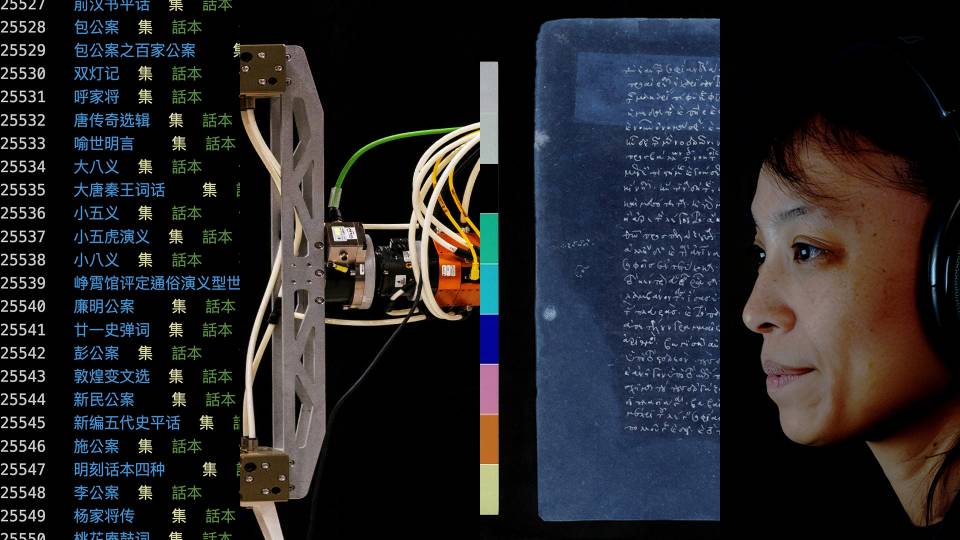
Princeton professors Eve Krakowski and Marina Rustow have received grants from the National Endowment for the Humanities (NEH) for projects connected with Princeton’s Geniza Lab, which studies a cache of more than 400,000 ancient paper and parchment documents recovered from a synagogue in Cairo.

Eve Krakowski and Marina Rustow
The grants were part of a round of awards made to 81 humanities projects nationwide to support “organizations and scholars working to illuminate and educate about the great ideas and events of the past,” NEH Acting Chairman William English said in the agency’s announcement. Both of the Princeton scholars’ grants were awarded as part of the NEH Scholarly Editions and Translations program.
Documents from the Cairo Geniza date back as far the 9th century and were discovered by scholars in the 1880s. Part of their appeal is that they were written by ordinary people, largely in Egypt but also in the Mediterranean, the Indian Ocean and beyond.
Rustow is the Khedouri A. Zilkha Professor of Jewish Civilization in the Near East and a professor of Near Eastern studies and history. She has overseen the Geniza Lab since joining Princeton’s faculty in 2015. Krakowski is an associate professor of Near Eastern studies and the Program in Judaic Studies and is the Geniza Lab co-director.
Eve Krakowski
Krakowski received $300,000 for the project “Living with Death in Medieval Egypt: Editions and Translations of a Cairo Geniza Corpus,” which explores the social history of death in the medieval Middle East through documents including mourning and condolence letters, service contracts and accounts.
The Cairo Geniza is “a goldmine for social historians," she said. "You get an ability to see things about everyday life that you really just cannot get from any other kind of material."
Krakowski will translate, edit and publish the texts in a comparative volume analyzing how ideas and practices of death evolved historically between the periods of late antiquity and the late 10th century to 1250.
She is collaborating with Oded Zinger, a Princeton undergraduate and graduate alumnus who received his B.A. in history in 2007 and Ph.D. in Near Eastern Studies in 2014 and is now at Hebrew University of Jerusalem. “It's a project that is very meaningful to me and that I think is going to hopefully yield something new and important,” Krakowski said.
Marina Rustow
Rustow received $300,000 for the project “Indian Ocean Documents from the Cairo Geniza,” which will publish editions and translations of three volumes of letters, legal documents and account ledgers by Jewish traders from North Africa, Sicily, Egypt and Yemen as they navigated the medieval Indian Ocean trade with the Mediterranean. These texts date from 1080 to 1250 and will be translated to English from Judeo-Arabic, Hebrew and Aramaic, both in print and digitally.
The project has also brought together an advisory group of historians and archaeologists of the Indian Ocean and Mediterranean worlds to understand the connections between those regions.
The Indian Ocean papers are unusual because they are “everyday, ephemeral writing that documents trade guilds and commodities in South Asia in the 12th century,” Rustow said. These “portable means of communication” reveal a different dimension of history from stone inscriptions and copper plates from that era in India, which were designed to be preserved.
Rustow called the NEH grant “a wonderful opportunity for synergy between exactly what these grants are meant to support and the research infrastructure that we already have at the Geniza Lab.”