Research, collaboration celebrated in banner year for Princeton Catalysis Initiative Symposium
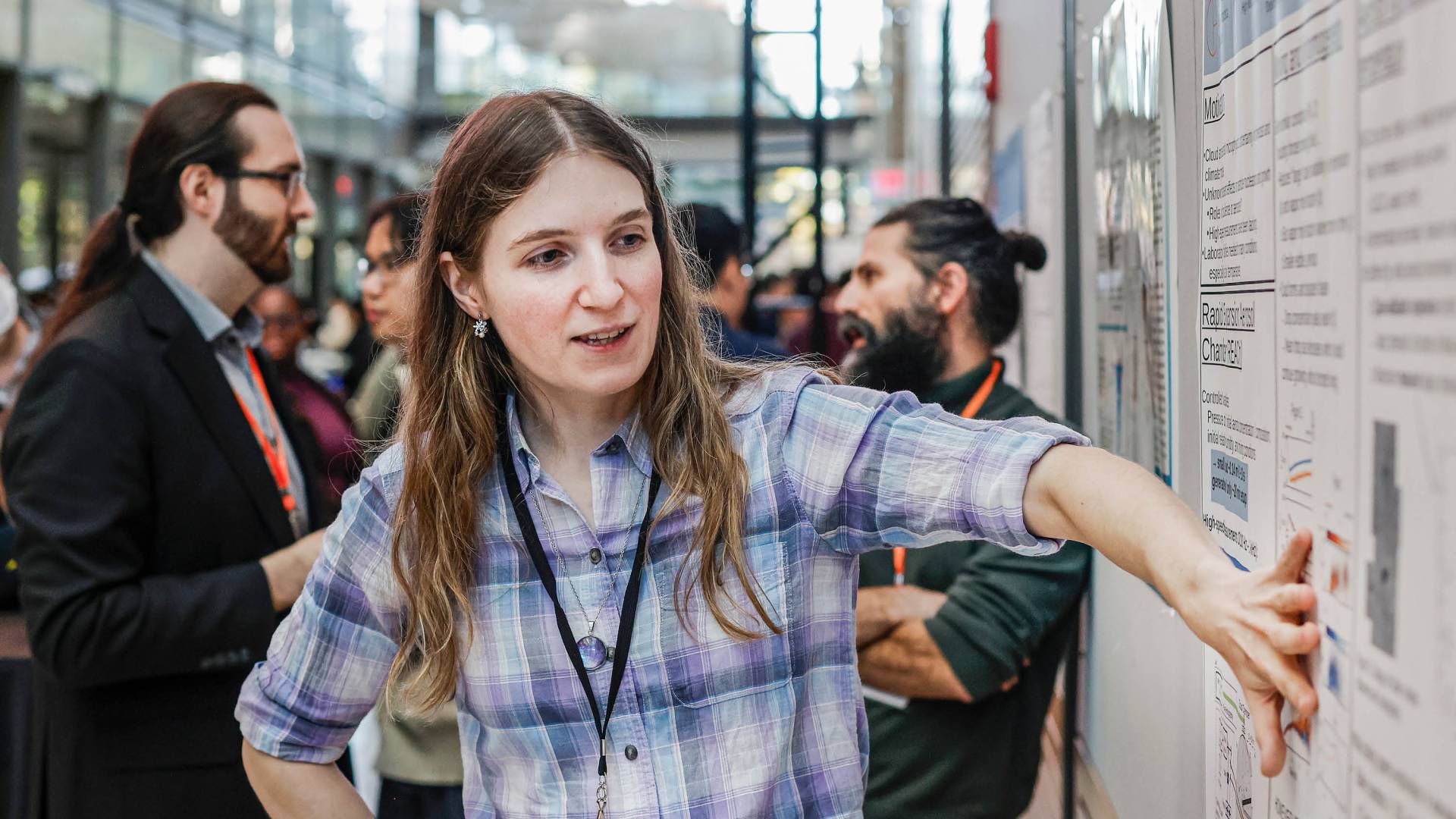
Gwenore Pokrifka, a postdoc with the High Meadows Environmental Institute, discusses her research during the PCI Symposium poster session last month.
The Princeton Catalysis Initiative drew more than 320 faculty, students, and industry leaders to Frick Chemistry Lab last month for its ninth PCI Symposium spotlighting innovative and collaborative scholarship.
At the crux of the two-day event were 26 faculty flash talks representing 20 departments and centers from across campus, with topics including soft robots, the formation of cellular structures and the neuromechanisms of learning.
As an opportunity for faculty to catch up on each other's work, “It’s quite exciting,” said Vice Dean for Innovation Craig Arnold, the Susan Dod Brown Professor of Mechanical and Aerospace Engineering. "I'm just amazed at how special PCI really is.”
Arnold presented a talk on “Materials Processing for Advanced Applications in Energy, Sustainability, and Manufacturing.”
In her first presentation with PCI, Rachael DeLue, the Christopher Binyon Sarofim ’86 Professor in American Art, said she appreciated PCI’s ability to generate discovery through cross-disciplinary collaborations.
“The first step is getting people in the same room, which is what the PCI symposium does so well," said DeLue, who directs the Princeton Humanities Initiative. "It was fascinating for me, as a humanist, to hear about the current research of my colleagues in STEM and to have the chance to identify connections and imagine new questions and potential pathways of inquiry that I might not have hit upon from the perspective of my individual discipline.”
The symposium, which took place Oct. 19 and 20, featured a campus-wide poster session for graduate students and postdocs, anchored by six postdoc presenters whose work spans the STEM fields from chemistry to genomics to mechanical and aerospace engineering. There were 107 posters on display, the symposium’s highest number yet.
Founded to catalyze new research
PCI was founded in 2017 by a handful of Department of Chemistry faculty eager to catalyze new synergies across campus. They envisioned an initiative that would bring researchers together with the industry leaders most likely to translate their work into real-world applications.
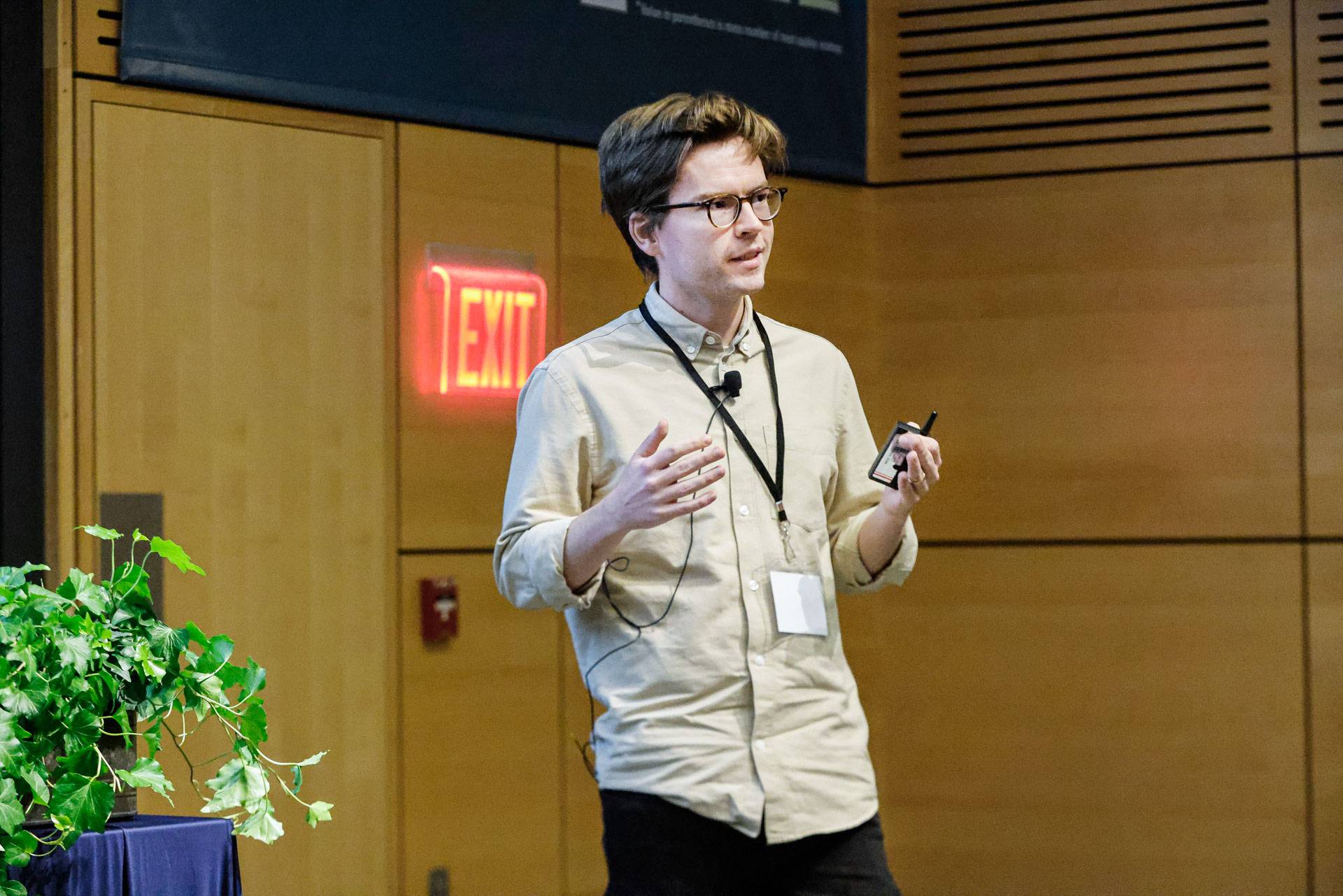
Michael Skinnider, an assistant professor in the Lewis-Sigler Institute for Integrative Genomics and a member of the Ludwig Princeton Branch, offers an overview of his pathbreaking research on metabolites. Skinnider was one of 26 faculty speakers at this year's symposium.
“The idea was that the Princeton faculty is doing great, so how do you catalyze ways to get them all together to start working with each other?” said founding member David MacMillan, the James S. McDonnell Distinguished University Professor of Chemistry.
Underscoring the successes to date, he said PCI has funded 193 collaborative projects for 154 faculty; engaged 25 departments and centers; published over 600 papers in 150 journals including Nature, Science, Cell, and the Journal of the American Chemical Society; realized a diverse portfolio of emerging intellectual property and 25 patent actions; and has committed funding for over $25 million from six industry partners.
MacMillan said 40% of funding drawn through PCI has gone on to accommodate the research of assistant professors, ensuring that new generations of scholars have a supportive network for their work. In addition, the funding level for all project proposals reached the 50% mark last year. Faculty in the School of Engineering and Applied Sciences have received the most funding overall.
The slate of talks held Oct. 19 and 20 was interspersed this year with breaks in which attendees were encouraged to network with “people you don’t know,” said MacMillan. “That’s why you’re here.”
Below, selections from the faculty flash talks:
From Kenneth Norman, the Huo Professor in Computational and Theoretical Neuroscience, Princeton Neuroscience Institute: “I want to start with the idea that we need to know things in our human brains to exert our agency in the world. Our human capacity for learning is really important for leading a meaningful and healthy life. So given that, I think it’s time for cognitive neuroscientists like me to set a challenge for ourselves. Namely, if we have truly figured out useful things about the neuromechanisms of learning, and I think we have, we should be able to leverage this to promote tangibly better real-world learning outcomes.”
From Rebecca Kramer-Bottiglio, professor of Mechanical and Aerospace Engineering: “When we imagine robots of the future, we imagine something more like animals, like ourselves. We are incredibly adaptable. Why is that? All animals look at least partially soft. There are no known animals in the world that are completely rigid. We as humans are 15% rigid bone and skeletal structure and 85% soft and fluid. Is it possible that our soft material composition plays a role in our ability to interact with and adapt to our environment? And if so, could soft robotic technology be a part of the solution to the adaptability problem for robots?”
From Michael Skinnider, assistant professor in the Lewis-Sigler Institute for Integrative Genomics and a member of the Ludwig Princeton Branch: “What we work on in my group is discovering unknown small molecules produced by the cells in the human body, which are known as metabolites. We think this is really one of the most exciting open problems in biology because we think it’s just astonishing that much of the chemistry in our own body is still unknown.”
From Greg Scholes, William S. Tod Professor of Chemistry: “Chemical manufacturing, which is a huge industry in the United States generates one-quarter of the country’s GDP, and maybe more importantly it’s extremely energy intensive. Could we use more modern catalysis to reduce the energy consumption in these manufacturing processes, and that would in turn give the country a strategic advantage?”
For more information on the 2027 request for project proposals or to view the flash talks from this year’s symposium, visit the PCI website.
The Princeton Catalysis Initiative acknowledges generous support from Anthony Evnin ’62 and Eric ’76 and Wendy Schmidt through the Schmidt DataX Fund.