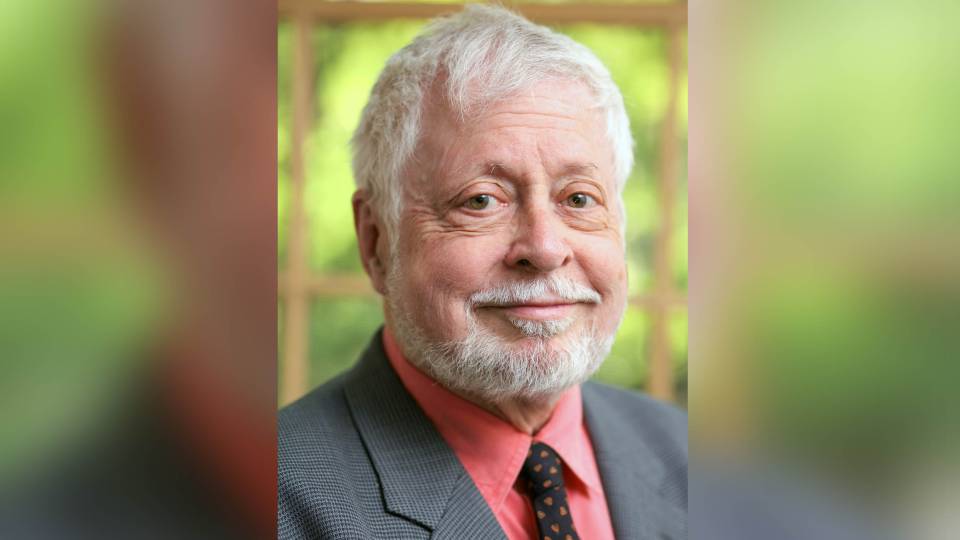
James Irby, renowned scholar of modern Latin American literature, ‘thoughtful and generous’ mentor, and ‘gentle soul,’ dies at 95
James Irby
James Irby, professor of Romance languages and literatures, emeritus, who specialized in modern Latin American literature, particularly fiction and the lyric since 1880, and is credited with introducing the works of the Argentinian writer Jorge Luis Borges to English-speaking readers, died on Nov. 11. He was 95.
Irby taught at the University for nearly four decades and was instrumental in establishing the Department of Spanish and Portuguese from what originally had been the Department of Romance Languages and Literatures. He came to Princeton as an instructor in Spanish in 1959, joined the faculty in 1962 and transferred to emeritus status in 2000.
He developed and taught Princeton’s first courses devoted exclusively to Latin American literature, at both the undergraduate and graduate levels — including Spanish American literature, Brazilian literature and comparative modern fiction, as well as Spanish and Portuguese language. He was a founding member of Princeton’s Program in Latin American Studies and served as its director from 1978 to 1981.
A pioneer in Latin American literary studies at Princeton
“A distinguished scholar of modern Latin American literature, Professor Irby played a pioneering role in establishing Latin American literary studies at Princeton,” said Christina Lee, the Edwards S. Sanford Professor of Spanish and Portuguese and department chair.
“He was one of the first U.S. critics to introduce Jorge Luis Borges to English-speaking readers with his landmark translation of ‘Labyrinths: Selected Stories & Other Writings,’” she said. “Labyrinths,” co-translated and co-edited with Donald Yates, was first published in 1962, followed by several updated editions through 2017.
The Department of Spanish and Portuguese is celebrating its 25th anniversary this academic year. “It is no exaggeration to say that our department owes its very existence, in no small measure, to Professor Irby’s vision and efforts,” Lee said. “We remember Professor Irby with deep gratitude and affection.”
In homage to Irby, the Department of Spanish and Portuguese will hold a public event in fall 2027 on Latin-American poetry, bringing together some of his former students and collaborators.
Irby published articles on and translations of Borges, Uruguayan writer Juan Carlos Onetti, the Argentine-French author Julio Cortázar, and the Cuban author and poet José Lezama Lima, among other Latin American writers, in academic journals but also in Harper’s Bazaar and The Paris Review. He served on the editorial boards of Revista Iberoamericana and Nueva Revista de Filología.
Irby remained actively engaged in the department after his retirement. Pedro Meira Monteiro, the Arthur W. Marks ’19 Professor of Spanish and Portuguese, fondly remembers the warm welcome Irby gave him when he arrived at Princeton as an assistant professor in 2002. They often discussed poetry over coffee.
“When we talked, Jim was able to immerse himself in a poem, and it was as if we would never emerge from it,” Monteiro said. “But suddenly, we’d return to the surface, and I’d find myself back in a café with him, with a poem that had been illuminated by his reading. It really was like emerging from an adventure — a kind of enchantment that he shared with warmth and critical rigor with his students and also with young colleagues like me.”
Monteiro said Irby’s engagement with a poem or passage had its own magical quality.
“He respected the ‘mystery’ that existed within the poem. He knew, after all, that a good poem only stands on its own when it is capable of leaving a question hanging in the air,” Monteiro said. “Without fanfare or grand gestures, he stepped into a literary text with the delicacy of someone entering a crystal shop or an old library — that is, with reverence and curiosity.”
A ‘humane scholar,’ ‘generous listener’ and ‘the best reader I have ever known’
Born in Bowie, Texas, in 1931, Irby earned his bachelor’s in Spanish from the University of Kansas in 1952. Directly after graduation, he served as a lieutenant in the U.S. Army at Ft. Knox, Kentucky, then in South Korea.
Irby went on to earn his master’s in Spanish letters from the Universidad Nacional Autónoma de México in 1957 and his Ph.D. in Spanish from the University of Michigan in 1962, writing his dissertation on Borges stories.
Many of his students have gone on to pursue prestigious careers in the field and remember him with fondness and the way he brought poetry to life in the classroom.
“I’ll never forget the experience of listening to him recite poems by Peruvian poet César Vallejo in a way that brought out all their complicated emotional resonance,” said Michelle Clayton, who earned her Ph.D. in 2003 in Romance languages and literatures and took several of Irby’s seminars on Latin American poetry during her first two years as a graduate student before Irby retired.
Clayton, the Royce Family Associate Professor of Teaching Excellence in Hispanic Studies and Comparative Literature at Brown University, wrote her dissertation on Vallejo’s poetry and Irby was her “extraordinarily patient, thoughtful and generous” dissertation adviser. Later, when she converted her dissertation into a book, Irby served as her first reader for every chapter. “He was such a humane scholar,” she said. “It was a privilege to work under the guidance of this gentle soul.”
“I learned more about close reading from Jim than from anyone else,” said Daniel Balderston, the Andrew W. Mellon Professor of Modern Languages, Emeritus, at the University of Pittsburgh, who earned his Ph.D. in 1981 in comparative literature and took every graduate seminar Irby taught.
“He pushed us to pay attention to the smallest details of a text, to appreciate its sound and rhythm, the special uses of words, the structure of a verse or a sentence,” he said, noting that he often recommended Irby’s own dissertation — “an extraordinary analysis of Borges’ style” — to his own graduate students. “His clarity and the depths of his insights derive from his intense engagement with texts and his refusal to take anything for granted. Jim Irby was the best reader I have ever known.”
Ronald Méndez-Clark, professor emeritus of Spanish at Fordham University, who earned his Ph.D. in Romance languages and literatures in 1980, wrote his dissertation on Onetti and remembers his adviser as “a quiet, modest man and teacher and a lucid, careful reader” whose thoughtful notes were always written in “impeccable handwriting” on the margins of his dissertation drafts.
“Jim was a good, patient, unassuming and generous listener,” Méndez-Clark said. “He passed on his deep appreciation and knowledge of Onetti's work and, most significantly, the importance and pleasure of reading a good story or novel more than once.”
After Irby’s retirement, he continued studying his favorite poets, including Vallejo, Gabriela Mistral and Lezama Lima. In 2019, he published “José Lezama Lima, A Poetic Order of Excess: Essays on Poets and Poetry,” co-translated and co-edited with Jorge Brioso (Green Integer). He also continued to publish scholarly articles and contribute his translations to English-language anthologies including “José Lezama Lima: Selections,” edited by Ernesto Livon-Grosman and published in 2017 as part of the University of California’s Poets for the Millennium Series.
Irby is survived by his wife, Marta Peixoto, a 1977 graduate alumna in comparative literature; his children, Lisa Favaro ’79 (Ken Favaro), Francisco Giral Irby, Daniel Peixoto Irby ’02 (Catherine Ho), Thomas Peixoto Irby ’13, and Mariana Peixoto Irby (Jonas Wieschollek); and four grandchildren.