“Revolution in the Archives”: Students delve into Princeton University Library archives to understand America’s past and help curate landmark exhibit
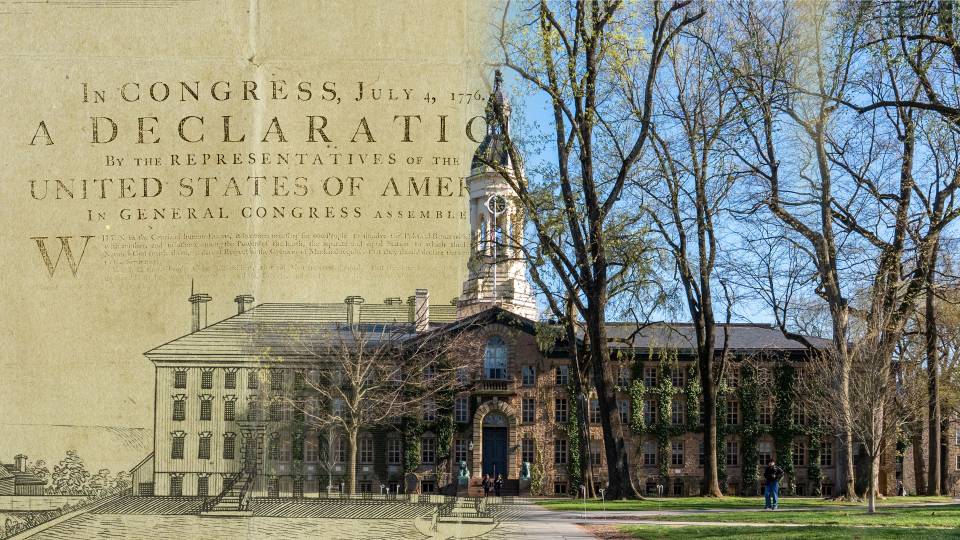
Students in the history course “Revolution in the Archives” examine Princeton University Library's original printing of the Declaration of Independence, of which only 26 are known to survive today. The class contributed to a landmark exhibit exploring Princeton and the American Revolution opening April 15.
As the country has prepared to celebrate its 250th anniversary, a Princeton undergraduate history course has welcomed students into Special Collections at Princeton University Library during the past year for an extraordinary opportunity to study documents from the Revolutionary era and explore Princeton’s role in America’s founding.
“I was holding Thomas Jefferson's letters, holding George Washington's letters, every week,” said Princeton senior Luke Johnston, a history major who took the course, “Revolution in the Archives,” last year.
Yena Choe, a junior majoring in the School of Public and International Affairs (SPIA) who is enrolled in the class this spring, called the opportunity to study American history during the 250th anniversary year a “once-in-a-lifetime experience.”
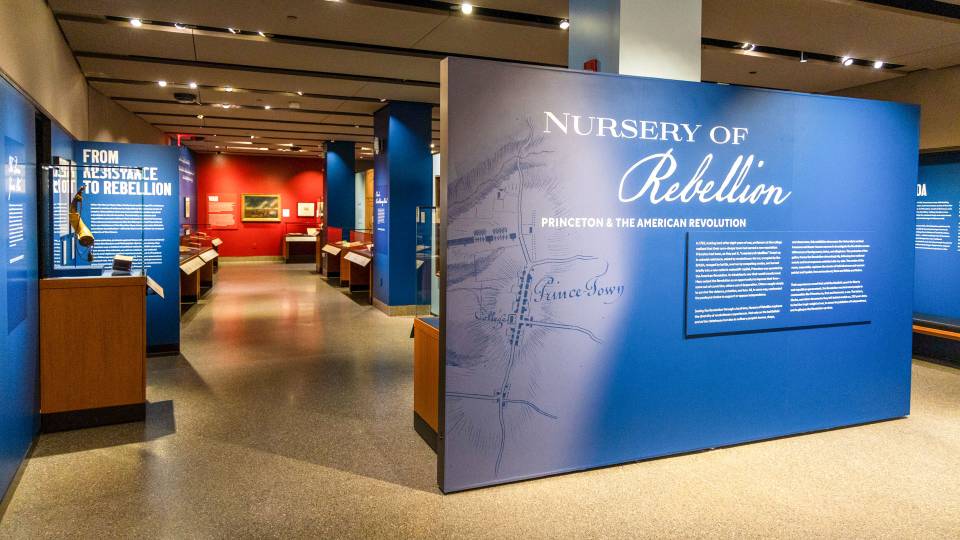
Students in the course conducted original research that contributed to a landmark exhibition at Princeton’s Firestone Library, “‘Nursery of Rebellion’: Princeton and the American Revolution,” on display through July 12 in the Ellen and Leonard Milberg Gallery.
“Nursery of Rebellion” showcases the library’s rare original Dunlap printings of the Declaration of Independence and the U.S. Constitution, as well as a cannonball found near the Princeton battlefield, among other extraordinary American documents and manuscripts from the library’s Special Collections.

Both the class and the exhibit focus on gleaning new knowledge from archival materials to add depth and breadth to what we know about America’s history. Items featured include the original “Dunlap Broadside” printing of the Declaration of Independence (left) and a cannonball found near the Princeton battlefield (right).
It also features archival items on loan from federal, state and community institutions that help flesh out the local and social history of Princeton in the Revolutionary era, including letters by and about three Lenape students at Princeton in the 1780s from the U.S. National Archives.
The “Revolution in the Archives” course is taught by the exhibit’s curators, Michael Blaakman, associate professor of history, and Gabriel Swift, librarian for Early American Collections.
Both the class and the exhibition focus on gleaning new knowledge from archival materials to add new depth and breadth to what we know about America’s history. “What unites them is that spirit of discovery in the archives,” Blaakman said, where “the direct encounter with the stuff of the past sparks new questions and insights.”
The course provides students unparalleled access to the University’s extensive collection of materials from the time of the country’s founding, allowing for classroom experiences “that you just cannot do anywhere other than a handful of other institutions,” he said.
Swift said being able to scrutinize these physical pieces of the past — to pursue “hands-on history,” as he calls it — resonates deeply with students who have grown up in the digital era.
Classwork with an eye toward curation
“Revolution in the Archives” is part seminar, part experiential workshop with materials from the archives. The course introduces students to Special Collections and teaches them advanced archival and research skills, in this case with an eye toward curating a public exhibition.
As part of their coursework, students in last spring’s class researched and examined documents and manuscripts that had been selected for the exhibition, then wrote scholarly exhibition labels for them. Students in this year’s spring session did similar work to help build online resources for the “Nursery of Rebellion” show, in addition to having a front-row seat for the curatorial process as the exhibition came together.
Senior Luke Carroll, a history major who took “Revolution in the Archives” last year, focused on analyzing “A List of the Tories,” a circa 1776 manuscript identifying about 80 Monmouth County residents suspected to be loyalists to Great Britain.
His rigorous analysis for his midterm project helped determine its place and rough date of origin by matching names to town and genealogical records. Carroll also wrote the exhibition label for the document.
“Despite its innocuous appearance,” Blaakman said, “this document was compiled to surveil neighbors and stifle dissent.” The list reflects “the internecine, ‘brother against brother’ nature of the struggle in a lot of places” during the Revolutionary era.
“It says a lot about the nature of the revolution and how it played out in ordinary lives,” Carroll said. “This is about the social fabric of America during the Revolution.”

“A List of the Tories" (left), a circa 1776 manuscript identifying Monmouth County residents suspected to be loyalists to Great Britain during the American Revolution, and Paul Revere's hand-painted engraving of the Boston Massacre (right).
Samuel Kligman, a senior SPIA major in last year’s session, studied and wrote the exhibition label for a 1785 letter from George Washington to James Madison in which Washington voiced his frustration over the lack of unified support from states under the Articles of Confederation. "We are either a united people, or we are not," Washington wrote.
The letter speaks to Washington’s “profound constitutional mind and sense of the necessity of a stronger central government,” Kligman said. “I'm not a history major, but in this course, there were so many materials that I worked with that I was just fascinated by … [It] reinforced my sense of excitement for the 250th and my sense of pride in being an American.”
Ella Harris, who graduated from Princeton last year with a degree in African American studies, analyzed and wrote the exhibition label for a receipt from 1775 for Revolutionary War weapons received by 11 militiamen from Natick, Massachusetts, including at least five soldiers of African or Native American ancestry. The document suggests the tensions between the idea of liberty, she said, and the lived experience of soldiers who fought for the patriot cause.
Harris said she cherished the course as “an interactive way to learn, where you can actually see and touch something from hundreds of years ago.”
“Revolution in the Archives” was the fourth course Harris took at Princeton that brought classes into Special Collections for primary archival research. She now plans to pursue a career working in museums and archives.

The course is taught by the exhibit's curators, Michael Blaakman, associate professor of history, and Gabriel Swift, librarian for Early American Collections. Swift (center left) leads a workshop on how news circulated in the 18th century.
Adding to the archives
“The purpose of the course is full immersion in primary source research,” Blaakman said ahead of this semester’s first class meeting. “We're going to roll up our sleeves and devote our shared energy to examining the 18th-century past through manuscript materials. Along the way, we’ll explore how archival collections are created and evolve, what they have traditionally preserved or excluded, and how they shape historical scholarship.”
For one assignment, students are asked to identify materials on the rare book and manuscripts market that Special Collections might consider purchasing to expand researchers’ understanding of early American history.
Last spring, Harris discovered a document listed online by an auction house that was signed by Revolutionary War veteran Wentworth Cheswill, considered the first elected official of African American ancestry in U.S. history. Her pitch was persuasive: The library acquired the document.
Johnston, who is captain of the Princeton men’s water polo team, said he sought out items exploring the maritime culture of the Revolutionary era and found a late 18th-century manuscript volume of sea shanties listed for sale online. The library acquired it as well.
“I had such a connection to the item because the water polo teams and alumni sing sea shanties together at Reunions every year,” he said. Blaakman explained that the document Johnston found “offers a scarce window into the experiences of early American sailors. It’s a terrific source for cultural and intellectual histories of life at sea.”
Building a “national memory”
On their first day in this spring’s class, students looked at some of the highlights of the upcoming exhibition prior to installation, including a hand-colored copy of Paul Revere’s engraving of the Boston Massacre and a signed copy of enslaved poet Phillis Wheatley’s “Poems on Various Subjects: Religious and Moral.”

Students closely examine a signed copy of enslaved poet Phillis Wheatley’s “Poems on Various Subjects: Religious and Moral” during the first day of this spring's "Revolution in the Archives" class.
The class then moved to the Scheide Library for a workshop on how news circulated in the 18th century. Students explored the relationship between format and content in the revolutionary press, comparing the first newspaper account of the Boston Massacre, a first edition of Thomas Paine’s bestselling pamphlet “Common Sense,” and celebrated broadsides, or single-page printings, such as the Declaration of Independence.
For the class’ second meeting, they practiced scrutinizing 18th-century handwriting and learning the skills to accurately distinguish an authentic George Washington letter from a forgery by comparing known samples side by side.
During another session later in the semester, they discussed how archives shape the national memory by selecting what is preserved as history and what gets left out.
“One of the ways a collection like Princeton's remedies the historical biases that have shaped the collection’s strengths and its blind spots,” Blaakman said later, “is by acquiring new things.”
With the U.S. Semiquincentennial approaching, Blaakman said he hopes the class and exhibit underscore how scholars are constantly learning about the American Revolution.

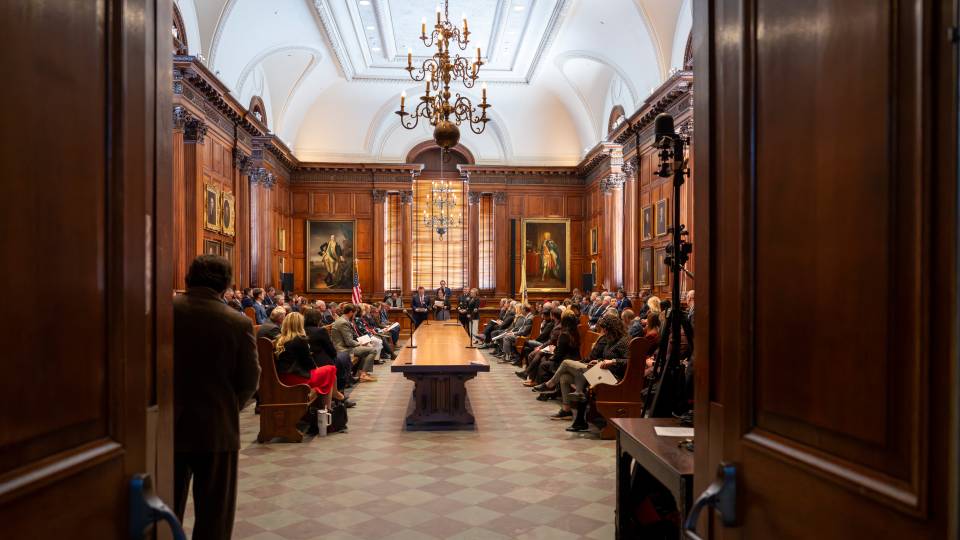
Blaakman leads a discussion with students who experienced firsthand what it was like to explore the University's extensive collection of materials from the time of the country’s founding — an opportunity, he says, that "you just cannot do anywhere other than a handful of other institutions."
“You want to find the new discovery that causes us to revise what we thought we understood, and archives are where that happens,” he said. "As the present changes — and especially when the present is changing as quickly as it is — then our relationship to the past changes and the questions we take to the past change,” Blaakman said. Both the exhibit and the course are invigorated by archival research that keeps going back to the source material for new inspiration, he said.
Hallie Graham, a junior politics major, said she rearranged her entire class schedule to fit in “Revolution in the Archives” this spring. She plans to work as an exhibit tour guide and researcher this summer in Special Collections.
Graham said she especially enjoyed researching broadsides from New Jersey, one of many collaborative class workshops.
“During that project, I found myself walking around all the time, and a college campus is a perfect place to see posters,” Graham said. “It's sort of the way college students communicate with each other.
“What I realized is, that hasn't changed,” she said. “We've always used broadsides, and even with an influx of technology, we still have these posters everywhere.”
“‘Nursery of Rebellion’: Princeton and the American Revolution” is curated by Michael Blaakman, associate professor of history, and Gabriel Swift, librarian for Early American Collections, with contributions from students in the spring 2025 “Revolution in the Archives” course. A digital version of the exhibit is also available.
The exhibition opens to the public on April 15 with gallery hours on Tuesdays, Wednesdays, Saturdays and Sundays from 10 a.m. to 6 p.m. and Thursdays and Fridays from 10 a.m. to 8 p.m. through July 12, 2026.
A second library exhibit, “Real and Remembered: Princetonians Caught Between Study and Revolution,” will explore campus and student experiences before, during and after the war. It is scheduled to open May 21 in the Mudd Manuscript Library and run through April 30, 2027.