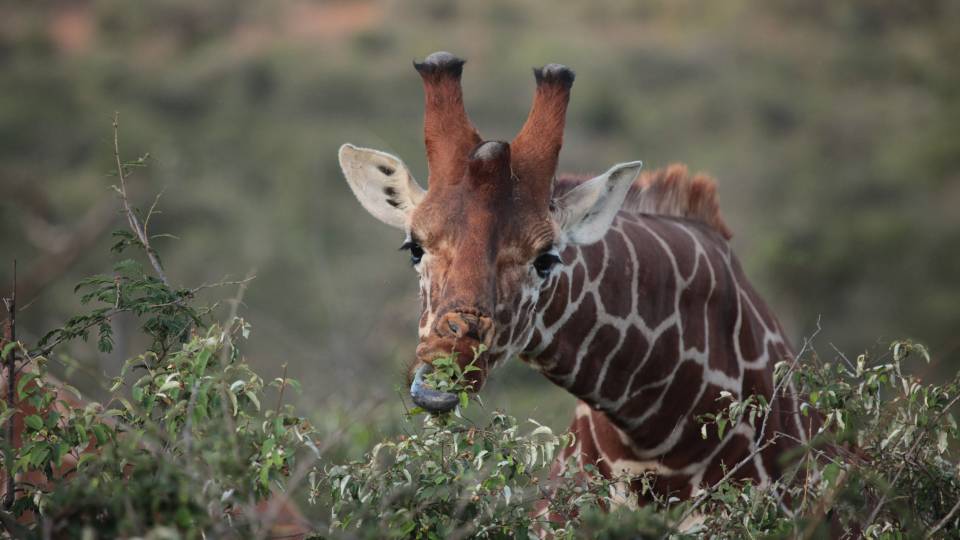
Princeton scientists identify first experimental evidence of a 'co-extinction' connection: Without elephants, dung beetles disappear
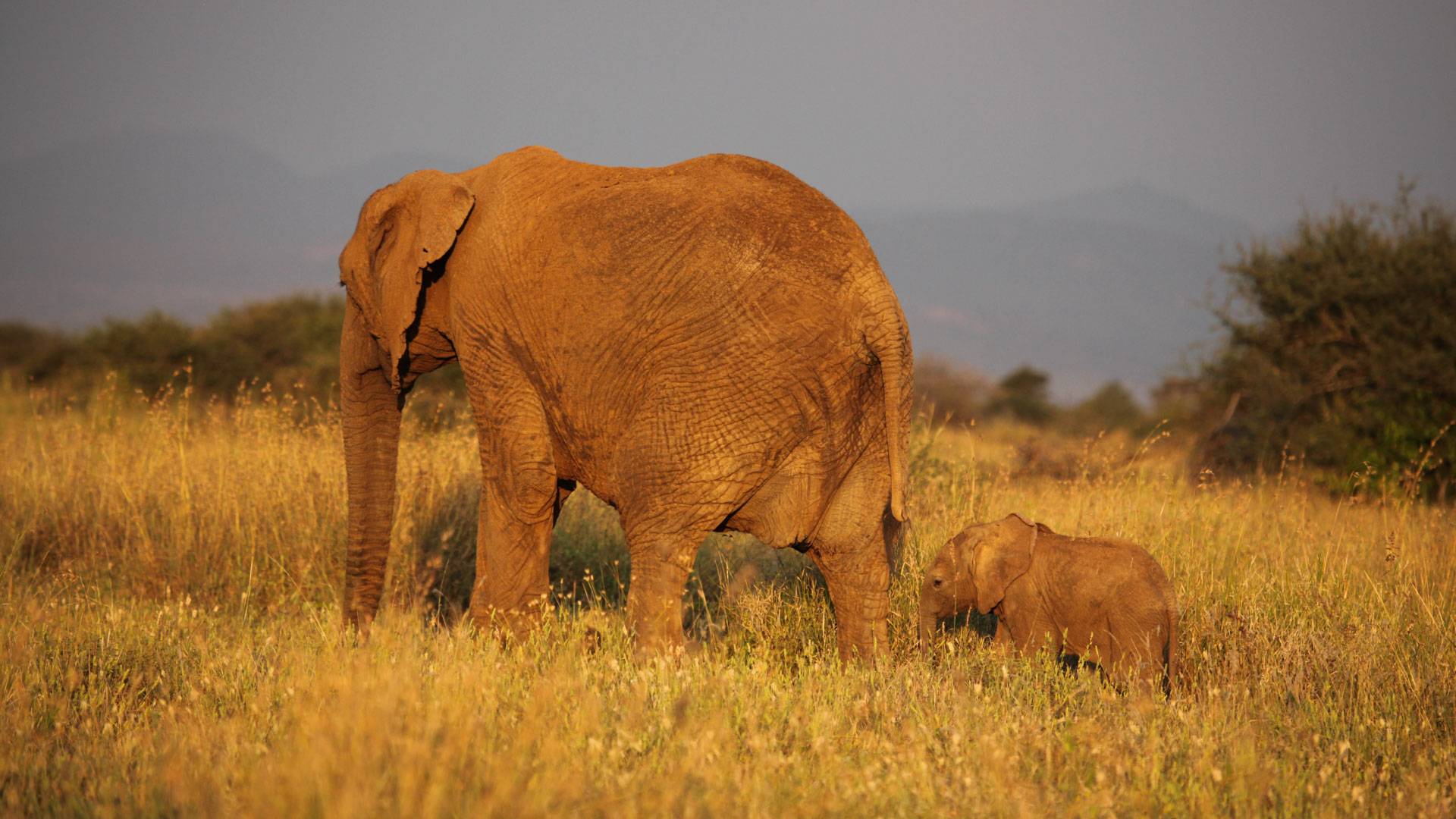
A mother and baby elephant walk through their savanna home. All photos are from Mpala Research Centre in Kenya unless otherwise noted.
Elephants sustain a diverse ecosystem, including many species of dung beetles — colorful insects that perform many key ecological functions. By breaking up, moving and burying dung, these tiny creatures contribute to soil aeration, nutrient cycling and seed dispersal. They also suppress intestinal parasites, lungworms, flies and other pests.
A new study from Princeton University, the Smithsonian Institution, the Mpala Research Centre and many partner institutions has now documented a “co-extinction” connection between the largest animals in the savanna with some of the smallest.
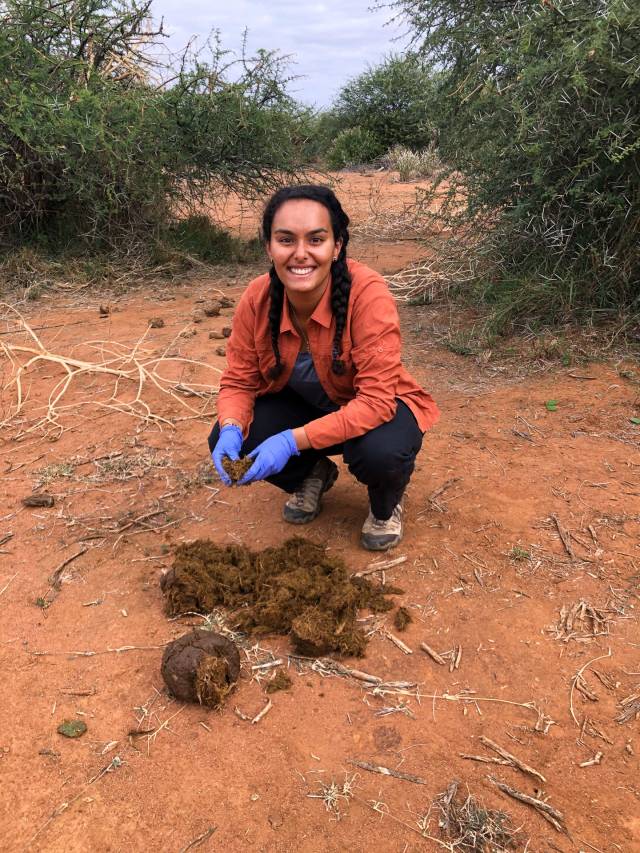
Finote Gijsman pauses in her work at Kenya's Mpala Research Centre.
The groundbreaking study appears in the current issue of the journal Science, from Finote Gijsman, a 2026 Princeton Graduate School Ph.D. recipient in ecology, and her mentor Robert Pringle, a Princeton professor of ecology and evolutionary biology, together with an international team of colleagues.
“There’s no question that big animals, where they still exist, play vitally important ecological roles. That’s not news,” said Pringle. “But what Finote did here was set a new bar of empirical rigor. She experimentally confirmed that if elephants disappear, many dung beetle species will also go extinct — and we will lose their valuable ecosystem services, including recycling waste and dispersing seeds. This represents a significant advance in our understanding of ‘co-extinction,’ which is when the loss of one species causes the secondary extinction of other, dependent, species in the interconnected web of life.”
For years, ecological models have predicted that when one species goes extinct, those that depend on it will also go extinct. But proving the existence of these co-extinctions proved frustratingly difficult. Often, the dependent species would prove to have a “hidden adaptability,” Pringle said, finding unexpected ways to accommodate the loss. He pointed to passenger pigeons. When they went extinct, scientists were sure that the lice living on them would follow them to extinction. Instead, the lice found other species to pester.
In 2008, Pringle and an international group of researchers built a set of 10,000-square-meter exclosures — not enclosures, but areas specifically excluding certain mammals — at the Mpala Research Centre in Kenya. One exclosure kept out elephants and giraffes, the tallest mammals in the region, while another exclosure kept out all but the tiniest.
These exclosures have served as a multiple-decade experiment examining what would happen should large- and medium-sized mammals go extinct.
Gijsman brought her pre-existing expertise in entomology to Pringle’s team, and during her five-year Ph.D. research she identified and DNA-tested more than 4,000 beetles to map precisely which species interact with which others.
“I came into the Ph.D. with a background in insects, and I also knew that I wanted to work at Mpala, because I grew up in Kenya,” said Gijsman. “I was lucky that there was already a dung beetle project at Mpala. Its initial phase, conducted about 20 years ago, created a big reference collection that provided the baseline information I needed.”
“For me, this is a new world — a new micro-world full of really cool-looking beetles,” said Pringle. “Dung ‘rollers’ have really long hind legs, and short front legs that push dung away from piles and then bury it. ‘Dwellers’ tunnel into a dung pat and build nests there, and then their larva hatches out and uses the dung as food. ‘Tunnelers’ bury dung beneath piles. The beetles have different morphologies that can correspond to their different lifestyles. I find it all very neat.”
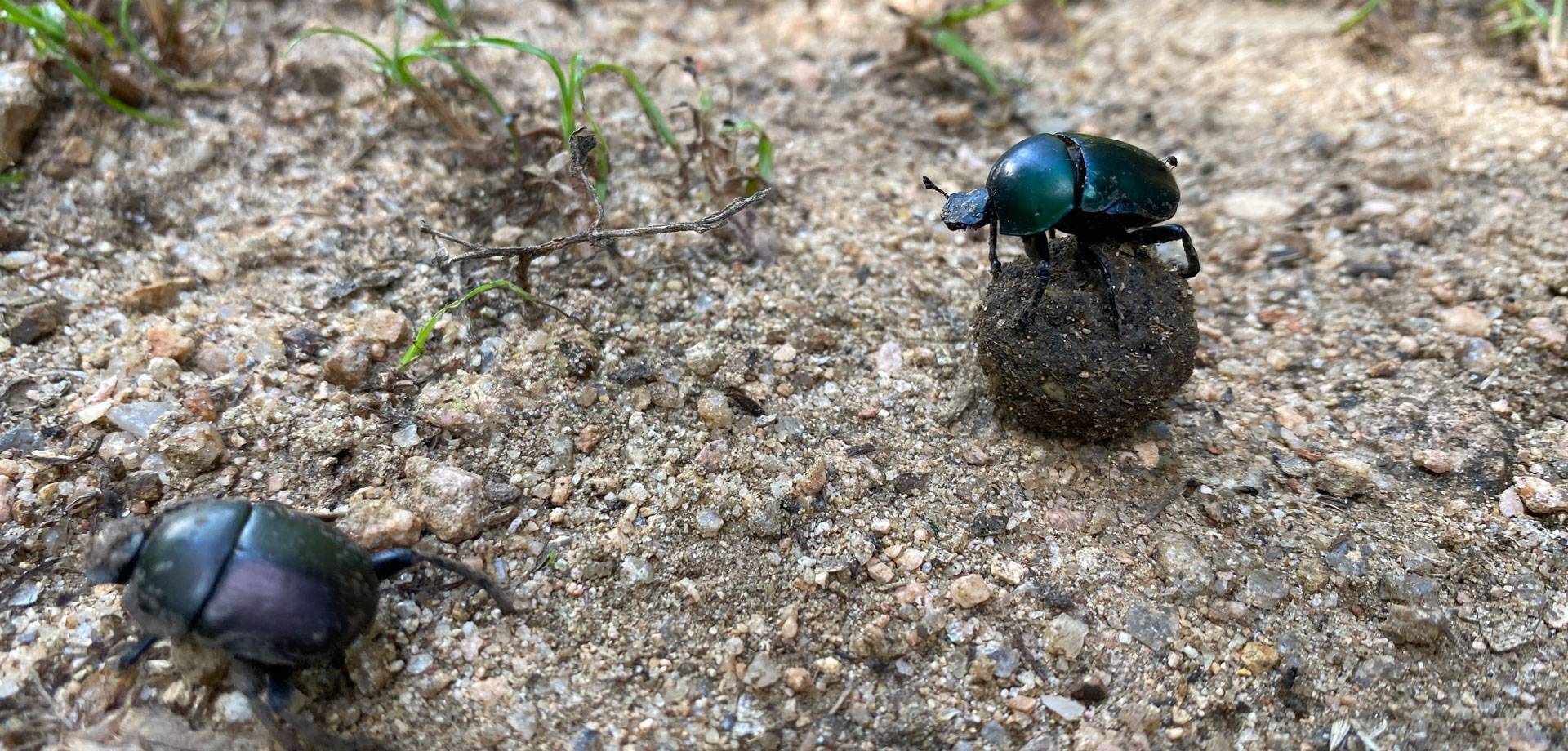
Dung beetles rolling their balls of dung at Gorongosa National Park in Mozambique.
Gijsman and her colleagues brought together modern approaches, including molecular techniques and DNA barcoding, with controlled experiments, classic fieldwork, and museum reference collections. “It’s very rare to have all those components come together to create such a clear picture,” said Gijsman.
The researchers documented that while nearly all dung beetles have a strong preference for elephant dung — which is nutrient-rich and voluminous — some will indeed reveal a “hidden adaptability” when there are no elephants around and make do with the dung of smaller ruminants.
But critically, some dung beetle species did disappear from the elephant exclosures. The researchers found that dung beetles were 67% less abundant, with 23% fewer species, in the exclosures.
That makes this study a significant contribution to the field of ecology as a whole, Pringle said. “This is really the first study where we’ve put together the food web and calculated multiple metrics of connectedness and centrality-in-the-network and shown that it corresponds very precisely with the impact and importance of that species.”
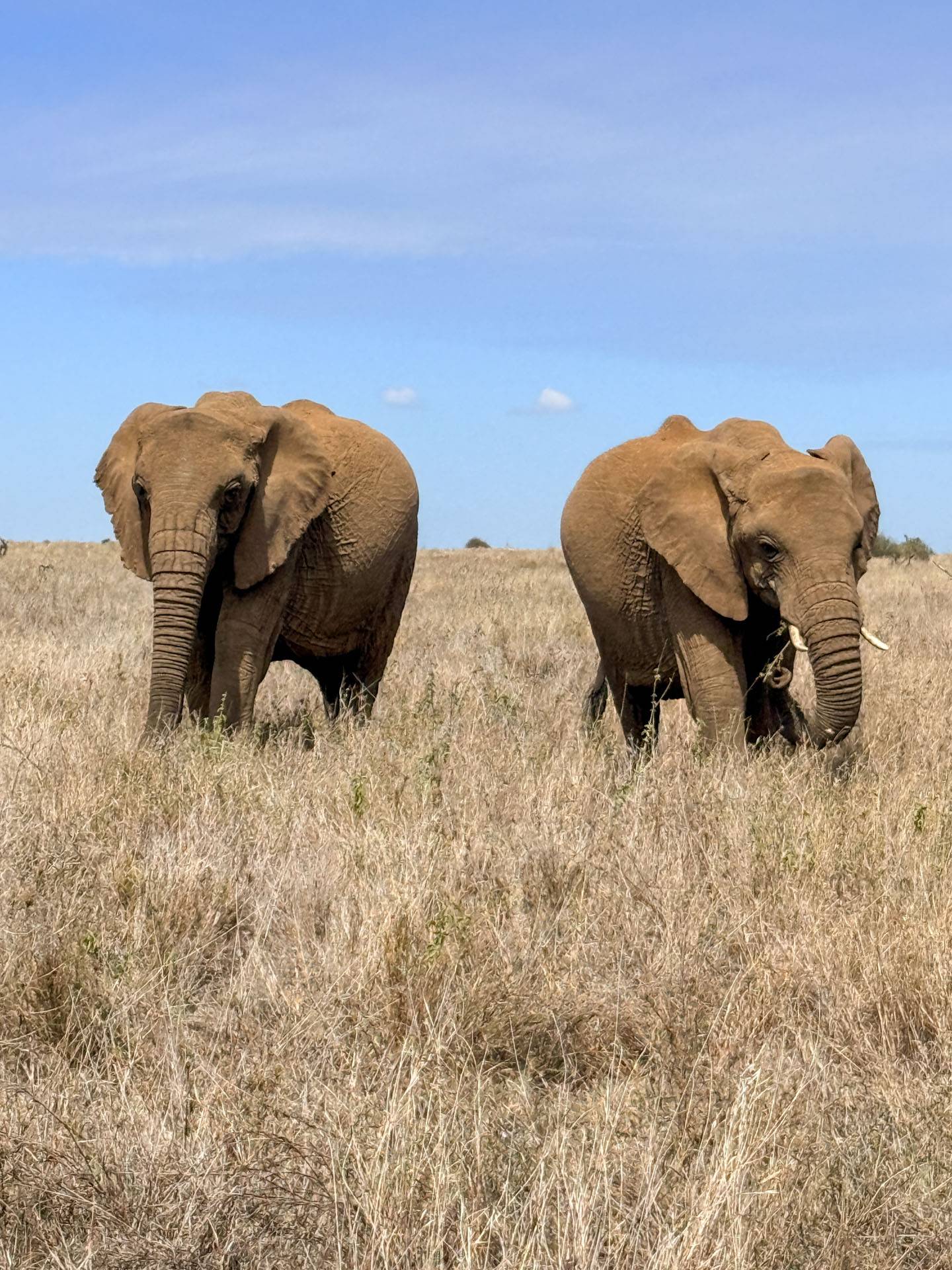
Elephants forage for food.
The paper, “Importance of elephants for dung beetle biodiversity and ecosystem functions,” appears in the May 28 issue of the journal Science (DOI: 10.1126/science.aeb7062) by Finote Gijsman, Ciara M. Nutter, Fathiya M. Khamis, Fidelis L.O. Ombura, Matthew C. Hutchinson, Todd M. Palmer, Jacob R. Goheen, Scott E. Miller, and Robert M. Pringle. This research was funded by the U.S. National Science Foundation (grants 1355122, 1457697, 1656527, 2225088, 2303836 to R.M.P. and 1547679, 1930763, 2018405, 2132265 to J.R.G.); the Mohammed bin Zayed Species Conservation Fund (212525091 to F.G.); the Rufford Foundation (38617-1 to F.G.); the American Philosophical Society (to F.G.); the Society of Systematic Biologists (to F.G.); the Mary & Randall Hack ‘69 Award of the High Meadows Environmental Institute at Princeton University (to F.G.); the Currie C. and Thomas A. Barron Biodiversity Challenge (to R.M.P.); the Carbon Mitigation Initiative (to R.M.P.); the Princeton Institute for International Relations (to F.G.); the Smithsonian Institution Barcode Network (to F.G. and S.E.M.); the Natural Sciences and Engineering Research Council (to J.R.G.); the University of Wyoming (to J.R.G.); Iowa State University (to J.R.G.); a Collegium Helveticum senior fellowship (to R.M.P.); a John Simon Guggenheim Memorial Foundation fellowship (to R.M.P.).