Yibin Kang’s team identifies new path to potential cancer treatments
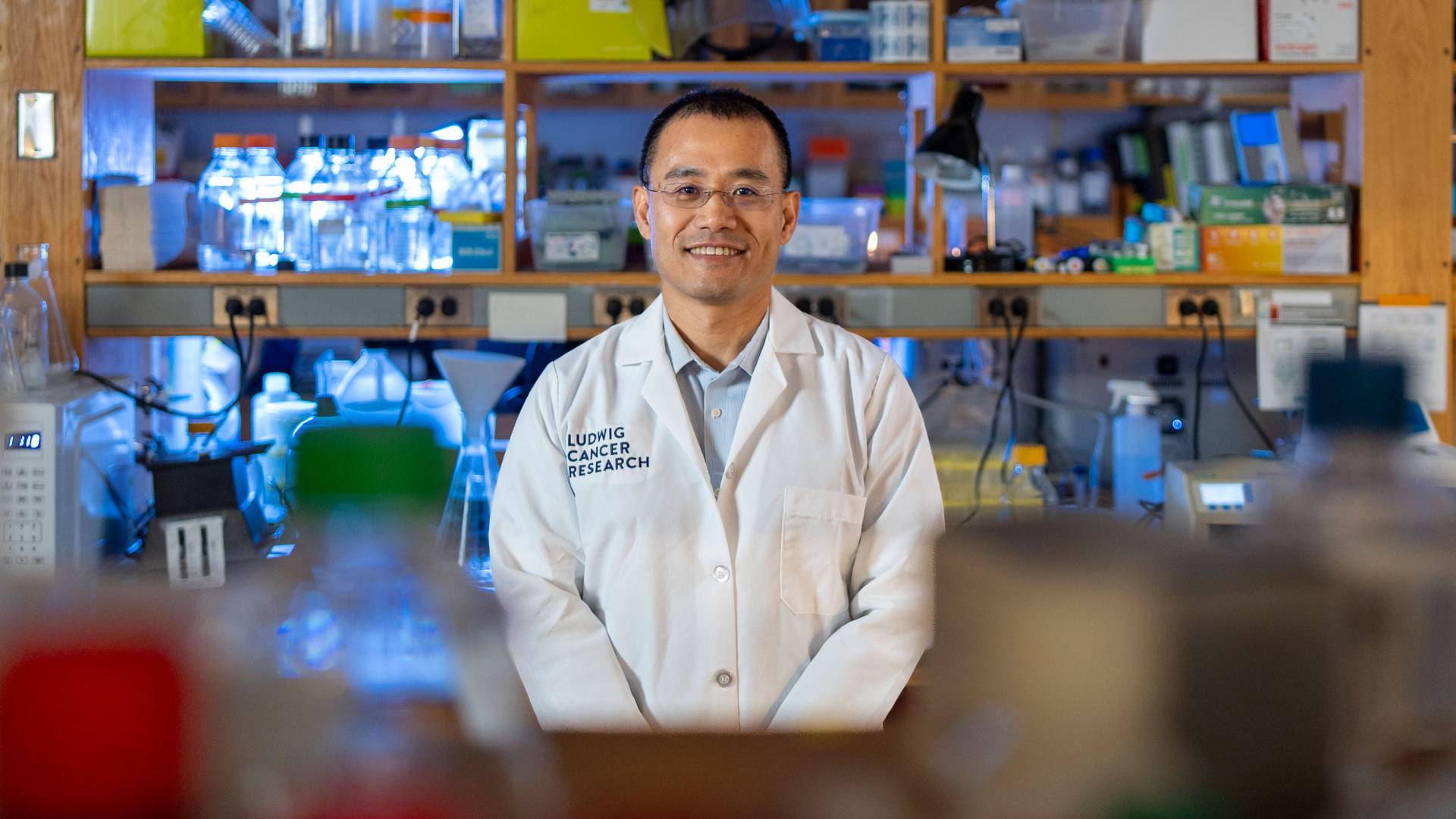
Yibin Kang, Princeton's Warner-Lambert/Parke-Davis Professor of Molecular Biology and a founding member of the Princeton Branch of the Ludwig Institute for Cancer Research
For years, scientists have puzzled over the paradoxical relationship between cancer and retinoids, the metabolites that animals and people produce when their bodies break down vitamin A.
About 40 years ago, a leukemia patient was cured with a combination of arsenic and a retinoid known as all-trans retinoic acid (ATRA). Popular science immediately seized on the idea that vitamin A-rich foods like carrots could help cure or prevent cancer.
But while some experiments in petri dishes seemed promising, nearly all efforts to treat cancer patients with vitamin A or retinoids caused tumors to grow, not shrink.
Eventually, the FDA started to heavily scrutinize vitamin A-related drug tests in cancer patients, and no such treatment was approved except for patients with one specific kind of cancer: acute promyelocitic leukemia (APL).
Now, a team of cancer biologists led by Yibin Kang, the Warner-Lambert/Parke-Davis Professor of Molecular Biology at Princeton University, have resolved this paradox, and in the process found a potential new avenue for thwarting many cancers, including pancreatic cancer, breast cancer and lung cancer.
They detailed their work in two recent papers: one in iScience published in November 2025 and a new paper published today in Nature Immunology. Kang, a founding member of the Princeton Branch of the Ludwig Institute for Cancer Research, is also an associate director of the Rutgers Cancer Institute of New Jersey.
Over the past decade, Kang’s laboratory has meticulously clarified the relationship between retinoids and cancer cells. While doctors have found that APL is highly treatable with ATRA and arsenic, Kang and his team discovered that other cancers use retinoids to shield themselves from the immune system.
Based on the molecular structure of the enzyme that produces retinoic acid, the immune-suppressing retinoid, they set out to find chemical compounds that could block it — eventually narrowing it down to a molecule known as KyA33. That molecule blocked a terminal step in the pathway without causing the harmful vision effects that would occur if vitamin A metabolism were eliminated altogether.
In the new Nature Immunology paper, first author Cao Fang (who received her Ph.D. from Princeton in 2025) from the Kang lab details just how KyA33 inhibits retinoic acid production by both cancer cells and the immune system’s dendritic cells (DCs). The research team found that KyA33 both boosted the effectiveness of DC vaccines in animals and also holds promise as an independent cancer immunotherapy.
“By targeting these enzymes that produce a localized high concentration of retinoic acid in tumors, our compounds have the potential to reactivate important immune responses to cancer,” said Kang.
Separately, Kang and his former graduate student Mark Esposito (a 2017 Ph.D. graduate) have launched a startup company, Kayothera. One of its goals is to work through the FDA process to bring more advanced compounds based on KyA33 to patients.
“This whole process is a very good example of how academic research in the lab can identify leads and targets that ultimately support a successful biotech company,” said Kang.
“Targeting autocrine retinoic acid signaling by ALDH1A2 inhibition enhances antitumor dendritic cell vaccine efficacy,” by Cao Fang, Mark Esposito, Ulrike Hars, Robert T. Byrne, Bokai Song, Jian Huang, Asael Roichman, Lawrence Shue, Xiaobing Cheng, John Proudfoot, Demin Zhao, Yong Wei, Ileana M. Cristea, Joshua D. Rabinowitz and Yibin Kang is in the Jan. 5 issue of Nature Immunology (DOI: 10.1038/s41590-025-02376-4). The research was supported by the Ludwig Institute for Cancer Research, the Brewster Foundation, the Susan Komen Foundation, Metavivor Breast Cancer Research, the Breast Cancer Research Foundation and the American Cancer Society.
“Development of retinoid nuclear receptor pathway antagonists through targeting aldehyde dehydrogenase 1A3,” by Mark Esposito, Cao Fang, Yong Wei, Alfonso Pozzan, Claudia Beato, Xiaoyang Su, Josiah E. Hutton, Tavis Reed, Xiang Hang, Enrico D. Perini, Wen Wang, Xiaobing Cheng, Yan Pan, Jianshi Yu, Maureen Kane, Malini Manoharan, John Proudfoot, Ileana M. Cristea and Yibin Kang, was published Nov. 21, 2025 in iScience (DOI: 10.1016/j.isci.2025.113675 ). The research was supported by the Ludwig Institute for Cancer Research, the New Jersey Health Foundation, the Brewster Foundation, the Susan Komen Foundation, the Breast Cancer Research Foundation, the American Cancer Society and the National Science Foundation.