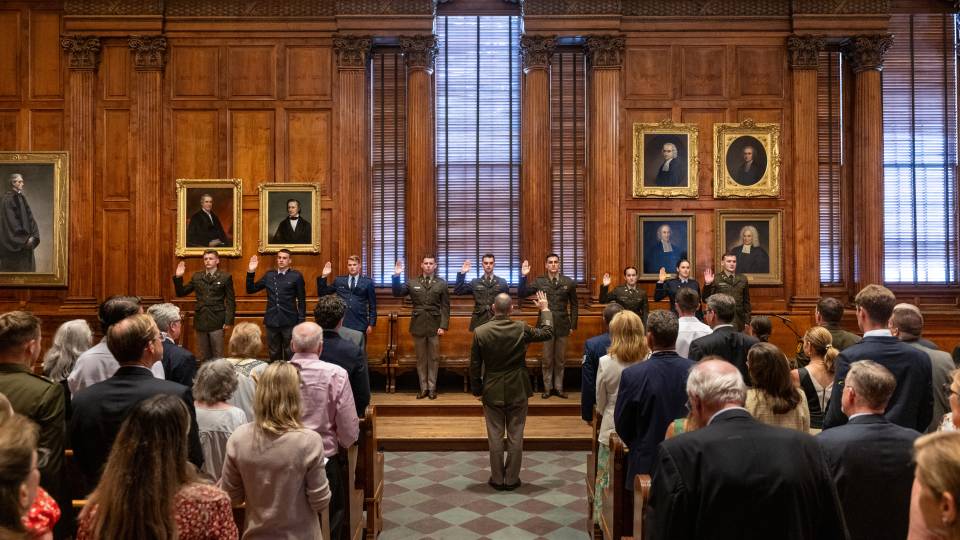
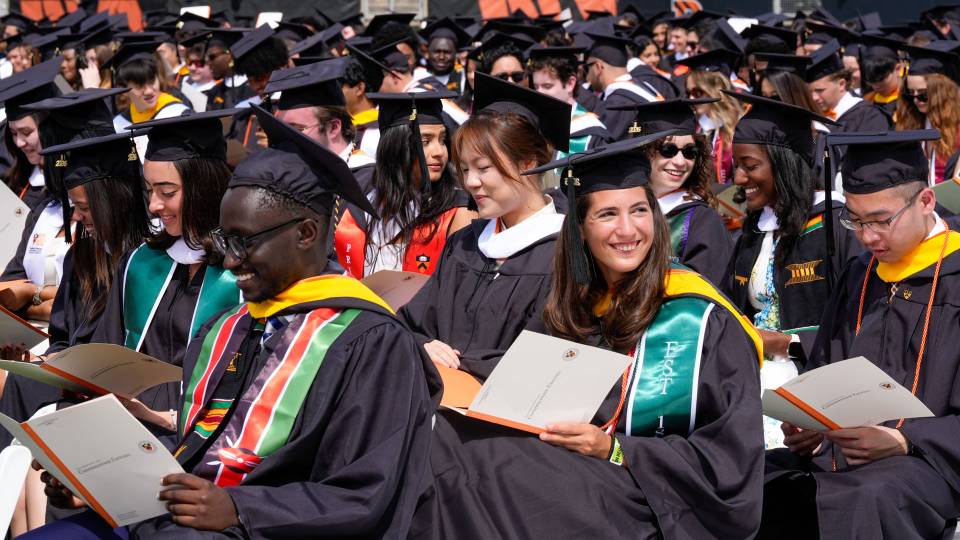
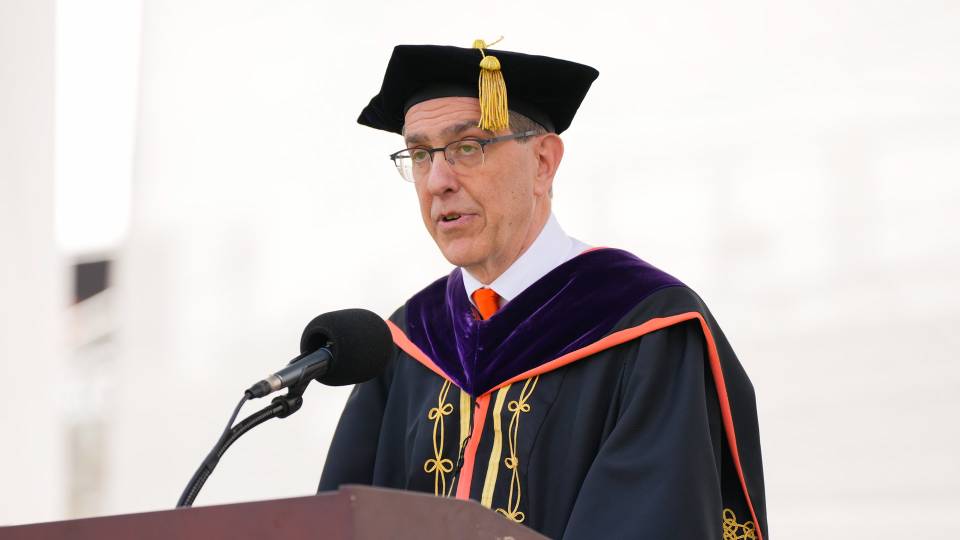
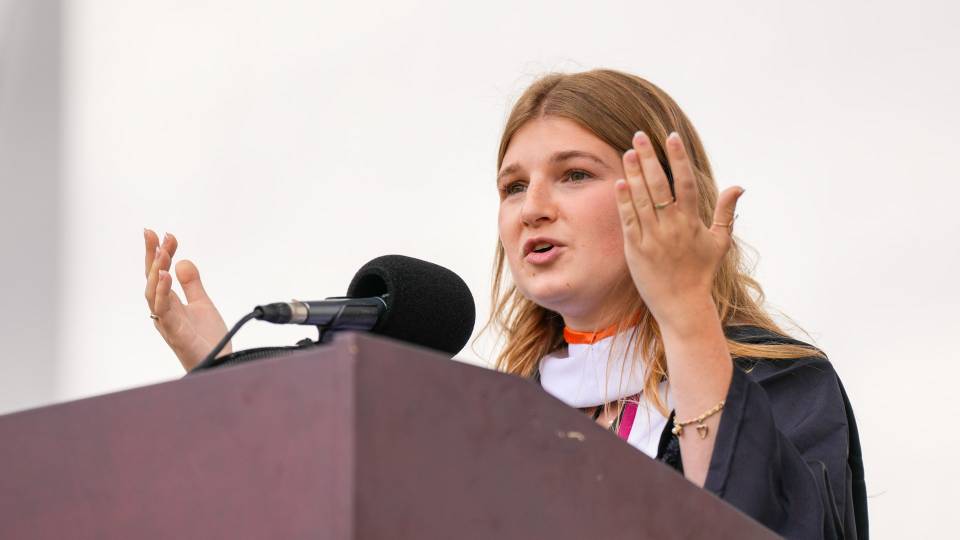
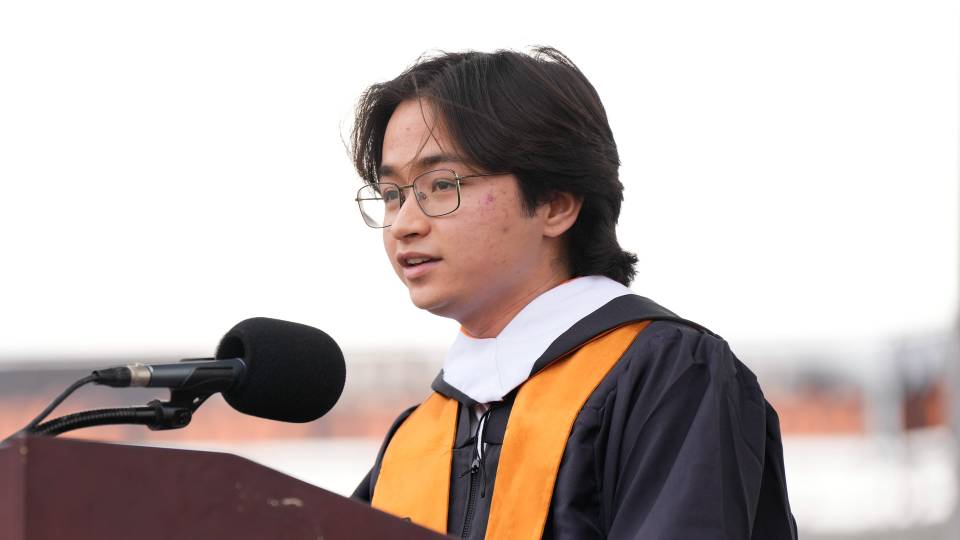
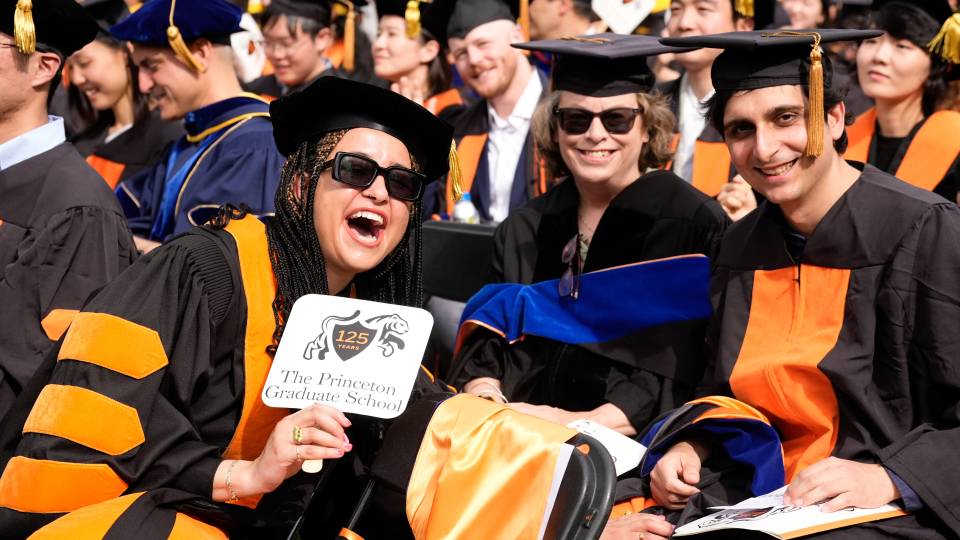
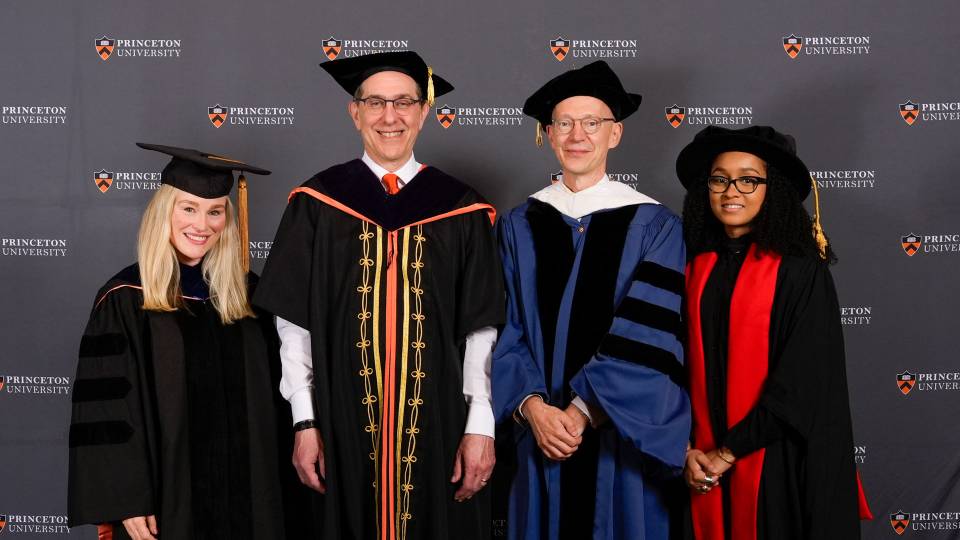
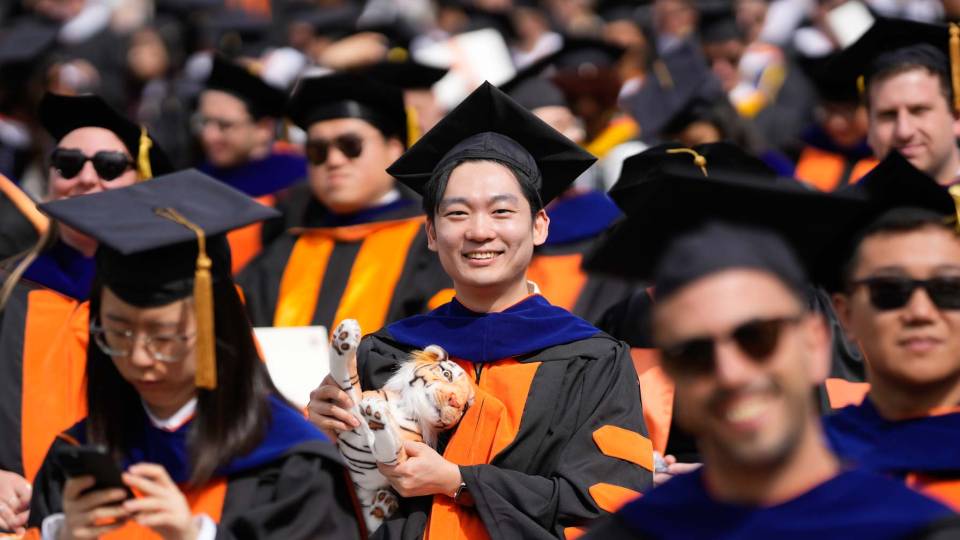
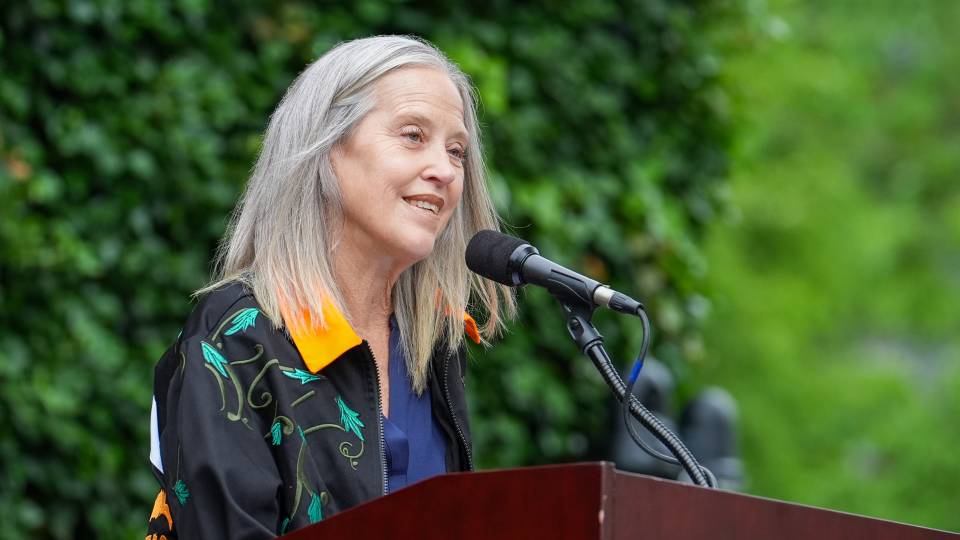
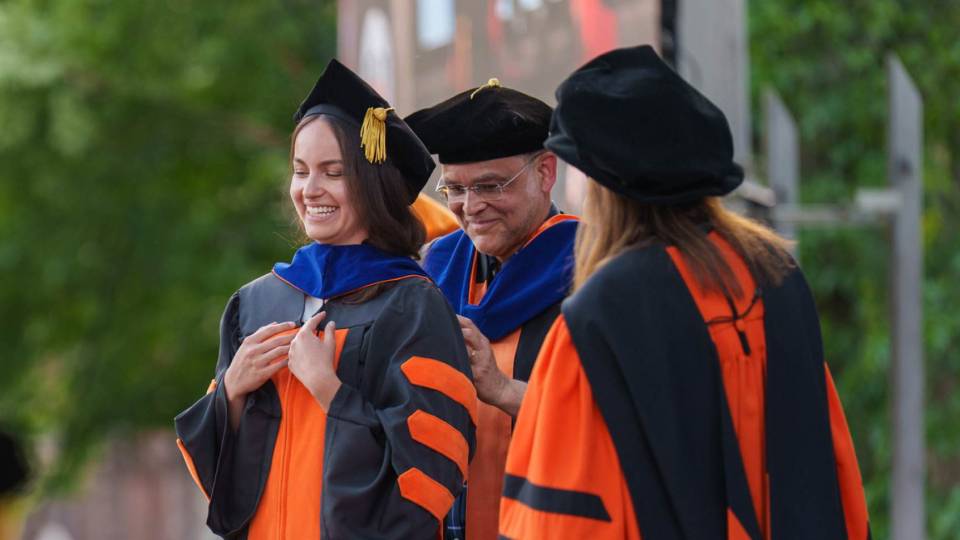
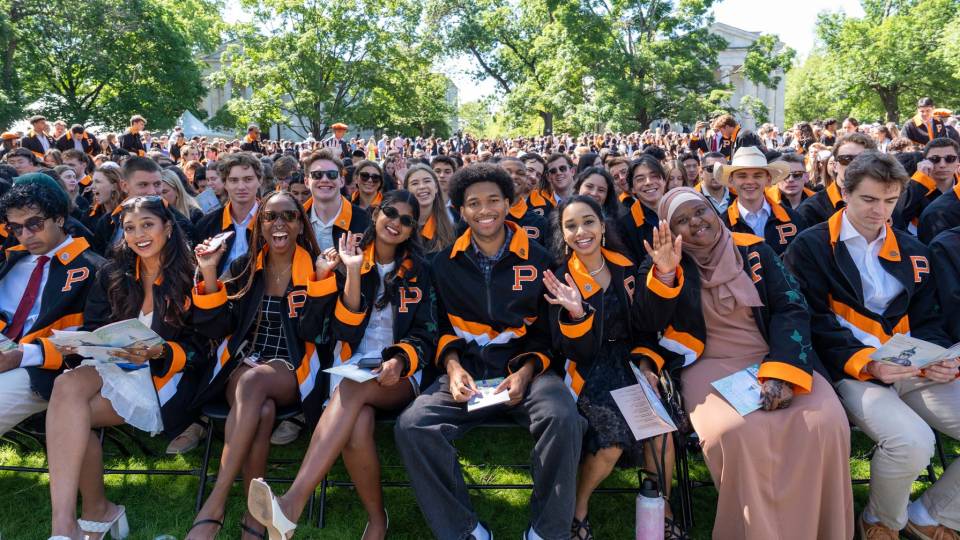
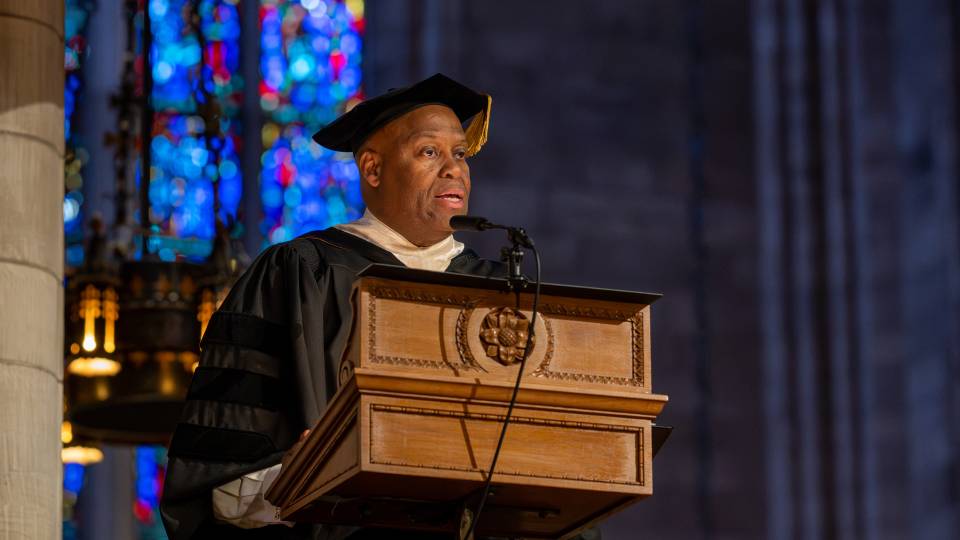
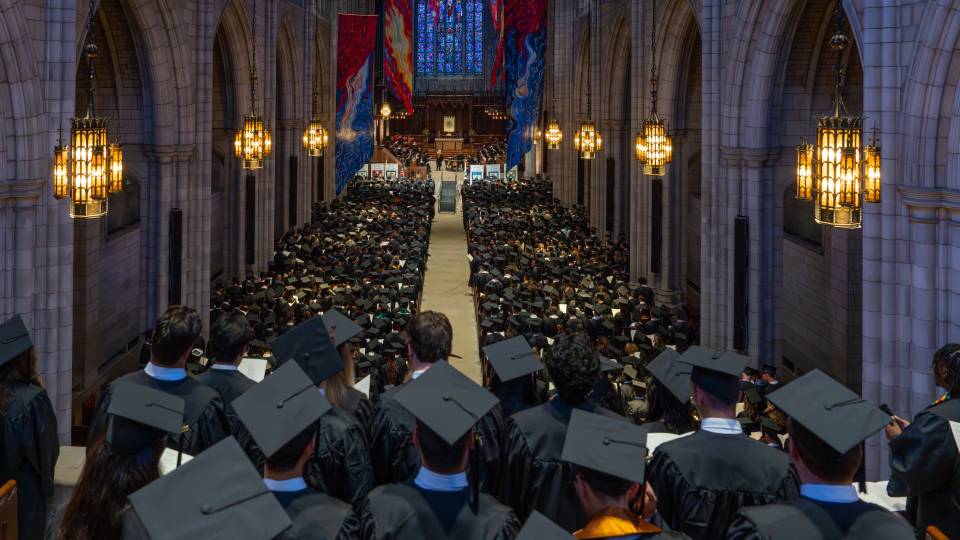
Princeton University awarded honorary degrees to the following recipients during the 2026 Commencement ceremony on Tuesday, May 26.
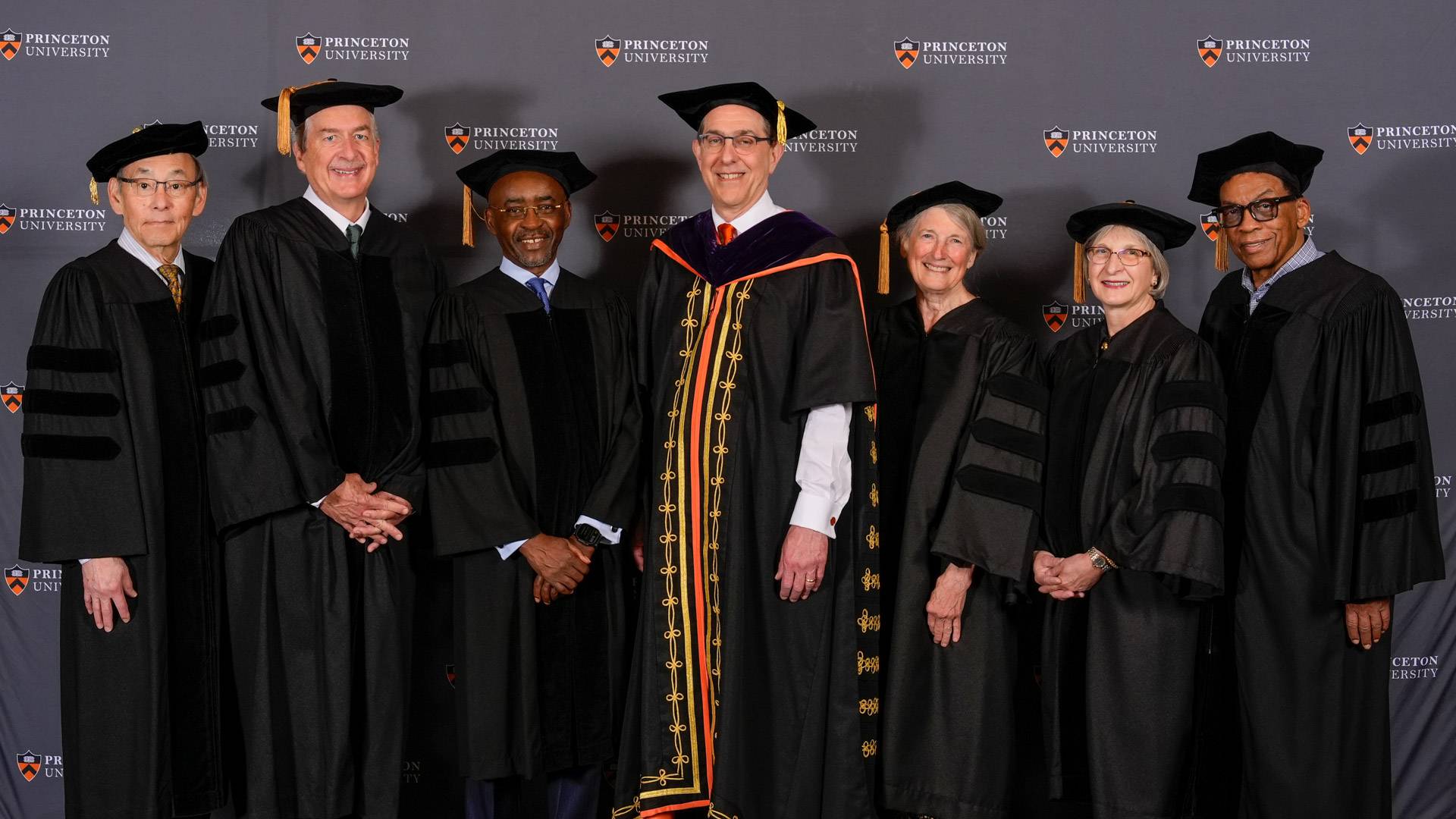
Princeton University awarded six honorary degrees at the 2026 Commencement ceremony. From left: Steven Chu, William Burns, Strive Masiyiwa, President Christopher L. Eisgruber, Caryl Emerson, Jaynee LaVecchia, and Herbie Hancock.
William J. Burns
Doctor of Laws
William J. Burns is one of the most distinguished and respected American statesmen of the last century. He most recently served as Director of the Central Intelligence Agency from 2021 to 2025, the first career diplomat to lead the CIA. Before that, Burns spent three and a half decades in the U.S. Foreign Service and achieved its highest rank, Career Ambassador. He served as U.S. ambassador to Jordan from 1998 to 2001, U.S. ambassador to Russia from 2005 to 2008, and Deputy U.S. Secretary of State from 2011 to 2014, among many other senior posts, including undersecretary of state for political affairs, executive secretary of the State Department, and senior director for Near East and South Asian affairs at the National Security Council. Burns also served as a Visiting Fellow at All Souls College, Oxford, in 2017 and as President of the Carnegie Endowment for International Peace from 2015 to 2021, during which time he wrote the bestselling book, The Back Channel: A Memoir of American Diplomacy and the Case for Its Renewal. He was on Time magazine’s list of Forty Most Promising Global Leaders Under Forty in 1994, and was named one of the magazine’s 100 Most Influential People in 2024.
University of Oxford (Marshall Scholar, DPhil, 1981)
LaSalle University (B.A., 1978)
A distinguished career ambassador, he served six presidents, modeling the enduring role and value of diplomacy on the national stage. Upon retiring from the U.S. Foreign Service after more than three decades, he went on to serve as president of the Carnegie Endowment for International Peace and as director of the Central Intelligence Agency. During remarks announcing his nomination, former President Biden described him as “an exemplary diplomat with decades of experience on the world stage, keeping our people and our country safe and secure.” Over the course of an illustrious career, his quiet, principled leadership strengthened alliances, widened dialogue with adversaries, and set a standard of excellence for generations of diplomats.
Steven Chu
Doctor of Science
Nobel laureate and former U.S. Secretary of Energy Steven Chu is a pioneering physicist whose research is foundational to quantum science and whose public policy leadership has advanced energy science and technology. Chu is currently the William R. Kenan, Jr. Professor of Physics, professor of Molecular and Cellular Physiology, and of Energy Science and Engineering at Stanford University. As Energy Secretary from 2009 to 2013, Chu led national energy policy, spearheading initiatives including ARPA-E (the Advanced Research Projects Agency–Energy), the Energy Innovation Hubs, and the international policy forum the Clean Energy Ministerial. From 2004 to 2009, Chu served as director of the Lawrence Berkeley National Laboratory and as a professor of physics and of molecular and cell biology at the University of California-Berkeley. He previously served as the Theodore and Francis Geballe Professor of Physics and Applied Physics at Stanford University, where he helped found the interdisciplinary biosciences institute Stanford Bio-X. Chu shared the 1997 Nobel Prize in Physics for research he conducted while at Bell Labs that led to the “development of methods to cool and trap atoms with laser light,” a technique that is now fundamental to quantum physics and supports technological advancements from atomic clocks to precision GPS and quantum computing. In 2024, Chu was awarded the Karl Taylor Compton Medal from the American Institute of Physics, which recognizes “highly distinguished physicists who have made outstanding contributions to physics through exceptional statesmanship in science.” Chu is a member of the National Academy of Sciences, the American Philosophical Society, the American Academy of Arts and Sciences, the National Academy of Inventors, and the Academia Sinica, and is a foreign member of the Royal Society, the Royal Academy of Engineering, the Chinese Academy of Sciences, the Korean Academy of Science and Technology, the National Academy of Sciences of Belarus, and the Pontifical Academy of Sciences.
University of California-Berkeley (Ph.D., 1976)
University of Rochester (B.S., 1970)
University of Rochester (A.B., 1970)
A groundbreaking scientist, educator, and public servant, he received the Nobel Prize in Physics for pioneering research on laser cooling and optical trapping of atoms—work that transformed modern physics. The first scientist to hold a United States Cabinet position, he served as the twelfth Secretary of Energy, bringing scientific rigor to public policy and guiding transformative investments in clean energy, climate science, and technological innovation. As a university professor and academic leader, he has inspired generations of students and strengthened collaboration across disciplines. Bridging discovery, education, and public leadership, he exemplifies the power of science in service to society.
Caryl Emerson
Doctor of Humane Letters
Caryl Emerson is known as one of the country’s leading Slavists, having shaped decades of scholarship and teaching on Russian and Central European literature, theater, music, and philosophy. Emerson is the A. Watson Armour III University Professor Emeritus of Slavic Languages and Literatures at Princeton University and served as longtime chair of the Department of Slavic Languages and Literatures. She has received fellowships from the Guggenheim Foundation and the American Council of Learned Societies and has been recognized with lifetime achievement awards from the American Association of Teachers of Slavic and East European Languages, of which she is a past president, and the Association for Slavic, East European, and Eurasian Studies. In 2003 she was elected to the American Philosophical Society. Emerson is the author and translator of several field-defining studies, notably on the philosopher and literature critic Mikhail Bakhtin, Alexander Pushkin’s works set to music, Modest Musorgsky’s opera Boris Godunov, the prose of the Russian modernist Sigizmund Krzhizhanovsky, and most recently of the post-Soviet novelist Vladimir Sharov. She values the difficult task of introducing subjects compactly to new audiences, as evidenced by her 2008 book The Cambridge Introduction to Russian Literature, and, as co-editor, The Oxford Handbook of Russian Religious Thought (2020). Passionate about translation and restoration, in 2007 and 2012 she co-managed the premieres of two all-campus productions, with music by Sergei Prokofiev, of Pushkin’s Boris Godunov and Eugene Onegin. Emerson has been recognized for her work as an inspiring professor and generous adviser, with a teaching career spanning more than five decades. At Princeton, she has received the President’s Award for Distinguished Teaching, the Howard T. Behrman Award for Distinguished Achievement in the Humanities, and the Graduate Mentoring Award. Her service to the University also includes roles on executive boards and committees for Princeton University Press, the University Center for Human Values, the Society of Fellows, and the Council of the Humanities.
University of Texas-Austin (Ph.D., 1980)
Harvard University (M.A., 1968)
Cornell University (B.A., 1966)
A trip to the Soviet Union at the age of eleven sparked her lifetime of groundbreaking work as one of America’s preeminent Slavists. A distinguished scholar, teacher, and critical theorist of Russian literature and culture, she has helped reshape the study of the humanities. Over a storied career at Princeton, she has received a President’s Award for Distinguished Teaching, the Howard T. Behrman Award for Distinguished Achievement in the Humanities, and a Graduate Mentoring Award. Reaching across disciplines and collaborating on ambitious productions, she has illuminated works once hidden behind the curtain of communism. In her scholarship and teaching, she embodies the highest ideals of humanistic inquiry and the enduring value of the liberal arts.
Herbie Hancock
Doctor of Music
Herbie Hancock is a modern music icon who has left an indelible mark on jazz, R&B, electronic, and funk music. The jazz legend has influenced generations of musicians around the world during his six decades as a solo artist, band leader and member, composer, producer, and innovator. Hancock has won fourteen Grammy Awards, including the 2016 Grammy Lifetime Achievement Award and the 2008 Album of the Year for River: The Joni Letters, the first jazz album to win the award in forty-three years. A child piano prodigy, Hancock went on to become a pioneer in the use of electric piano, synthesizer, and clavinet in jazz music. His career has crossed genres and spanned media—from his early work with the Miles Davis Quintet, to his groundbreaking solo albums and platinum hits with his band The Headhunters, to leaving his indelible mark on hip hop with “Rockit.” He has composed music for television and film, including the Oscar-winning score for the movie Round Midnight. Hancock is also known for his support of arts, education, and cultural institutions, serving as chairman of the Herbie Hancock Institute of Jazz, a nonprofit devoted to jazz performance and education worldwide, and as the Los Angeles Philharmonic’s creative chair for jazz. He is a founder of the International Committee of Artists for Peace, a UNESCO Goodwill Ambassador, and a recipient of France’s Commandeur des Arts et des Lettres, the country’s highest cultural honor. He is a member of the American Academy of Arts and Sciences and a 2013 Kennedy Center honoree.
Grinnell College (B.A., 1960)
An Academy Award winner and recipient of fourteen Grammy Awards, including Album of the Year for River: The Joni Letters, his remarkable artistic journey began at age eleven, when he performed Mozart’s Piano Concerto No. 26 with the Chicago Symphony Orchestra. A double major in electrical engineering and music, he recognized early that technology would shape the future of sound; his fascination with electronics led to a pioneering exploration of synthesized music. Across decades, his innovations have influenced countless artists, redefined ensemble collaboration, and expanded the possibilities of improvisation. As an advocate for arts education and a UNESCO Goodwill Ambassador, he demonstrates how artistic excellence can foster connection, curiosity, and shared humanity worldwide.
Jaynee LaVecchia
Doctor of Laws
Justice Jaynee LaVecchia is a former associate justice of the New Jersey Supreme Court and is the state’s longest-serving female justice. She is a partner at the law firm McCarter and English, LLP. LaVecchia was nominated to New Jersey’s top court by Gov. Christine Todd Whitman in 2000 and retired from the bench at the end of 2021. During her 21 years on the state Supreme Court, she presided over hundreds of cases and authored numerous opinions. Upon LaVecchia’s retirement from the court, Gov. Phil Murphy commended her “independence and integrity.” Prior to her judgeship, LaVecchia served as the New Jersey Commissioner of Banking and Insurance and earlier held leadership positions in state government, including as deputy chief counsel in the Office of Counsel to Gov. Tom Kean, chief administrative law judge in New Jersey’s Office of Administrative Law, and director of the Division of Law within the Department of Law and Public Safety. For her service on the court and in government, LaVecchia received the New Jersey Law Journal’s Lifetime Achievement Award, the New Jersey State Bar Foundation’s Medal of Honor Award, NJBIZ’s Icon Award, and the New Jersey Women of Achievement Award. She was recently honored with the Special Recognition Award by the Trial Attorneys of New Jersey, which is given to “individuals whose careers reflect a deep commitment to the legal profession and a lasting contribution to the pursuit of justice in New Jersey.” LaVecchia is an elected member of the American Law Institute and a fellow of the American Bar Association, as well as a member of the Rutgers University Hall of Distinguished Alumni. In addition, she currently serves as a trustee on the boards of Legal Services of New Jersey and the Atlantic Health System.
Rutgers-Newark School of Law (J.D., 1979)
Douglass College (B.A., 1976)
For more than two decades, she served the citizens of New Jersey as an associate justice of the New Jersey Supreme Court and as its longest-serving female justice. Her commitment to public service began earlier, in roles as commissioner of the Department of Banking and Insurance and director of the State Attorney General’s civil division. Among the defining moments of her tenure were landmark decisions that reshaped the lives of New Jersey’s most vulnerable residents—ensuring fair access to education for children in urban school districts and expanding affordable housing for those in need. An outstanding jurist, public servant, and mentor, she has devoted her career to strengthening the rule of law and advancing justice for all.
Strive Masiyiwa
Doctor of Humane Letters
Strive Masiyiwa is a global technology entrepreneur and philanthropist known for pioneering the transformation of Africa’s digital landscape. In a career spanning almost forty years, he is credited with having led the African mobile revolution which has resulted in over 1 billion people on the continent having a mobile phone. Masiyiwa has invested in and operated numerous businesses in this effort, playing a key role in rolling out digital infrastructure including fiber-optic networks, satellite and cloud communications, data centers, cybersecurity, and Africa’s first AI Factory initiative. He has also founded and invested in other businesses spanning Africa, Europe, the Middle East, New Zealand, the United Kingdom, and the Americas. Recognizing his most recent work, Masiyiwa was named twice to Time magazine’s list of the 100 Most Influential People, including in AI. As a philanthropist, Masiyiwa served for several years as Chairman of AGRA (the Alliance for a Green Revolution in Africa), succeeding the late U.N. Secretary-General Kofi Annan, a role recognized in 2019 with the World Food Prize Foundation’s Norman Borlaug Medallion. He has served on two U.N. commissions related to sustainable energy and global education, and led the African Union’s COVID-19 response as Special Envoy from 2020 to 2022, having held a similar role during the Ebola pandemic from 2014 to 2015. Through his family foundations, Higherlife Foundation and Delta Philanthropies, Masiyiwa and his wife, Tsitsi, have since 1996 supported more than 400,000 scholarships for orphaned, vulnerable, and gifted young Africans from early childhood to doctoral studies, and continue to invest in catalytic initiatives in education, health, rural transformation, and sustainable livelihoods. In 2025, the couple received the David Rockefeller Bridging Leadership Award for their philanthropic work together. They are early signatories of the Giving Pledge. Masiyiwa currently serves on the boards of Netflix and the National Geographic Society and the advisory boards of Stanford University and Bank of America. He is also a trustee of the Gates Foundation. He previously served on the boards of The Rockefeller Foundation and Unilever, among others. Masiyiwa is an international honorary member of the American Academy of Arts and Sciences and was awarded the W. E. B. Du Bois Medal by Harvard University.
Cardiff University (B.Eng., 1984)
This Zimbabwe-born entrepreneur and humanitarian has transformed lives across Africa and around the globe through bold leadership and an unwavering commitment to social progress. His integrated technology enterprises, Econet Group and Cassava Technologies, have expanded digital access and economic opportunity for millions, and equipped entrepreneurs to create, innovate, and compete globally. Through the Higherlife Foundation and Delta Philanthropies, he and his wife, Tsitsi, have expanded access to education for more than 400,000 young Africans, strengthened maternal health outcomes, and supported the transformation of rural communities across the African continent. An inspiring leader, tireless entrepreneur, and generous mentor, he stands in the service of humanity.