Ahmadi, Dolven, Joseph and Ljung receive President’s Awards for Distinguished Teaching
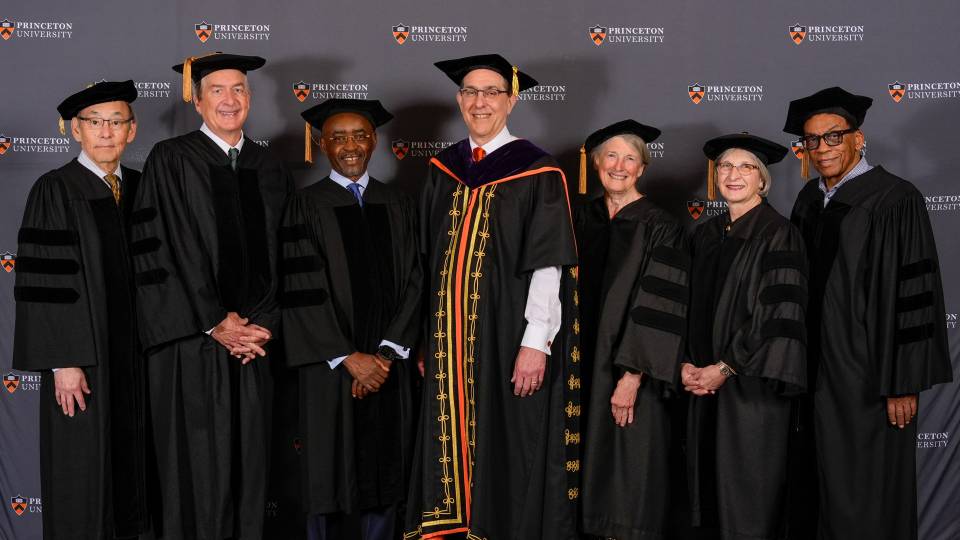
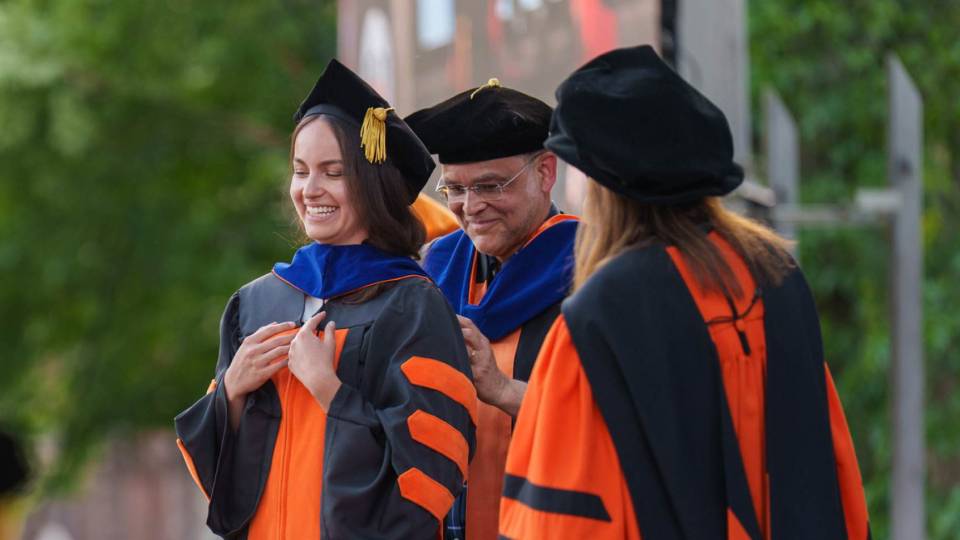
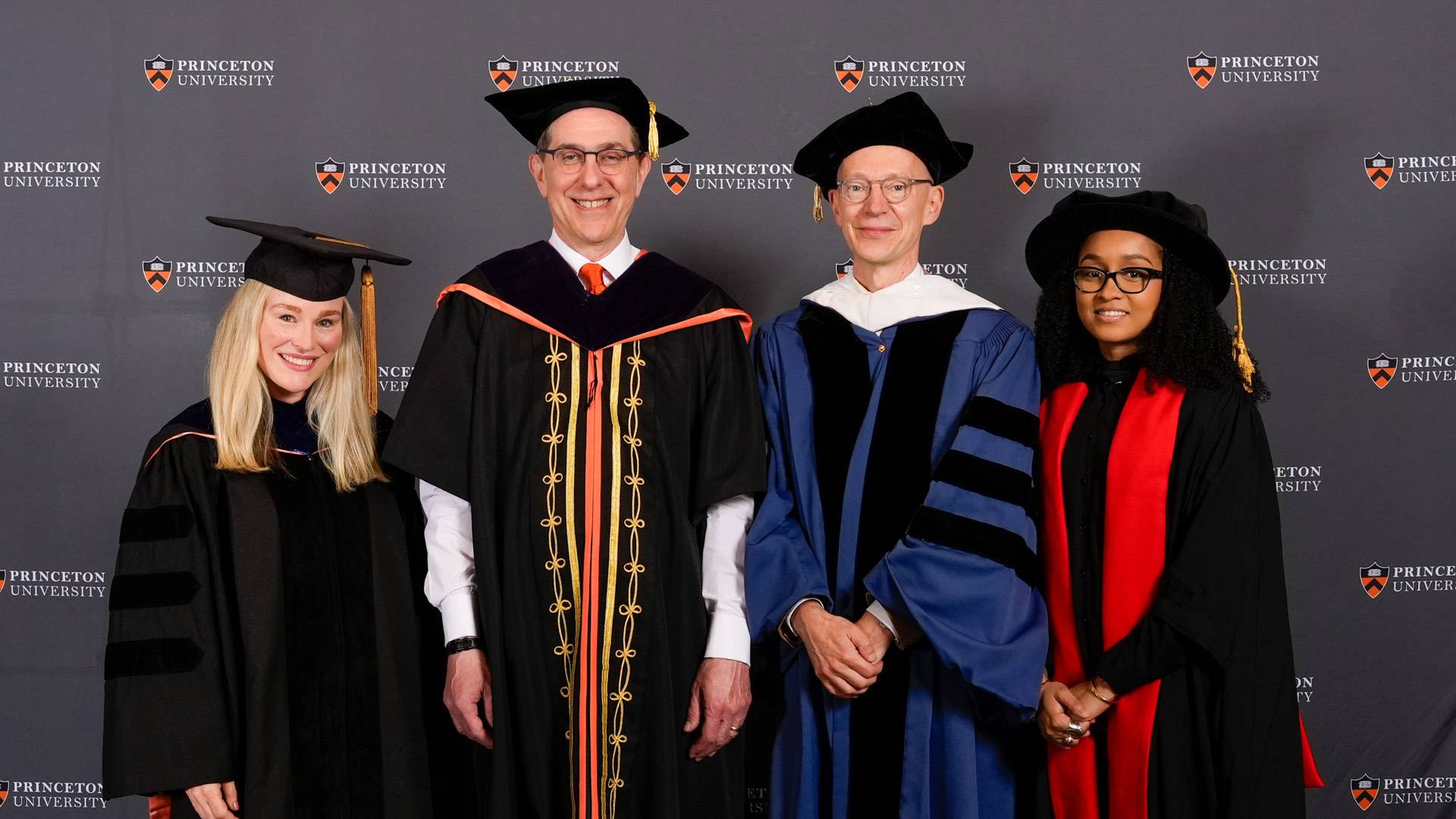
Shown from left with Princeton University President Christopher L. Eisgruber are Distinguished Teaching honorees Emma Ljung, Jeff Dolven and Jerelle Joseph. Not pictured: Amir Ali Ahmadi.
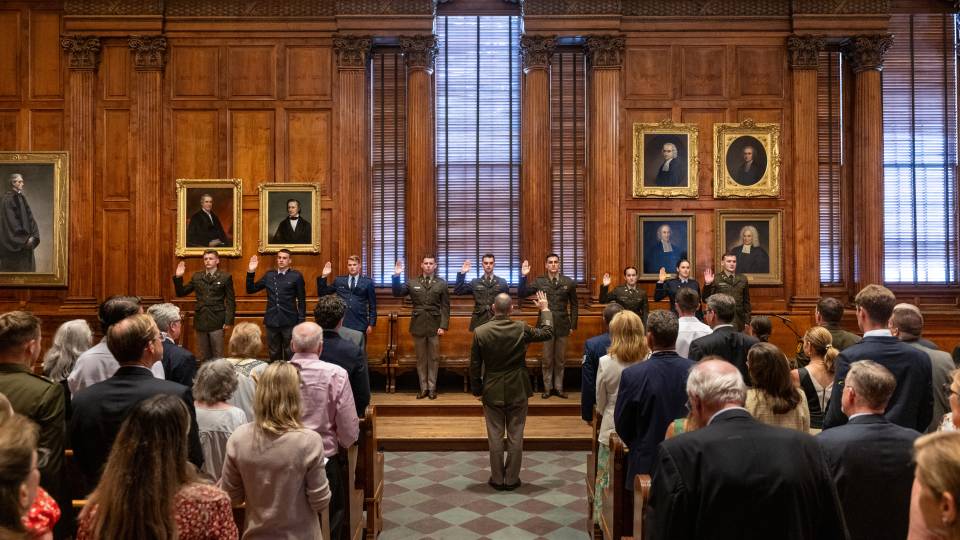
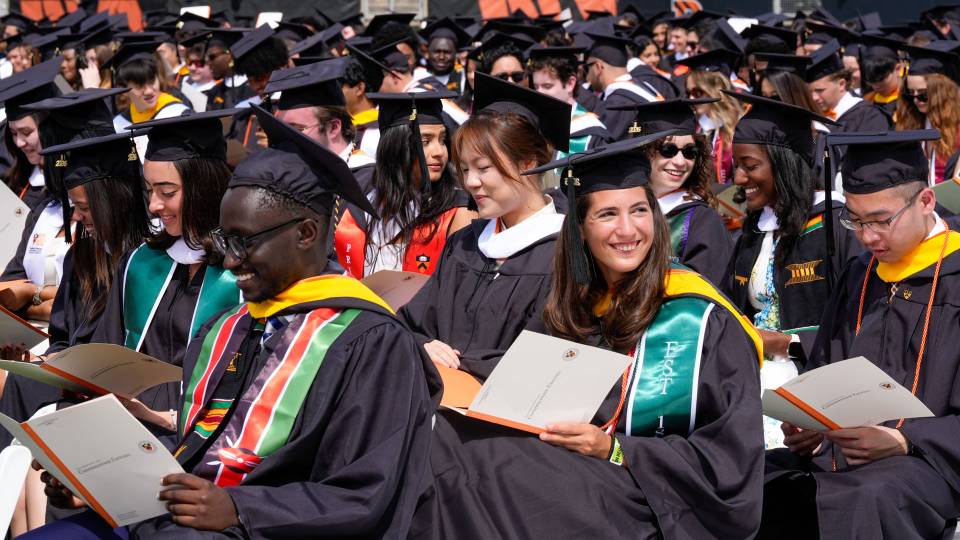
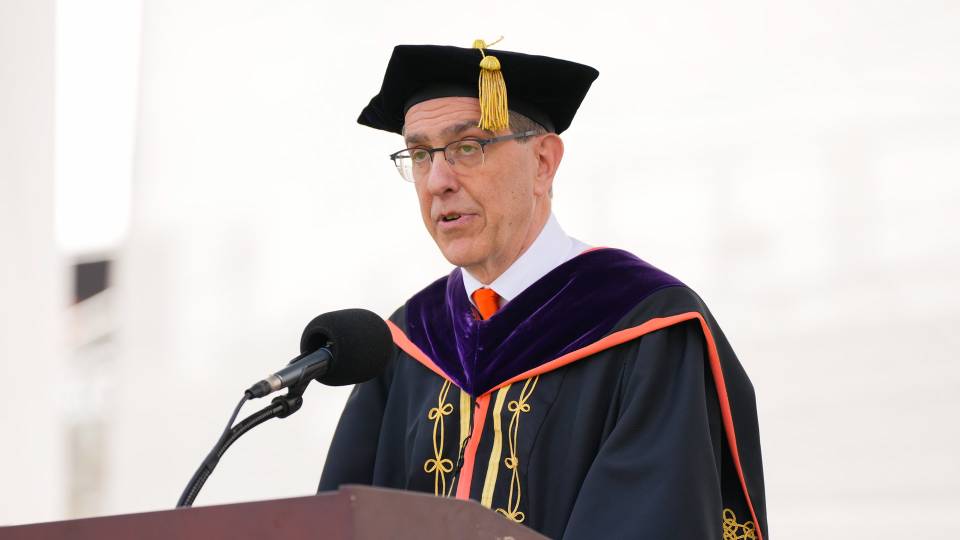
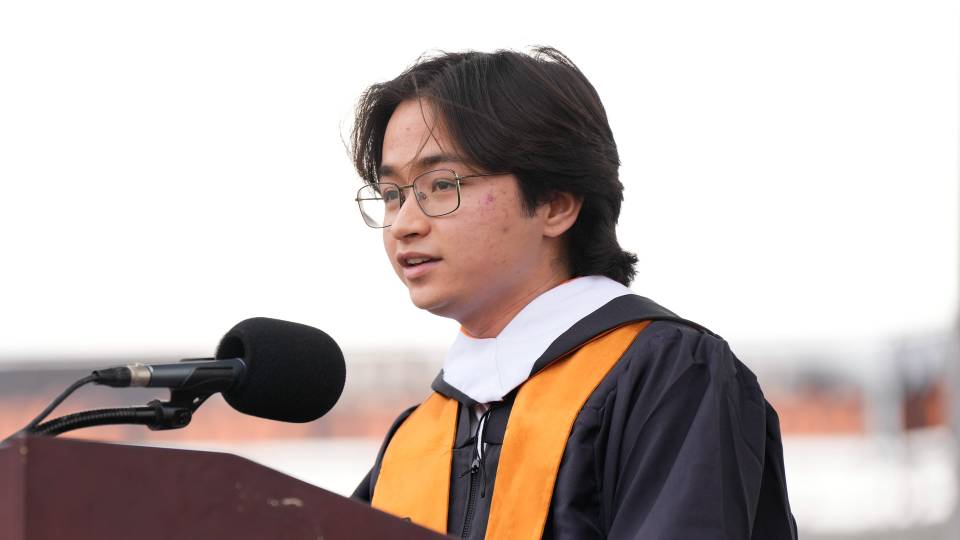
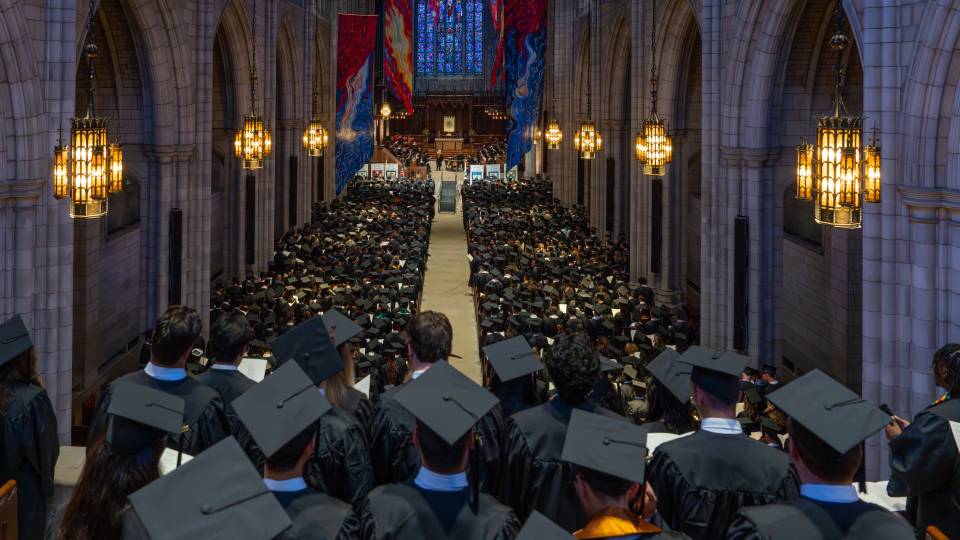
Four Princeton University faculty members received the President’s Award for Distinguished Teaching at Commencement ceremonies on Tuesday, May 26.
They are Amir Ali Ahmadi, professor in the Department of Operations Research and Financial Engineering; Jeff Dolven, professor of English; Jerelle Joseph, assistant professor of chemical and biological engineering (CBE) and bioengineering; and Emma Ljung, a senior lecturer in the Princeton Writing Program.
The awards were established in 1990 through a gift by Princeton alumni Lloyd Cotsen of the Class of 1950 and John Sherrerd of the Class of 1952 to recognize excellence in undergraduate and graduate teaching by Princeton faculty members.
A committee of administrators, faculty, undergraduates and graduate students selected the winners from nominations by students, faculty colleagues and alumni.
Amir Ali Ahmadi
Amir Ali Ahmadi is a professor in the Department of Operations Research and Financial Engineering who has been at Princeton since September 2014.
He is affectionately known as “Professor Triple A,” a reflection of both his initials and the “exceptionally high regard in which his teaching is held,” said a colleague.
“Having AAA as a professor was truly one of the greatest experiences of my Princeton career,” wrote a recent graduate. “After the first lecture, I knew that it would be an extraordinary academic experience. By the end of the semester, I was convinced that AAA is the greatest teacher I have ever had.”
His intent is to teach thinking, not just knowledge. “He made a point of motivating why each technique was natural — what you would try first, why that fails, and what insight leads you to the right approach — so that the proofs felt discoverable rather than mysterious,” said a recent student.
His core courses are “Computing and Optimization for the Physical and Social Sciences,” better known as ORF 363, and the graduate-level course “Convex and Conic Optimization.”
“Simply put, ORF 363 was one of those classes where it was a joy to be a student,” said a recent graduate. “Professor Ahmadi’s passion for teaching results in every student, too, feeling a passion for learning and optimization.”
A recent physics major said, “I certainly didn’t expect that a class colloquially called ‘Convex Optimization’ would be nearly as exciting as I found it to be, but when listening to him teach, you cannot help but share his joy for the subject.”
Jeff Dolven
Jeff Dolven is a professor of English and a founding co-director of the Interdisciplinary Doctoral Program in the Humanities. He has been at Princeton since 2001, and he teaches courses across the English curriculum and the two-semester Humanities Sequence, with a special focus on poetry.
After taking one of his courses, an engineering student said, “Professor Dolven’s class sparked a relationship to poetry that I will carry long past my graduate date.”
Many students and colleagues praise his experimental approach to teaching — how he both tests out new approaches and also encourages his students to innovate. “Jeff challenges students to experiment with language, sound and style in order to make discoveries that are fresh and exciting,” said a longtime colleague. “It’s no surprise that the students love the way he teaches — I do, too.”
Many colleagues and former-students-turned-English-professors admit that they have borrowed Dolven’s approaches and imitate his teaching style.
“Professor Dolven is one of the greatest teachers with whom I have worked, and his devotion to the craft is extraordinary,” said a colleague who launched his career by teaching the Humanities Sequence with Dolven. “I am not exaggerating when I say that I learned to teach — really, to ‘profess’ — by watching him every week.”
Dolven also teaches incarcerated students as part of Princeton’s Prison Teaching Initiative. “Alongside Jenny Greene, Jeff served as our program’s faculty champion,” a colleague said, helping to guide PTI as it evolved from a grassroots initiative among faculty and graduate students to a flagship University outreach education program.
Jerelle Joseph
Jerelle Joseph is an assistant professor in the Department of Chemical and Biological Engineering and the Omenn-Darling Bioengineering Institute. She has been at Princeton since January 2023.
“Although Jerelle has only been at Princeton University for three years, she has continued to demonstrate excellence in teaching from the outset, forging remarkable connections with students,” said a colleague.
Another colleague praised her “meteoric trajectory” as a teacher and researcher, and also highlighted the culture she is building with her research group. “Jerelle is exactly the kind of professor that makes Princeton so special,” he said. “Her students are not simply people she is supposed to teach, but rather beloved junior colleagues, brought together into a family of scholars, and personally shepherded into a deep appreciation of the life of the mind.”
A graduate student added, “A testament to her work as a mentor is the numerous manuscripts that the undergraduates are authors on — in some cases, first authors.” Yesterday, Joseph received a 2026 Graduate Mentoring Award.
Joseph has received departmental teaching awards each semester that she has taught her signature course, CBE 422, “Molecular Modeling Methods.” Students from outside the major praise how she made each concept accessible, and students with strong backgrounds admired the breadth of the course.
One undergraduate said, “Professor Joseph has that unique gift of being able to be kind and direct at once, always pushing to make you your best. I’m a better scientist, a better student and a better person for having worked with her.”
Emma Ljung
Emma Ljung, a senior lecturer in the Princeton Writing Program, has taught at Princeton since September 2013, shortly after she finished her Ph.D. in art and archaeology from Princeton. Ljung teaches writing to students at many levels — first-years, sophomores, transfer students, graduate students — in student-centered courses that one colleague described as “both clearly defined and wildly flexible.”
“Professor Ljung’s course has been nothing short of a godsend for many graduate students,” said a current Ph.D. candidate who took “Write to Publish,” a course Ljung created for students submitting papers to peer-reviewed journals. “To have a professor create a course aiming to demystify this process is priceless.”
“Emma Ljung is one of the most incredible mentors I have had,” said a current Princeton senior. “She puts an outrageous degree of thoughtfulness into planning her courses, never forgetting where her students might feel insecure or overwhelmed, and doing everything in her power to maximize their ability to thrive in an intense environment.”
Several of her past and current students spoke to the extraordinary community she creates in her classrooms, as well. Ljung created a writing seminar, “Discovering New Pasts,” for incoming transfer students. “Many of us arrived at Princeton feeling the weight of impostor syndrome,” said one new Princetonian, “but from the very beginning, Dr. Ljung created an environment of both intellectual rigor and wholehearted support. She made each of us feel seen, valued, and capable of success at Princeton.”
A colleague noted that “Dr. Ljung’s transfers adore her, because she persuades and cajoles, and inspires them to do very hard things they didn’t know they could do, and then she manages to push them a few steps more.”