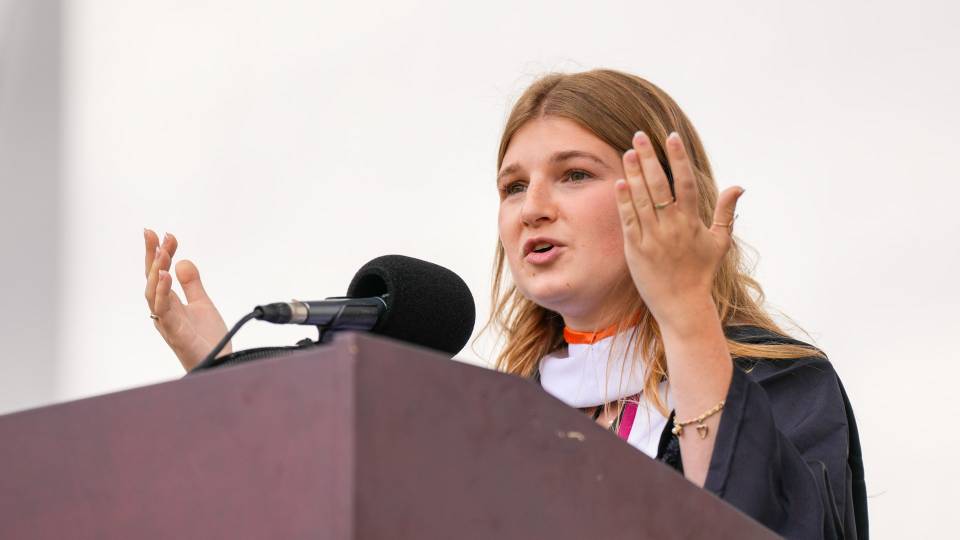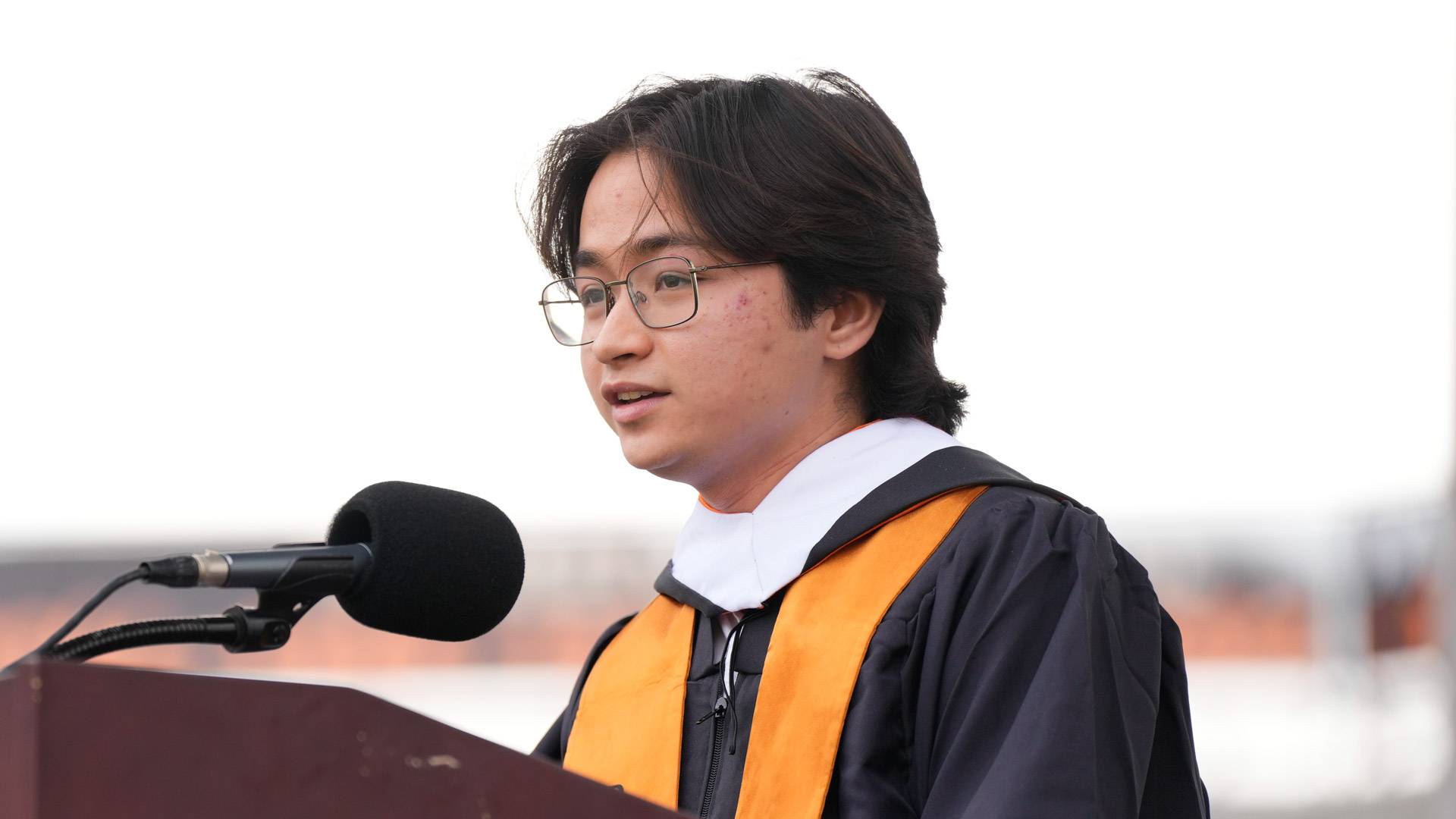
Commencement remarks from Valedictorian Daniel Yu
Valedictorian Daniel Yu
— Remarks as prepared —
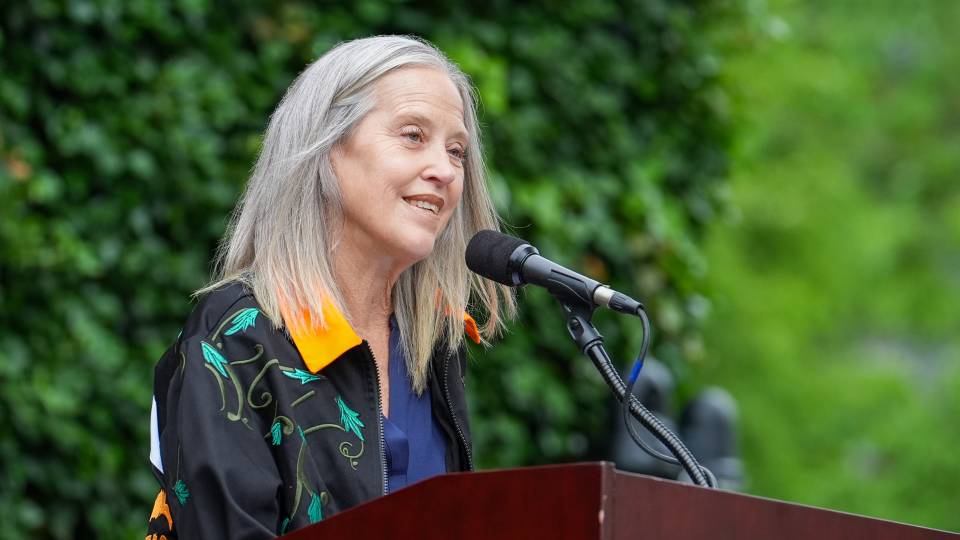
Good morning. To begin, I would like to share some thank yous.
First, to the faculty: Thank you for your generous, patient and compassionate mentorship. You have shaped each of us indelibly.
Secondly, to the staff: You have made Princeton home for us — for that, we can never thank you enough.
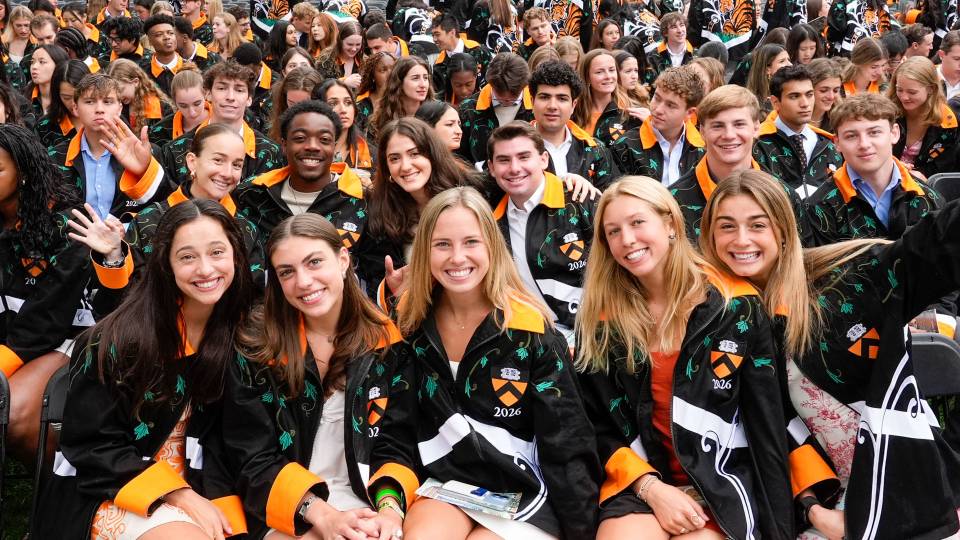
Finally, the relatives, friends and communities who helped us get to, and through, Princeton: We are enormously grateful and forever in your debt. This moment belongs to you, too.
Two years ago, I was sitting in a seminar in Morrison Hall, staring out the window. It was spring, and the campus moved in its familiar rhythms, rhythms I’m sure you all know: people playing frisbee on Cannon Green, the whiz of an e-bike careening towards Elm Drive. In true Princeton fashion, my mind wandered — to an upcoming dinner with a friend, a problem set due next week, my Writing Center appointment on the other side of campus. The discussion hummed along. Then our professor paused, looked out at us and asked: “So what? You’ve certainly all made interesting points, but I want you to consider: What are the real-life stakes of what we’re talking about? Why does any of this matter?”
The question caught me off guard. My classmates and I had spent the last 45 minutes doing what we did every week in seminar: listening to one another, adding thoughts of our own, while fully immersed in our lives on campus. The world beyond Nassau Street felt miles away. Yet suddenly, we were being asked to reconcile the two.
During our time here, almost all of us have had moments like this one. Collisions between the “Orange Bubble” and reality, where suddenly — perhaps where we least expected — we left the predictable rhythms of life at Princeton and came face to face with the real world. Maybe it was trying to explain some piece of Princeton jargon to a friend back home — RCA, COS or ORFE — and realizing that a term you had taken for granted was, in fact, unique to here. Maybe it was showing up to volunteer with Mutual Aid Princeton, or an impromptu conversation with a local while waiting in line at Small World. Or maybe it was watching as our professors revised and reoriented course policies each semester to adapt to the rapidly evolving capabilities of artificial intelligence.
This past year, as the attacks — on higher education, on civil liberties, on our lives and the lives of people we love — have intensified, these moments have become harder to ignore and to bear: uncertainty over one’s own or a loved one’s immigration status; cuts to funding for vital research, like climate science and ethnic studies; threats to free expression and student protest on campus.
Each of these instances forced us to confront the stakes of our choices on campus. To consider why we were here, and what we stood for. To question what it means to be “in the nation’s service and the service of humanity” — or even to ask ourselves: What ought we do if those imperatives conflict?
Together, we all — students, faculty, staff and alumni — have risen to meet this moment. Student leaders have found creative ways to hold community together. Scientists on campus have continued their critical work, despite the federal landscape shifting beneath them. Undergraduate organizers have demanded better of this institution — not out of betrayal, but out of belief, imagining the ways Princeton can live up to its highest ideals.
We have done this work while remaining generous with one another — intellectually, interpersonally and often without thanks. I have seen this during late hours at Firestone, watching a bleary-eyed student fighting sleep to help a friend work through a difficult practice problem. I have seen it in the wake of tragedy, including the loss of students who should be here with us today. And I have seen it in my own department of African American Studies — in peers who laugh freely, think deeply and refuse to do either halfway. Across the University, each of you has shown me what it means to be brilliant and kind — and that one does not cancel out the other.
In a moment defined by social, financial and political precarity, this is a most beautiful act of resistance: to refuse the pull of individualism. To turn toward one another, toward community, and practice generosity, even when it may seem unearned. This is what you, the Class of 2026, have taught me. That to live “in the service of humanity” is not an old, forgotten motto, and it is not something we save for our careers. It is something we have practiced here, together, every day.
When my professor asked us to consider the stakes on that warm Princeton afternoon, this is what he was asking us to do: to think beyond ourselves and consider what responsibilities we have to one another. As we go forward, we must hold fast to these responsibilities, every day asking ourselves: So what? What are the stakes of our actions, and our inactions?
These are the questions the humanities and social sciences raise — and they are the answers our world right now requires. Attacks on such disciplines reaffirm these fields’ very purpose: the power of ideas in unsettling the status quo. We must also discover new cures, find new solutions, invent technologies we can hardly yet dream of. But none of it matters without asking why, and for whom.
Indeed, while some might consider our graduation a transition from the security of Princeton to the unpredictability of real life, our time here has taught us that the Orange Bubble was never truly separate: not from the considerations of ethics and politics, not from the tumult and uncertainty of life outside these walls. The world acts on Princeton, and Princeton acts on the world.
We cannot opt out of that exchange. To withdraw or be silent is its own kind of choice. What we can do is choose — in our words, in our work, in the lives we build — to orient ourselves, deliberately and stubbornly, toward the world we want for our communities now and generations after. In boardrooms and classrooms and living rooms, we must, as Professor Ruha Benjamin once wrote, “imagine and craft the worlds [we] cannot live without, just as [we] dismantle the ones [we] cannot live within.”
I will end with this. There’s a poem I love, titled “Meditations in an Emergency,” by Cameron Awkward-Rich. The poem speaks to some of the contradictory feelings of this moment: joy at the communities we have built here and all we will go to build; and uncertainty and fear — at the future we approach, at all that cannot be known. It ends like this:
There’s a dream I have in which I love the world. I run from end to end like fingers through her hair. There are no borders, only wind. Like you, I was born. Like you, I was raised in the institution of dreaming. Hand on my heart. Hand on my stupid heart.
This, I believe: that as we remain fiercely compassionate and unceasingly generous, and attend to the stakes of our work, we will reshape this world and imagine new ones, oriented toward justice, peace and freedom. I am excited to see what you all dream up.